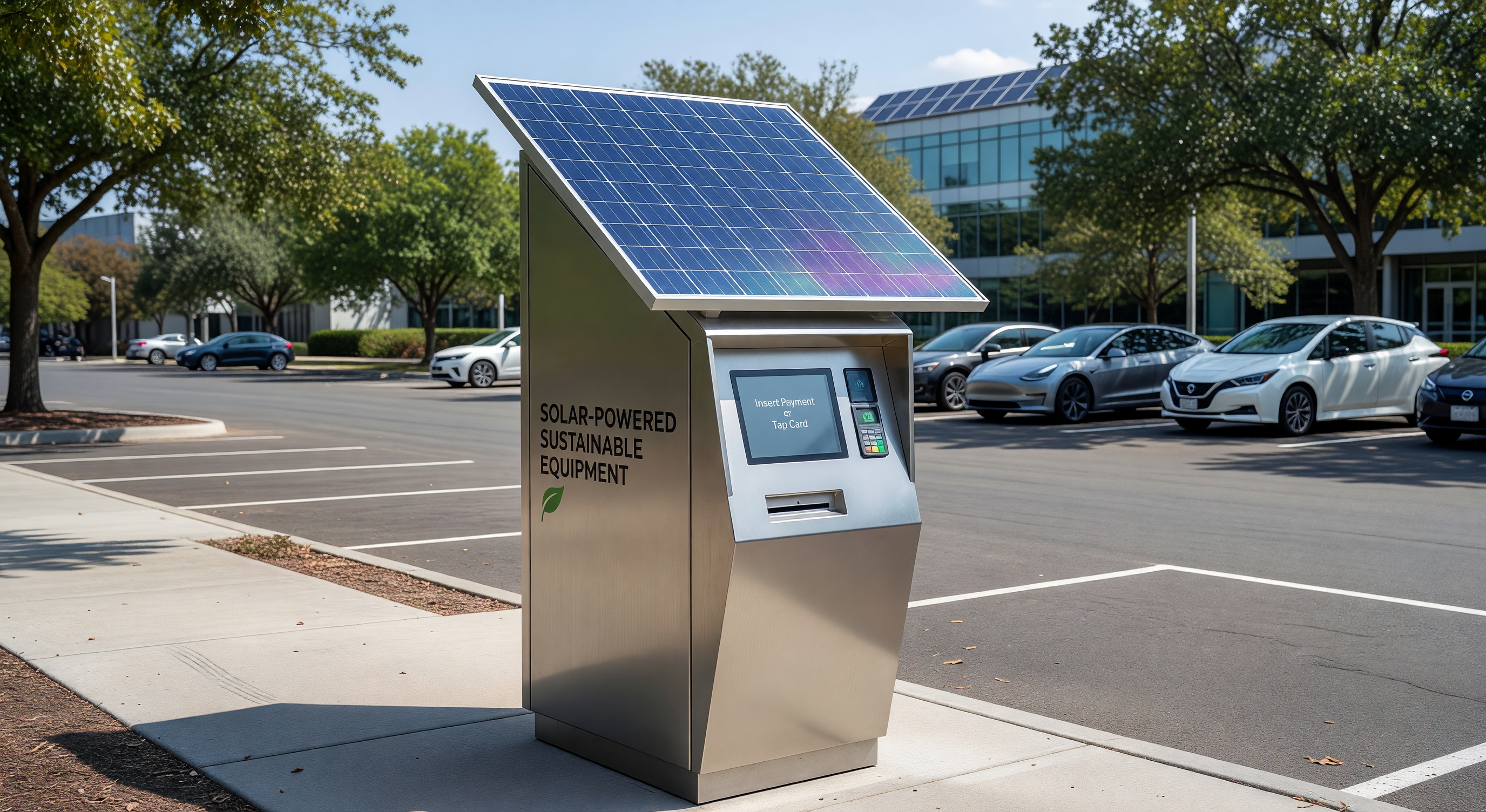
Solar-powered pay stations eliminate the primary infrastructure barrier for deploying payment equipment in remote or temporary parking locations: the electrical service connection. Without the need for trenching, conduit, and grid connection, solar-powered units can be deployed in days rather than weeks.
But solar power for parking pay stations involves real trade-offs — in power reliability, cold-weather performance, feature limitations, and total cost of ownership — that aren’t always clearly communicated by vendors. This guide provides an honest assessment of where solar-powered pay stations work well, where they struggle, and what to evaluate before purchasing.
Why Solar Power for Pay Stations?
The Infrastructure Cost Problem
Running electrical service to a pay station in an existing surface lot typically costs $2,000–$8,000 per unit depending on the distance from the nearest power source, pavement conditions, and permit requirements. In lots where the electrical panel is at the building perimeter and pay stations must be deployed throughout the interior, individual trenched service runs for each unit become prohibitively expensive.
Solar eliminates this cost entirely — a solar-powered pay station is self-contained. The tradeoff is the additional cost of solar hardware (panel, charge controller, battery bank) and the operational constraints that solar power imposes.
Temporary and Event Parking
Solar-powered pay stations are well-suited for temporary parking installations — event parking, construction zone parking, temporary overflow lots — where running permanent electrical service would be impractical and the deployment duration doesn’t justify the infrastructure investment.
Environmental Positioning
Some municipalities and campus parking operations choose solar to align with sustainability commitments. The environmental benefit of a solar-powered pay station is real but modest compared to the indirect environmental factors of parking operations themselves.
True Off-Grid vs. Solar-Assisted Systems
True Off-Grid Systems
True off-grid pay stations run entirely from solar panels and batteries with no grid connection. Every watt of power used by the unit must be generated by the solar panels and stored in the battery bank.
Power budget considerations for a typical pay station:
- Touchscreen display: 15–30W
- Bill acceptor motor: 20–40W during acceptance (intermittent)
- Receipt printer: 15–25W during printing (intermittent)
- Main processor and network modem: 5–15W (continuous)
- Cabinet heater: 50–150W (intermittent in cold climates)
- Coin mechanism: 10–30W during dispensing (intermittent)
Average continuous consumption: 20–40W for a cashless or cash-lite unit; 40–80W for a full cash-accepting unit with heater in cold climates.
A true off-grid system must generate and store enough power to cover the worst-case winter period (shortest days, coldest temperatures, lowest solar insolation) with adequate reserve for several consecutive cloudy days.
Battery sizing: A system that must cover 72 hours without solar input at 40W average consumption requires 120Wh minimum, with 2–3x safety factor → 250–400Wh battery capacity. Lithium iron phosphate (LiFePO4) batteries are the preferred chemistry for parking equipment: they handle temperature cycling better than standard lithium-ion, have longer cycle life, and don’t have the thermal runaway risk of some lithium chemistries.
Solar panel sizing: For a 40W average load in a geographic location with 4 peak sun hours per day (typical mid-latitude), the minimum solar panel capacity is: 40W / 4 hours × 1.5 safety factor = 15W minimum. Practical systems for full-featured pay stations use 60–120W panels.
Solar-Assisted (Hybrid) Systems
Solar-assisted systems use solar panels and batteries to supplement grid power — typically to reduce demand charges, provide backup power during outages, or qualify for sustainability programs — while the primary power connection remains to the grid.
These systems have simpler power design requirements (the grid provides backup) and can run full-featured pay stations with heaters, large displays, and full cash acceptance without solar sizing constraints.
Solar-assisted systems aren’t truly off-grid but offer some of the flexibility benefits (reduced electrical demand charges, backup power resilience) without the compromises of fully off-grid operation.
Geographic Suitability
Solar-powered pay stations are not equally suitable everywhere. Geographic factors that determine viability:
Solar Resource (Insolation)
Solar insolation is measured in peak sun hours per day — the equivalent number of hours of full-intensity sunlight. Higher is better for solar system performance.
- Southwest US (Phoenix, Las Vegas, Los Angeles): 5–7 peak sun hours per day — excellent solar resource
- Southeast US (Florida, Georgia): 4.5–6 peak sun hours — good solar resource
- Northeast US (New York, Boston): 3–4 peak sun hours per day — marginal for full-featured pay stations in winter
- Pacific Northwest (Seattle, Portland): 2.5–3.5 peak sun hours — challenging for solar-only off-grid operation
- Canada (Toronto, Vancouver): 2.5–4 peak sun hours depending on location and season
For locations with 3 or fewer winter peak sun hours, solar-only off-grid operation of a full-featured pay station requires very large battery banks (expensive) or feature limitations (reduced display brightness, cashless operation, no receipt printing).
Cold Weather
Both solar performance and battery performance decrease in cold weather:
- Solar panel efficiency decreases slightly at very high temperatures but increases at cold temperatures — cold climates can be good for solar panel output
- Battery capacity decreases significantly at cold temperatures — a battery bank that delivers full capacity at 70°F may deliver only 70–80% capacity at 30°F and 50–60% at 0°F
- Cabinet heaters in cold climates consume significant power — the heater requirement may be the biggest power burden in a northern off-grid system
Feature Trade-offs in Solar-Powered Units
Full-featured pay stations in an off-grid solar configuration typically require compromises:
Cash acceptance is a major power consumer — bill acceptors and coin mechanisms are the highest single-event power consumers in a pay station. Some operators configure solar pay stations as cashless (card and app only) to significantly reduce power requirements.
Heating in cold climates is the other major consumer. Some operators reduce heater duty cycle in very cold conditions, accepting slightly degraded component performance to preserve battery reserve.
Display brightness can be reduced in bright daylight without affecting readability, reducing display power consumption by 30–50%.
Transaction processing speed is typically not affected by solar power — the processor and modem consume relatively little power continuously.
Total Cost Comparison
For a single pay station in a surface lot where trenching is required:
Grid-powered option:
- Pay station hardware: $9,000
- Trenching and electrical connection: $5,000
- Total: $14,000
Solar-powered option:
- Solar-equipped pay station hardware: $12,000–$16,000
- Installation (no trenching required): $500–$1,000
- Total: $12,500–$17,000
- Battery replacement (every 5–7 years): $500–$1,500
For a single unit, the economics are comparable. For a large lot where multiple units require trenching, the solar option often provides better economics — the trenching savings compound per unit while the solar premium is relatively fixed per unit.
Frequently Asked Questions
Can solar pay stations operate normally during a cloudy week in winter? Systems with properly sized battery banks (7+ days of storage at average consumption) can operate through typical winter cloudy periods. Extreme cases (extended low-light periods in high-latitude or low-resource locations) may trigger power management modes that reduce some functions.
Do solar pay stations require special maintenance? Solar panels require occasional cleaning (dust and debris reduce panel output). Battery health monitoring is important — lithium batteries degrade over cycles and years; replacement every 5–7 years is typical. The rest of the pay station maintenance is identical to grid-powered units.
Can we add solar power to an existing grid-connected pay station? Some manufacturers offer solar-assist retrofits for existing units. The retrofit adds solar panels and a charge controller that reduces grid demand and provides battery backup. True off-grid conversion of a grid-dependent unit is more complex and may not be cost-effective.
What happens during an extended outage of the solar system? True off-grid units go offline when battery reserves are depleted. Configure the system to alert the management platform when battery state drops below a threshold, allowing proactive service dispatch before the unit goes offline.
Key Takeaway
Solar-powered pay stations solve a real infrastructure problem in surface lot deployments, but their suitability depends heavily on geographic location, feature requirements, and climate. In high-insolation climates with mild winters, solar off-grid operation is mature and practical. In northern climates with limited winter sunlight and heating requirements, solar-assisted (grid-hybrid) configurations provide better reliability than fully off-grid systems.