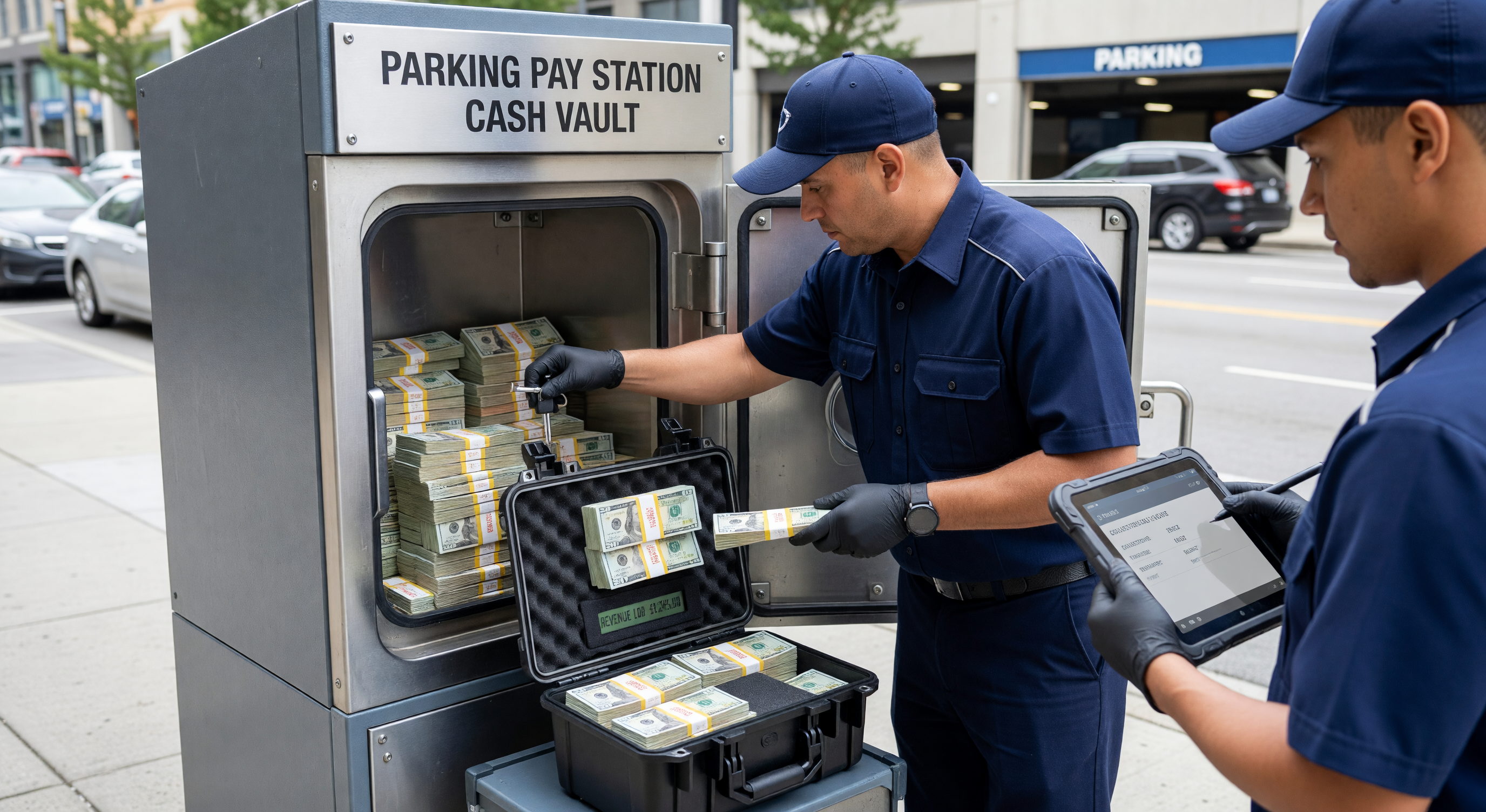
Cash management in parking operations is unglamorous work that has significant financial and legal consequences when done poorly. Overfull vaults cause pay station jams; infrequent collection increases theft exposure; poor reconciliation allows shrinkage to go undetected. A structured cash management program — vault capacity planning, collection schedules, reconciliation procedures, and security protocols — converts an operational risk into a routine process.
This guide covers the complete cash management workflow for multi-space pay stations and kiosks, from vault capacity planning through final reconciliation.
Vault Capacity Planning
Understanding Your Vault Configuration
Commercial parking pay stations include one or more secure vaults for currency storage. Common configurations:
- Single bill vault: A single stacker that holds all denominations. Capacity ranges from 400 to 2,000 notes depending on the unit.
- Multi-denomination vaults: Separate stacking compartments for different bill denominations, allowing more targeted collection.
- Coin hoppers and coin vaults: Some pay stations include coin dispensing (for change) and coin collection vaults. Coin management adds significant collection complexity.
- Coin-free configurations: Pay stations configured as bill-and-card-only have simpler vault management. Increasingly common as coins become a smaller share of parking payments.
Capacity vs. Transaction Mix
Vault capacity in “notes” assumes each note occupies one slot. In practice, heavily worn or folded notes take more space; crisp new notes take less. Use 85–90% of rated capacity as the effective maximum for collection scheduling — a vault showing 90% full may not accept additional notes reliably.
Your transaction mix affects how quickly the vault fills:
- Facilities with predominantly $10 and $20 transactions fill vaults faster than facilities with $1–$5 transactions
- High-transaction-volume periods (events, peak commuter times) consume vault capacity faster than normal operations
Setting Collection Frequency
Determine collection frequency based on transaction volume and vault capacity:
- Measure or estimate average notes per day (historical data from your PARCS transaction log)
- Divide vault capacity (at 85%) by notes per day = maximum days between collections
- Schedule collection to occur before the vault reaches maximum capacity
Example:
- Vault capacity: 800 notes
- 85% effective maximum: 680 notes
- Average daily notes: 200
- Maximum collection interval: 680 / 200 = 3.4 days → schedule collection every 3 days
For high-volume facilities or those with smaller vaults, daily collection is appropriate. Never allow a vault to reach capacity — an overfull vault jams the bill acceptor and may damage currency.
Collection Procedures
Personnel Requirements
Cash collection from parking pay stations requires:
- Two people at minimum (one collects, one documents) — this is both a security best practice and a fraud prevention measure
- Clear chain of custody at every transfer point
- Consistent procedure followed every collection without shortcuts
The Collection Workflow
Before collection:
- Access the management software to retrieve the expected count for the station before physically accessing the vault
- Document the transaction total from the software log for this station through this collection period
- Record any anomalies noted during the last PM visit (known bill jams, vault issues)
During collection:
- Open the payment station with the appropriate key (different from the vault key in properly configured two-key systems)
- Access the vault with the vault key — note that two-key access (cabinet and vault require separate keys) provides better security
- Remove the bill cassette or stacking module — do not count cash at the machine; bring the entire cassette to the counting room
- Install a replacement cassette (if your operation uses exchange cassettes for faster collection)
- Document the cassette removal: time, technician name, meter ID, cassette serial number (if applicable)
- Close and secure both the vault and cabinet doors — verify both locks are engaged before leaving
Coin collection (if applicable):
- Remove coin container and replace with empty container
- Document the same information as bill collection
Secure Transport
Cash collected from pay stations must be transported in a locked bag or container to the counting area. Never leave collected cash unattended in an unlocked vehicle. For facilities with significant cash volumes, armored courier service provides secure transport and reduces internal theft exposure.
Reconciliation Procedures
Counting Procedures
Count cash in a controlled environment with:
- A second person present throughout the count
- Surveillance camera coverage of the counting area
- Counterfeit detection capability (UV lamp or counterfeit detector pen)
- A currency counter for large volumes
Count the cash and record:
- Total bill count by denomination
- Total coin count (if applicable)
- Total cash value
- Any counterfeit notes identified (separate and document)
Reconciliation Against the Software Log
Compare the counted cash total against the expected amount from the PARCS transaction log:
- Software total: Sum of all cash transactions since the last collection
- Physical count: Actual cash collected
- Variance: Difference between the two
A variance of zero or within $2–$5 (accounting for mechanical bill rejections that weren’t processed) is normal. Variances over $10–$20 warrant investigation.
Common sources of legitimate variance:
- Bills rejected by the acceptor but credited in the transaction log before rejection (system counts the insertion attempt before the authentication rejection)
- Bills jammed during transport that the system recorded as accepted
- Physical counting errors
Sources of concerning variance:
- Consistent pattern of shortfall across the same station
- Variance correlated with specific collection personnel
- Irregular patterns that don’t match transaction volume patterns
Document all variances and investigate persistent variances systematically.
Reporting and Deposits
Prepare a collection report for each pay station collection including: station ID, collection date/time, collector names, expected amount, actual count, variance, and any notes. Submit collection reports with the currency deposit.
Make bank deposits promptly — most operations policies require deposit within 24 hours of collection. Undeposited cash in a facility creates theft exposure.
Security Protocols
Key Management
Pay station security is only as strong as key management discipline.
- Maintain a key log: who holds which keys
- Keys must be returned to the key management system at the end of each shift
- Lost or unaccounted keys require immediate lock cylinder replacement — not just notification
- Cabinet keys and vault keys should be on different key blanks so they can be managed independently
Two-Person Rule
No single employee should perform the complete collection workflow alone — from accessing the cabinet to completing the reconciliation. The two-person rule for cash collection is the primary fraud prevention control. Document that two people were present at every collection.
Collection Timing Randomization
Predictable collection schedules create theft exposure — both from internal actors who know when cash is most concentrated and from external actors who observe patterns. Vary collection times within the required frequency window. If collections are needed every 3 days, vary the time of day and exact day within the constraint.
Transitioning Away from Cash
Many parking operators are evaluating whether to eliminate cash acceptance from some or all pay stations. The financial analysis typically includes:
Cash handling costs: Labor for collection, counting, and reconciliation; bank fees; cash transport; PCI compliance scope for cash-adjacent systems; coin management infrastructure.
Revenue impact: Percentage of transactions currently in cash, and the risk that cash-paying customers will use an alternate facility or not park.
Regulatory considerations: Some jurisdictions have enacted cash acceptance mandates for public-facing payment systems. Review local regulations before eliminating cash acceptance.
For facilities where cash represents under 10% of transactions and regulatory requirements don’t mandate cash acceptance, the case for cashless operation is often strong. For facilities serving demographics with higher cash usage, the revenue risk is more significant.
Frequently Asked Questions
How should we handle counterfeit notes found during counting? Counterfeit notes found during counting should be: separated from the legitimate currency, not returned to circulation, and reported to the US Secret Service (for US currency) or appropriate authority. Your bank will also want notification when depositing the legitimate currency from the same collection. Document the counterfeit note (denomination, approximate bill serial number) and the collection it was found in.
What is the appropriate separation of duties for cash management? Ideal separation: one person accesses and collects, a different person reconciles, and a third person reviews reconciliation reports. In smaller facilities where this level of separation isn’t staffing-feasible, at minimum ensure that the collector doesn’t perform their own reconciliation unsupervised.
How do we handle a pay station that’s reporting significantly less cash than the transaction log shows? This is a red flag requiring immediate investigation. Steps: verify the software log for the station is accurate; check for system errors that may have affected the count; review camera footage from the station for the collection period; if internal theft is suspected, involve management and follow your organization’s incident response procedures before confronting any individual.
How often should vault lock cylinders be replaced? Lock cylinders should be replaced when keys are lost or unaccounted for, when personnel with key access depart the organization, and proactively every 3–5 years depending on usage. High-traffic key cylinders show wear that makes picking easier over time.
Key Takeaway
Cash management quality is determined by procedure consistency, not by policy documents. The collection and reconciliation procedures must be followed the same way every time, by every collector. Variances from procedure — even minor ones — create the conditions for theft and reconciliation failures. Build cash management into your operational culture as a non-negotiable discipline.