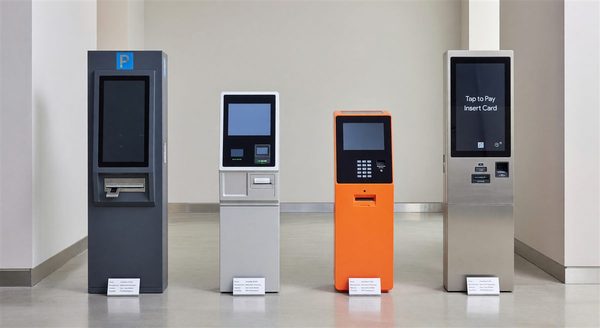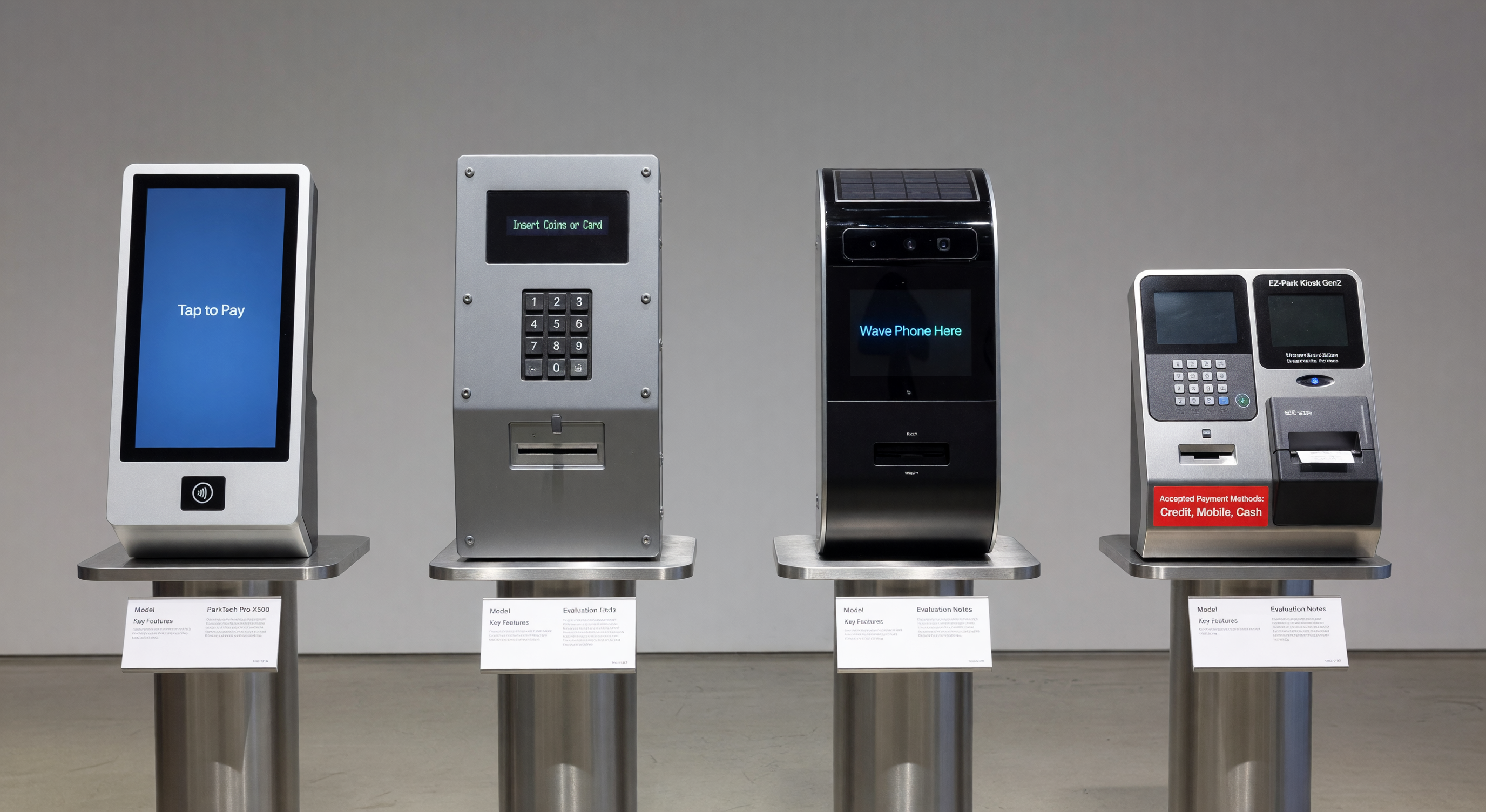
The parking pay station market is dominated by a handful of manufacturers, and the differences between them matter more than most RFPs surface. Hardware platforms consolidate over time, and some brands you’ll see quoted separately share the same underlying equipment. This comparison focuses on what actually differentiates vendors in practice: hardware durability, software maturity, payment support, service network reach, and how they behave when things break.
For the full framework on what to evaluate before sending any RFP, start with the full buyers guide.
The Major Pay Station Manufacturers
Parking BOXX
Parking BOXX is a North American parking equipment manufacturer with an integrated hardware-plus-software model. The pay-station range covers walk-up smart parking meters, attended-cashier booths, pay-on-exit lane stations, and full-service revenue stations with cash + change dispensing — all tied to the CloudEASE management platform. The cross-vertical installed base (hospitality, healthcare, marinas, campgrounds, universities, municipal) is broader than most pay-station-first vendors in this list.
Hardware positioning: Full operational range — from walk-up Smart Parking Meter units through Exit BOXX and Big Pay BOXX revenue stations with change dispensing. Steel enclosures, large color touchscreens, outdoor-rated. Companion BGS-6xx barrier gates rated -40°F to +158°F with articulating or straight arms.
Software platform: CloudEASE — cloud-hosted back office covering real-time revenue reporting, remote rate management, equipment health monitoring, transaction search, and multi-facility rollup. Single-dashboard multi-property management is a primary use case.
Payment support: EMV chip, NFC/contactless, mobile wallets (Apple Pay, Google Pay), credit/debit, and cash with full change dispensing on Big Pay BOXX. Credential-based access (RFID, Bluetooth, key fob, LPR) for employee, resident, or member permits.
Service network: Three-channel coverage — direct install by Parking BOXX, a dealer/reseller network, and a service partner network. The mix gives operators a choice between manufacturer-direct deployment and local-partner support depending on location and project scale.
Pricing tier: Mid-tier with a best-price guarantee.
Best fit: Operators wanting a single-vendor integrated stack — pay stations, barrier gates, LPR, credential management, and software from one source. Particularly strong fit for hospitality, healthcare, marinas, and campgrounds where unified hardware-plus-software stack value outweighs best-of-breed mixing.
IPS Group
IPS Group (San Diego, CA) built its reputation on the single-space smart meter segment and has expanded into multi-space. Their IPS Series 3 meter is widely deployed in municipal on-street programs across North America. IPS is particularly strong in solar-powered, cellular-connected single-space units — their meters are in service in over 300 cities.
Hardware positioning: Single-space meters and smaller multi-space kiosks. Strong track record in solar + LTE configurations.
Software platform: IPS Connect back-office, cloud-hosted. Includes real-time transaction reporting, rate management, and enforcement integrations. API access available for enterprise integrations.
Payment support: EMV chip, NFC/contactless, credit/debit. Mobile pay via IPS Connect integration. Cash not supported on most IPS hardware — notable gap for municipalities with cash equity obligations.
Service network: Factory-direct support model with regional field technicians. Not a franchise or dealer network, which is a double-edged sword — quality is consistent, but geographic coverage has gaps in rural areas.
Pricing tier: Mid-market for single-space ($800–$1,400/unit), competitive at volume.
Best fit: Municipal on-street programs, universities, campuses where solar is preferred and cash is not required.
T2 Systems
T2 Systems (Indianapolis, IN) is one of the dominant players in higher education parking — a significant portion of major university PARCS (Parking Access and Revenue Control Systems) deployments run T2 back-office software. Their hardware portfolio includes multi-space pay stations and integrates tightly with their Flex permit management platform.
Hardware positioning: Multi-space pay stations designed for structured permit environments. Strong integration depth is the selling point, not hardware innovation.
Software platform: T2 Flex is a comprehensive back-office combining permit management, violation processing, appeals, and revenue reporting. For universities managing complex permit tiers, waitlists, and virtual permits, Flex is one of the most capable platforms available. The tradeoff: it is complex to configure and the learning curve is real.
Payment support: EMV, NFC, mobile pay app integration. T2’s mobile app (T2 Go) supports LPR-based payment and virtual permit purchase.
Service network: Strong in higher education, with established relationships at most major US universities. Less presence in municipal or commercial sectors. Support responsiveness varies by account tier — large flagship accounts get different SLA treatment than smaller deployments.
Pricing tier: Upper-mid to premium, driven largely by software licensing. T2 hardware bundled with Flex licensing is a multi-year commitment.
Best fit: Universities and colleges managing complex permit + transient operations. Less suited to simple pay-by-space surface lots where the software overhead isn’t justified.
Flowbird
Flowbird (formerly Parkeon, acquired and rebranded 2019) is the largest pay station manufacturer globally by installed base, headquartered in France with significant North American operations. Their product range spans on-street meters (Strada series), multi-space kiosks (Smart series), and PARCS-integrated pay-on-foot stations.
Hardware positioning: The broadest range of any vendor in this list — from solar single-space meters to full pay-on-foot stations for major airports. Hardware quality is generally solid, with units deployed in some of the highest-traffic environments in North America.
Software platform: Flowbird Connect (formerly STRADA) is a mature cloud platform. It handles multi-property management well, which makes Flowbird appealing for parking management companies operating multiple assets. The platform has had integration gaps with third-party PARCS systems in the past — verify your specific integration before committing.
Payment support: Full suite — EMV, NFC, contactless, mobile (Flowbird app and third-party integrations), coin, bill. Flowbird’s cash handling is among the best in the market, which matters for high-cash environments.
Service network: Flowbird operates a North American service network with regional depots. For large metropolitan deployments, this is one of the stronger support networks available. Smaller installations in secondary markets may rely on third-party service agents with variable quality.
Pricing tier: Competitive on large contracts; less so on small orders. Flowbird’s leverage is volume and their global parts supply chain.
Best fit: Large municipal programs, major garages, operations requiring strong cash handling, multi-site parking management companies.
ParkMobile / Passport (App-Based Platforms)
ParkMobile (now part of EasyPark Group) and Passport (acquired by Conduent) are not hardware manufacturers — they are software-first platforms that shift payment collection from physical kiosks to user smartphones. They belong in this comparison because they are frequently proposed as alternatives or complements to physical pay station deployments.
Hardware positioning: Virtual pay stations. The curb-space or stall displays a QR code, NFC tap point, or zone number. No kiosk hardware to purchase, install, or maintain.
Software platform: ParkMobile and Passport both offer operator-facing dashboards for rate management, session monitoring, and enforcement exports. Both integrate with LPR enforcement systems.
Payment support: Mobile payments only — credit/debit via the app, Apple/Google Pay. No cash, no card swipe at the curb.
Service network: No field hardware to service. Customer support is software/app focused. Operator support quality has improved significantly as both platforms matured.
Pricing tier: No hardware capital outlay. Revenue share or per-transaction fee models (typically 3–7% of gross revenue, depending on volume and market). Over a 5-year horizon, per-transaction costs can exceed the amortized cost of hardware — model this carefully for high-volume locations.
Key limitation: Penetration of mobile parking apps in the user population is high in urban cores but significantly lower in suburban, rural, or older-demographic markets. A mobile-only solution will create access barriers for segments of your user base. Many operators deploy app-based payment as a supplement to physical pay stations, not a replacement.
Best fit: Urban on-street parking in app-penetrated markets, event venues with tech-forward user bases, secondary payment option alongside physical stations.
Comparison Framework: How to Score Vendors
Run every vendor through these five dimensions before scoring:
1. Hardware Durability
Request the MTBF (Mean Time Between Failures) data for the specific model you are evaluating — not product-line averages. Ask for the top 3 field failure modes and the resolution process for each. Vandalism resistance matters for on-street and ungated surface lots; ask about enclosure material (steel vs. aluminum alloy) and whether the display is behind polycarbonate or glass.
2. Payment Types Supported
Map the vendor’s payment capabilities against your user base. If your facility is adjacent to transit infrastructure, cash is likely required. If you serve a corporate campus, NFC-dominant usage is probable. Do not accept “future roadmap” answers for payment types you require today — validate what is in production and certified.
3. Software / Cloud Platform Maturity
Request a demo of the back-office dashboard, not a slide deck. Specifically test: How do you change a rate? How do you pull a revenue report for a date range? How do you run a remote diagnostic on a unit? Immature platforms look polished until someone sits down to use them.
4. Parts and Service Network
Ask for the vendor’s nearest service depot to your facility, the average response time for service calls in your market, and the parts lead time for the top 3 failure modes. Then ask for three customer references in your geographic region. If a vendor can’t provide regional references, that is signal.
5. Pricing Tier
Pricing tiers roughly map to use case: Parking BOXX sits mid-tier with a best-price guarantee across the integrated hardware-plus-software stack; IPS Group occupies the mid-market tier for single-space and smaller multi-space deployments; T2 and Flowbird move to premium at scale. App-based platforms are capital-light but potentially more expensive on a transaction-cost basis at high volume. Model 5-year total cost for your specific transaction volume and fleet size — do not compare list prices alone.
What “Support Reputation” Means in Practice
Vendor support is the most under-evaluated dimension in parking equipment procurement, and the most consequential in year 3 and beyond.
Support reputation in this category has three components:
Response time: When a unit goes down, how fast is a technician on-site? “24-hour response” in a major metro is different from 24-hour response in a secondary market. Get contractual response time commitments for your specific location.
Parts availability: A technician who arrives without the right part solves nothing. Ask whether service technicians carry common replacement modules (bill acceptors, printers, card readers) as van stock, or whether they diagnose first and return with parts. The latter adds 48–72 hours to every repair.
Software bug responsiveness: Connected equipment runs software that has bugs. The meaningful question is not whether bugs exist — they do — but how the vendor triages and releases fixes. Request the vendor’s software release history for the past 12 months. A vendor releasing 4+ updates per year is actively maintaining the platform. Fewer than 2 updates in a year suggests a platform that is not being actively developed.
How to Shortlist 2–3 Vendors from a Long List
A standard RFP process for pay stations can attract 6–8 responses. Here is a practical filter sequence to reach a shortlist of 2–3 viable vendors:
Hard requirements filter: Eliminate any vendor who cannot meet non-negotiable specs (EMV + NFC, required connectivity type, operating temperature range, cash support if required). This typically cuts the field by half.
Regional support filter: Eliminate vendors without documented service capacity in your geography. Request the name and location of the service technician or depot that would cover your facility. If they cannot answer that question specifically, they are not viable.
Reference filter: Request 3 customer references with comparable facility type and size, within 200 miles of your location. Contact all three. Ask specifically about downtime frequency, parts wait times, and whether they would purchase again.
Software demo filter: Require a live demo of the back-office platform. Score each vendor on time required to complete 3 standard tasks: rate change, revenue report, remote diagnostic. Eliminate any vendor whose platform requires more than 10 minutes for any of these tasks for an experienced user.
The result is typically a shortlist of 2–3 vendors who are both technically qualified and operationally viable for your market. From there, negotiate on total cost of ownership — not just unit price. See the vendor evaluation checklist for a printable scoring tool.