ADA compliance for parking pay stations is not optional or aspirational — it’s a legal requirement for facilities subject to the Americans with Disabilities Act, which includes virtually all publicly accessible parking operations. Noncompliant pay stations create legal liability exposure and, more importantly, exclude individuals with disabilities from equal access to parking services.
The complexity is that ADA requirements for pay stations are specific, frequently misunderstood, and not always met by equipment that manufacturers market as “ADA compliant.” This guide covers the actual technical requirements, the common compliance gaps, and the documentation practices that demonstrate compliance.
Applicable ADA Standards for Parking Pay Stations
The primary reference for pay station accessibility is the ADA Standards for Accessible Design (2010 Standards), specifically:
- Section 309: Operable parts (controls and operating mechanisms)
- Section 308: Reach ranges
- Section 402: Floor and ground surfaces
- Section 707: Fare machines (for transit) — referenced for similar equipment
For parking specifically, the 2010 ADA Standards apply to parking facilities covered under Title II (state and local government) and Title III (places of public accommodation and commercial facilities). This covers the vast majority of commercial parking operations.
Core Technical Requirements
Reach Range Requirements (Section 308)
Reach range limits define where controls, slots, and interfaces must be located for use by a person in a wheelchair.
Unobstructed forward reach:
- Minimum height: 15 inches (380mm)
- Maximum height: 48 inches (1220mm)
Unobstructed side reach:
- Minimum height: 15 inches (380mm)
- Maximum height: 48 inches (1220mm)
Obstructed forward reach (where there is an obstacle between the wheelchair user and the element being reached, such as the pay station pedestal):
- Maximum height: 48 inches when the obstacle depth is 10 inches (255mm) or less
- Maximum height: 44 inches when the obstacle depth is 11–25 inches (280–635mm)
Practical application: The topmost control or input element on the pay station — typically the display touchscreen or the highest function button — must be within the applicable reach range for a wheelchair user approaching from the front or side.
Many pay stations with touchscreens mounting the interface at 50–54 inches are not compliant for full forward-reach access. Verify actual mounting heights against the applicable reach standard based on your specific pedestal design.
Operating Force (Section 309.4)
Controls and operating mechanisms must be operable with one hand and must not require:
- Tight grasping
- Pinching
- Twisting of the wrist
The maximum operating force for controls is 5 lbs (22.2 N).
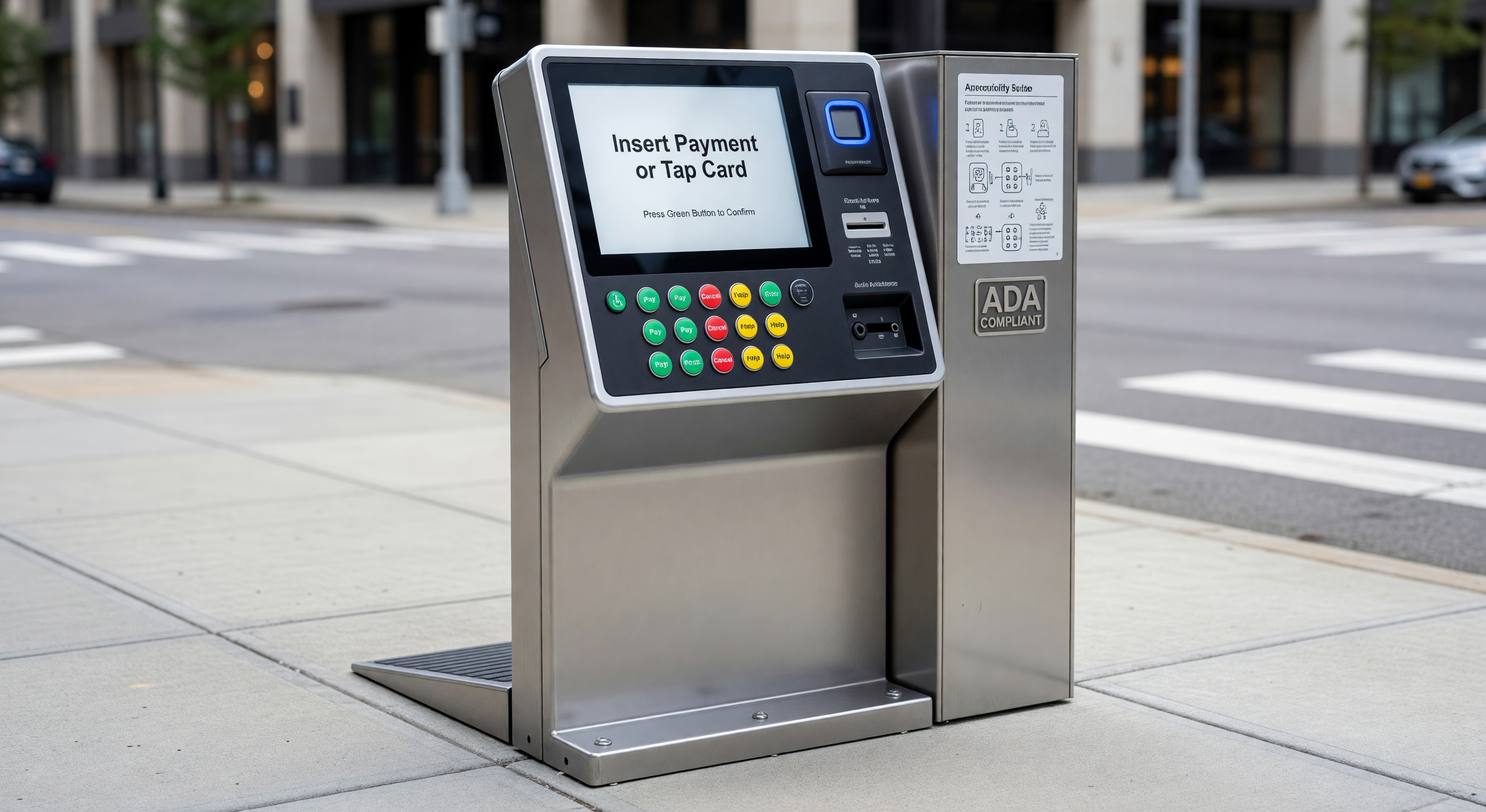
Practical application: Rotating knobs, difficult-to-press buttons, and stiff card reader slots that require significant force may not comply. Physical button keypads with appropriate spring resistance meet this standard more reliably than touchscreens requiring precise pressure.
Clear Floor Space (Section 309.3)
A clear floor space of 30 × 48 inches (760 × 1220mm) must be available at each operable part. This space allows a wheelchair user to position their wheelchair to reach the controls.
Practical application: Pay station placement that positions the unit in a walkway, against a curb, or adjacent to parked vehicles in a way that prevents a wheelchair from occupying the required clear floor space is non-compliant even if the equipment itself meets reach range requirements.
Verify that the installed configuration — not just the equipment — provides the required clear floor space. The approach path to the clear floor space must also be accessible (firm, stable, slip-resistant surface per Section 402).
Audio Guidance Requirements
Pay stations with visual-only interfaces (text-only displays or touchscreens without audio) are not accessible to users who are blind or have low vision. ADA-compliant pay stations for parking facilities must provide:
Audio guidance: All information presented visually must also be presented in audio form. This includes instruction prompts, transaction status, error messages, and completion confirmations.
3.5mm audio jack: The standard implementation is a standard 3.5mm headphone jack where the user plugs in their own headphones to receive private audio guidance. This jack must be located within reach range.
Volume control: The ability to adjust audio output volume is required.
Alternative: Speaker output: Some pay stations provide audio through a speaker rather than a headphone jack. Speaker output satisfies the audio requirement but provides no privacy — acceptable for many outdoor applications where ambient noise would obscure the audio content anyway.
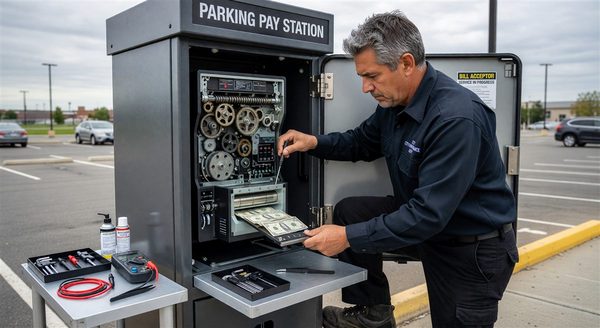
Practical application: Many older pay stations have audio jacks that are disconnected, not configured, or blocked. Test audio output at every pay station as part of regular PM checks. A non-functional audio jack is a compliance failure.
Braille and Tactile Elements
Keypads: Physical keypads (not touchscreen-only) with raised dot indicators — specifically, a raised dot on the 5 key per telephone convention — allow visually impaired users to orient to the keypad without sight. Braille-grade key labels are required on keypads used for letters (if alphabetic input is required).
Touchscreens: Touchscreen-only interfaces present an accessibility challenge for blind users. ADA requirements for touchscreen kiosks continue to evolve; the current guidance requires that any touchscreen with input functions must provide an accessible mode that doesn’t require visual interface interaction. Audio guidance with keypad input alternatives addresses this.
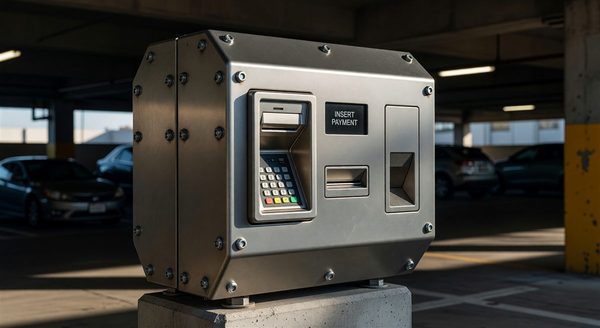
Slot identification: Bill acceptor slots, card reader slots, and ticket slots should have tactile identification so users can locate them without relying on visual reference.
Common Compliance Failures
Controls Above 48 Inches
The most common pay station ADA compliance failure: a touchscreen or primary interface mounted too high. For a person using a standard wheelchair (seat height approximately 17–19 inches), reaching a 50-inch touch target requires significant stretch that may not be possible.
Verify interface height at the actual installation, not from the product drawing. Pedestal height varies; wall-mount heights vary; grade changes between the specification drawing and the installed condition create height differences.
Non-Functional Audio Interface
Audio jacks present on the pay station but not configured or not operational. Audio function must be tested at commissioning and included in PM checks.
Inadequate Clear Floor Space
Pay stations placed against walls or curbs, on sloped surfaces, or in locations where vehicle parking prevents wheelchair access. ADA requires the clear floor space to be on firm, stable ground.
Fixed-Height Mounting Where Adjustable Mounting Is Feasible
Some installations mount pay stations at heights optimized for standing users, even in facilities that serve significant populations of wheelchair users. Adjustable-height mounts exist for some pay station models and are appropriate in facilities like medical centers where a high proportion of users may use mobility aids.
Compliance Documentation
For facilities that may face ADA compliance review or litigation, maintain documentation of:
- As-installed measurements for each pay station (control heights, clear floor space dimensions, approach path slope)
- Audio function testing records
- Manufacturer’s accessibility certification for the specific model and configuration
- Any accessible features that go beyond minimum requirements
ADA compliance is not a one-time certification — it must be maintained through equipment changes, site modifications, and ongoing maintenance. Include accessibility verification in your annual maintenance program.
Frequently Asked Questions
If our pay station manufacturer says the equipment is ADA compliant, are we covered? Manufacturer ADA compliance certifications typically apply to the equipment in a standard configuration, not to your specific installed configuration. A pay station that is compliant at 46 inches installed height becomes non-compliant if your installation places the top control at 52 inches. You are responsible for compliance of the installed configuration, not just the equipment.
What are the consequences of ADA non-compliance at pay stations? Private litigation by individuals denied accessible access, DOJ enforcement actions, and state ADA equivalents all create legal exposure. Complaints are often settled with facility modifications plus attorney fee payments. Proactive compliance is significantly less expensive than reactive remediation after a complaint.
Do ADA requirements apply to temporary or event parking? Yes. Temporary parking operations subject to ADA (any public accommodation or government facility) must provide accessible payment options. If temporary pay stations are not accessible, an alternative accessible payment method must be provided (e.g., a staffed booth, mobile payment app).
What’s the difference between ADA compliant and Section 508 compliant? Section 508 applies to federal government electronic and information technology — it applies to federal agency parking payment systems. ADA applies to publicly accessible parking generally. They have overlapping but not identical requirements. Government facility pay stations may need to satisfy both.
Key Takeaway
ADA compliance for parking pay stations is determined by the installed configuration, not the equipment catalog. Verify control heights, clear floor space, and audio function at each installed unit — not just at the design stage. The most common compliance failures are installation-related rather than equipment-design-related and are preventable with pre-commissioning verification.