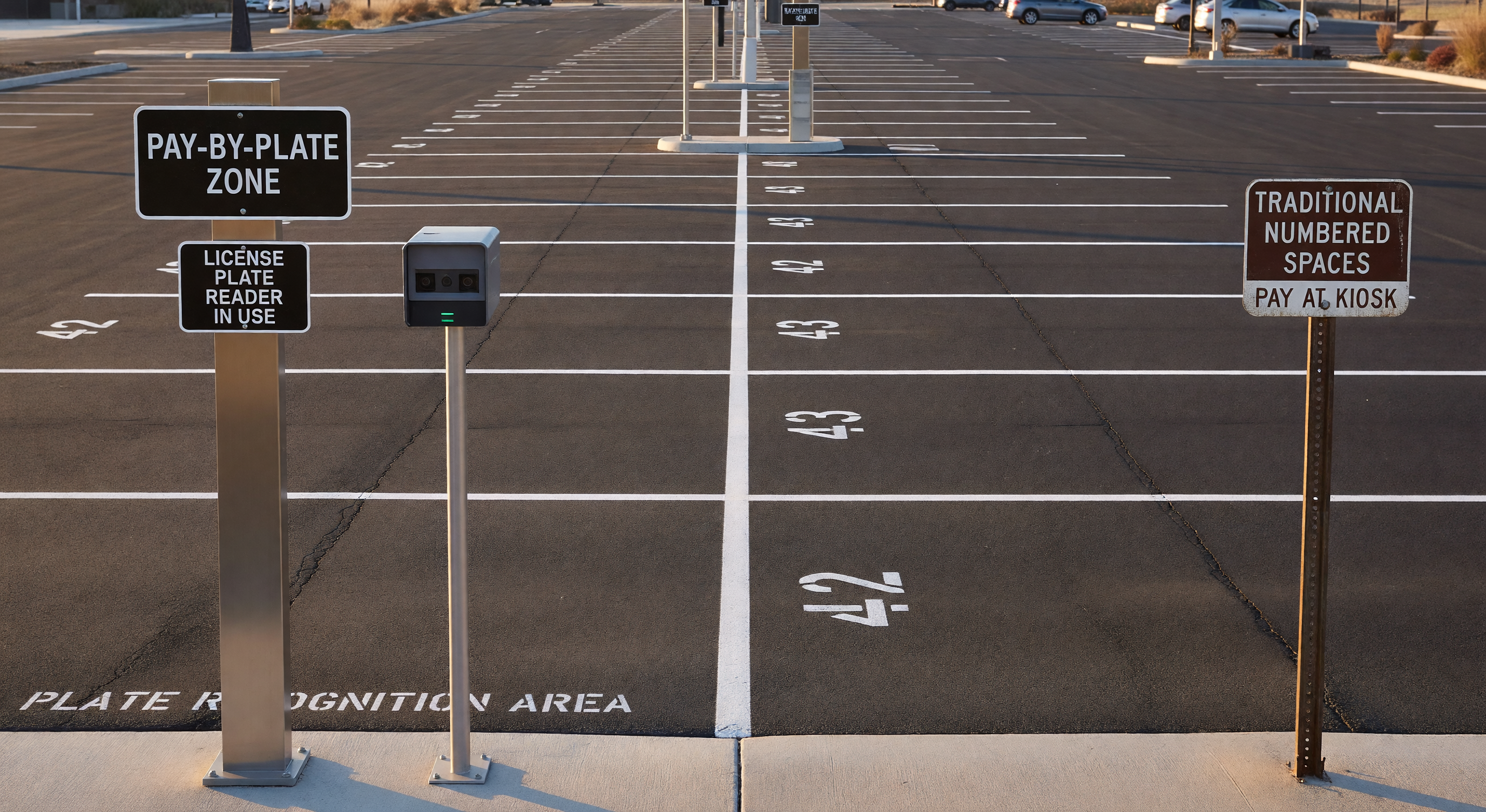
Pay-by-plate and pay-by-space systems represent fundamentally different approaches to connecting a parking transaction to a specific vehicle or location. The choice between them affects enforcement operations, customer experience, equipment configuration, and integration architecture in ways that compound over years of operation.
Many facilities default to one model based on what their PARCS vendor offers or what the previous operator used, rather than evaluating which model fits their specific operation. This guide provides a structured comparison to support that evaluation.
Defining the Models
Pay by Space
In a pay-by-space system, each parking space has a number assigned to it. When a customer parks, they enter their space number at the pay station, then pay for the duration they want. The transaction is associated with the space, not the vehicle.
The space number is the key identifier: the transaction is valid for the space, and any vehicle in that space during the paid period is considered compliant. If the vehicle moves and a different vehicle occupies the space, the new vehicle’s occupancy time isn’t covered by the original transaction.
Traditional application: Classic single-space parking meters operate this way. Multi-space pay stations using pay-by-space require physical space number markers visible to users.
Pay by Plate
In a pay-by-plate system, the customer enters their license plate number at the pay station. The transaction is associated with the plate, not a specific space. Any space in the lot (or zone) is valid during the paid period — the customer can return to a different space and their plate is still compliant.
Modern application: Most multi-space pay station deployments in the past 5–7 years use pay-by-plate, which aligns with LPR-based enforcement systems.
Enforcement Implications
This is where the most significant operational difference between the two systems appears.
Pay-by-Space Enforcement
Enforcement of pay-by-space systems requires manually checking each space: is this space number paid in the system, and has the payment not expired? Officers walk or drive the lot, look up space numbers, and check payment status.
With traditional meters: The space is clearly paid (meter shows time remaining) or unpaid (meter expired or zero). Enforcement is visual.
With multi-space pay stations: The officer references the space number against the PARCS database, either through a handheld device connected to the system or through a printed or downloaded expired-space list.
The pay-by-space problem: Vehicles frequently move before their paid time expires, leaving an unused paid time on a space that is now occupied by an unpaid vehicle. The enforcement system shows the space as paid when the paying vehicle has already left. This creates phantom payments — the space appears compliant in the database but the current vehicle has no paid transaction.
Pay-by-Plate Enforcement
Enforcement of pay-by-plate systems uses LPR cameras or handheld plate scanners to read each vehicle’s plate and query the database for a valid payment. The query returns whether the plate has a valid transaction covering the current time and location.
Advantages:
- Handles vehicle movement cleanly — the payment follows the vehicle, not the space
- Compatible with mobile LPR enforcement for high-efficiency patrol
- No need to correlate space numbers with database records
- Customers who re-park in a different spot don’t need to pay again
Disadvantages:
- Requires plate-number entry accuracy from customers (mistyped plates = enforcement disputes)
- Requires LPR-capable enforcement for efficient patrolling
- Plate-based enforcement disputes (correct payment, wrong plate entered) require customer-facing resolution procedures
Customer Experience Comparison
Pay by Space
Pros:
- Familiar model to customers accustomed to parking meters
- No need to know or enter license plate number
- Simple: find space, note number, go to machine, pay for space number
Cons:
- Must correctly read and remember the space number
- Space numbers can be obscured, damaged, or missing
- Can’t return to a different space without re-paying
- If space number changes during relabeling or repainting, confusion results
Pay by Plate
Pros:
- Payment follows the customer, not the space
- Mobile payment extensions are easier to implement — the app knows your plate, not your space
- Can re-park during the paid period without additional payment
- Better integration with LPR-based facility management
Cons:
- Customer must accurately enter their own license plate
- Plate entry errors create compliance issues — the customer thinks they’re paid, enforcement says the plate has no valid transaction
- Vanity plates, out-of-state plates, or rental car customers may have plate confusion
- Less intuitive for customers unfamiliar with the model
Addressing plate entry errors: Most pay-by-plate systems allow a grace period for customers to correct plate entry errors before a violation is issued. Configuring this grace period, and training enforcement staff to handle plate disputes promptly and customer-serviceably, is essential for customer satisfaction.
Equipment Requirements
Pay-by-Space Equipment
- Physical space number markers (painted numbers, signage, or embedded markers) at every space
- Pay station configured to accept space number entry
- Database connection for space payment status queries
Ongoing operational cost: maintaining readable space numbers (repainting, replacing damaged markers). This is surprisingly labor-intensive in high-turnover surface lots.
Pay-by-Plate Equipment
- Pay station with plate number entry (keypad or camera-based automatic plate recognition at the station)
- LPR enforcement capability (vehicle-mounted or handheld)
- Database infrastructure to link plate numbers with payment records
The LPR enforcement requirement is the primary capital cost difference. A pay-by-plate system without LPR enforcement capability defaults to manual enforcement, losing one of its primary advantages.
Integration Considerations
Mobile Payment App Integration
Pay-by-plate integrates more naturally with mobile parking payment apps than pay-by-space. The app knows the user’s plate number; when they park, the app knows their session is valid without any action at a pay station. Extensions and payment confirmation are all linked to the plate.
Pay-by-space mobile integration requires either the user to enter the space number in the app (creating the same space-number-finding friction as the pay station) or a QR code at the space that the user scans.
Dynamic Pricing Integration
Pay-by-plate systems allow dynamic pricing implementation more naturally — the payment system knows which plate entered and when, enabling demand-based pricing adjustments in near-real time.
Multi-Facility Management
In a portfolio of facilities using pay-by-plate, a single permit or subscription can cover multiple lots since the plate is the identifier, not a specific space or facility location. This simplifies monthly permit management for operators and frequent parkers.
Which Model Is Right for Your Operation?
Pay-by-space is appropriate when:
- LPR enforcement isn’t feasible or budgeted
- The customer base is unfamiliar with plate entry (infrequent visitors, tourist-heavy areas)
- Single-space meter replacement where the space-based model is deeply established
- Regulatory environment requires space-specific payment
Pay-by-plate is appropriate when:
- LPR enforcement is used or planned
- Mobile payment integration is a priority
- The facility has high turnover with customers frequently re-parking
- Multi-facility portfolio management is a goal
- The operator wants to eliminate space numbering maintenance
Frequently Asked Questions
Can we operate pay-by-plate in a facility without LPR enforcement? Yes, but enforcement quality suffers. Without LPR, enforcement requires manually typing plate numbers into a handheld device for each vehicle — slower and more error-prone than automated plate reading. For facilities where enforcement intensity is lower (monthly permit facilities with limited transient parking), manual plate entry for enforcement may be acceptable.
How do we handle plates that are difficult to read (damaged, temporary, obscured)? Most pay-by-plate enforcement systems allow manual citation issuance for unreadable plates after photographing the plate area and documenting the condition. Develop a standard procedure for staff to follow — inconsistent handling of unreadable plates creates enforcement disputes.
Do rental car customers have problems with pay-by-plate? Customers in rental vehicles may not know their plate number. Most rental vehicles have the plate number on the rental agreement or visible from the driver’s seat through the rear window. Signage advising customers to check the plate before entering the lot helps. Alternatively, some facilities allow rental car company account billing as an alternative to plate entry.
Can we switch from pay-by-space to pay-by-plate on an existing system? Yes, in most cases. The pay station software is reconfigured for plate entry rather than space entry; enforcement procedures change; space number markers can be removed or left as reference markers. Verify that your PARCS platform supports pay-by-plate before committing to the switch — some older platforms have limitations.
Key Takeaway
Pay-by-plate is the modern standard for multi-space parking because it aligns with LPR enforcement, mobile payment, and portfolio management. Pay-by-space remains appropriate in specific contexts where LPR enforcement isn’t practical or the customer base benefits from the familiar space-number model. The decision is operational, not technological — evaluate against your enforcement capability and customer demographics.