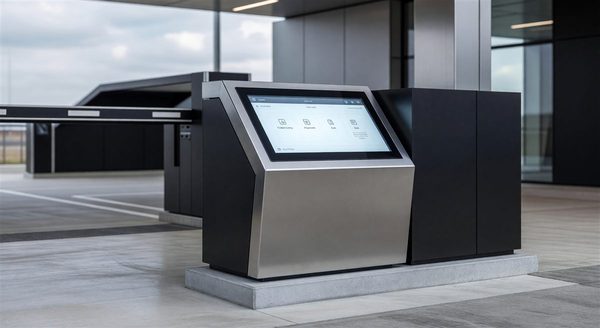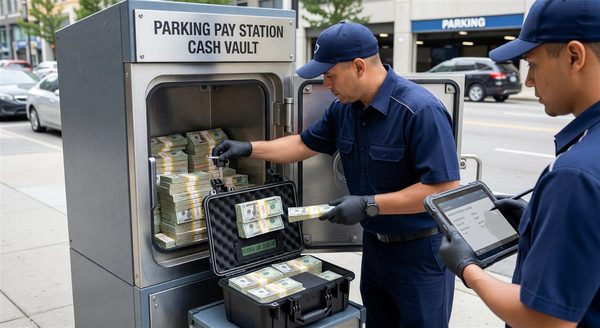
Parking pay stations present an attractive target in urban environments: they contain cash, accept payment card data, and operate in locations with limited surveillance. Physical attacks on pay stations include smash-and-grab attempts at the display or card reader, prying or drilling attacks on vault access points, and service entry attacks through cabinet openings.
Effective vandalism protection is a combination of equipment specification, site design, and surveillance integration — no single element is sufficient alone. This guide covers the layers of protection that reduce both attack success rates and the operational impact when attacks occur.
Understanding Vandal Attack Patterns
Smash-and-Grab Attacks
The most common form: impact damage to the display screen, keypad, or card reader with the goal of accessing components or disrupting operations. Broken screens and card readers are the most frequently vandalized components.
Motivation: Disruption (out-of-service pay station reduces revenue), opportunistic theft of accessible payment credentials, or frustration with the equipment.
Defense priority: Impact-resistant display covers, IK-rated housings, card reader recessing.
Vault Attacks
Direct attacks on the cash vault — prying, drilling, or grinding at vault door edges. These require tools and time; most vault attacks on attended or surveilled facilities fail or are abandoned.
Motivation: Cash theft.
Defense priority: Vault door steel gauge, lock mechanism quality, physical anchoring, surveillance deterrence.
Card Reader Skimmer Installation
Criminals install overlay devices (skimmers) on card readers that capture card data from legitimate transactions. Unlike impact attacks, skimmer installation is designed to go undetected.
Defense priority: Card reader recessing that prevents overlay installation, semi-conductor display showing card reading status, regular reader inspection.
Service Entry Attacks
Attempts to access the equipment through service panels or by mimicking service personnel to gain legitimate access.
Defense priority: Tamper-evident fasteners, two-key access systems, staff awareness.
Equipment Specification for Vandal Resistance
Housing and Structural Integrity
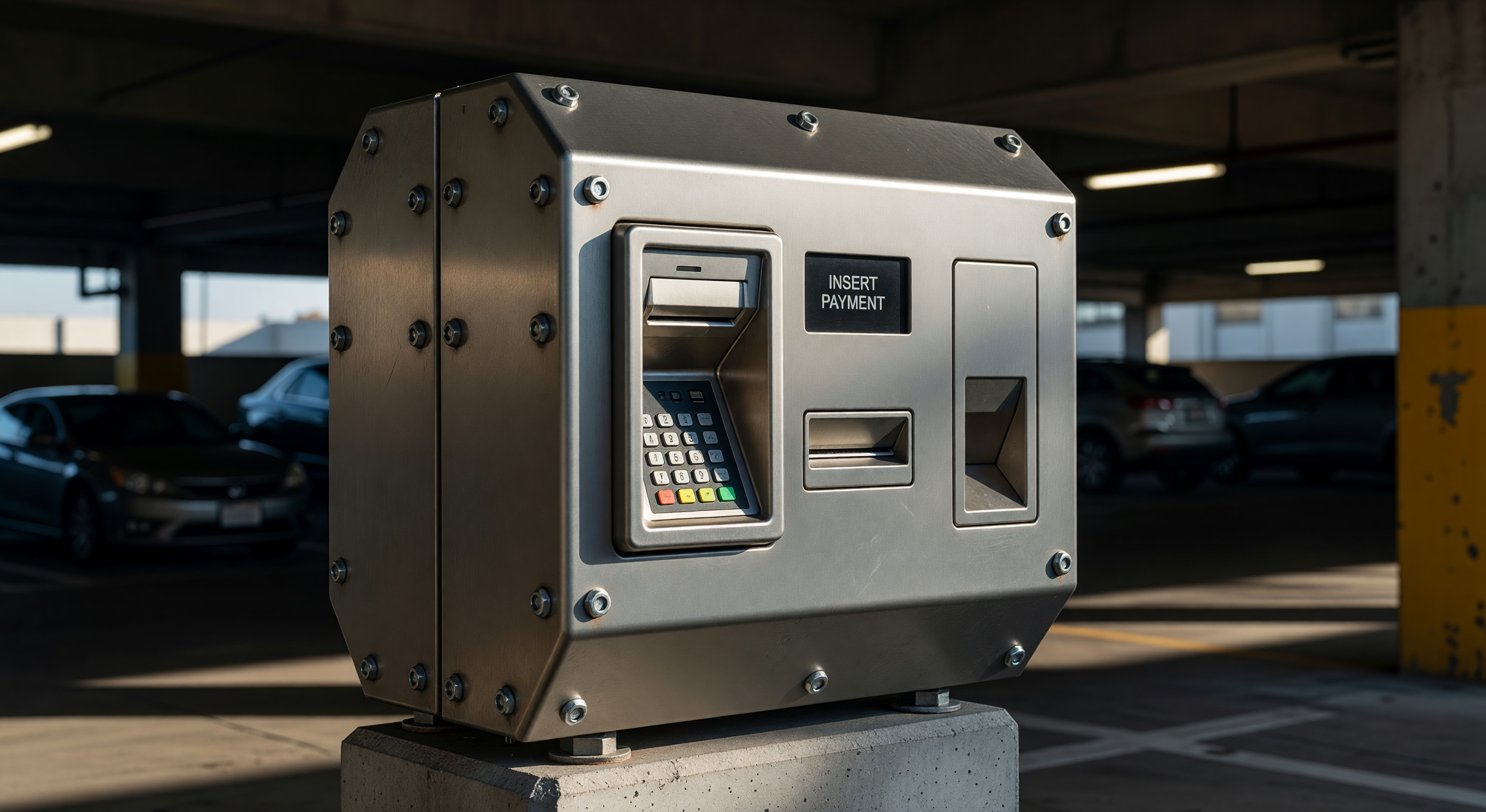
Steel gauge: Commercial pay station housings are typically 11–14 gauge steel. Higher gauge (lower number) means thicker, more impact-resistant steel. For urban high-risk installations, specify 11-gauge or thicker for vault compartments.
Seam and weld quality: Welded seams rather than bolted joints provide better structural integrity against prying attacks. Inspect welds at corners and edges in pre-purchase equipment evaluation.
IK rating: As discussed in the camera vandal resistance guide, IK10 is the highest impact resistance rating. Specify IK10 for pay stations in high-risk environments.
Anchoring: Freestanding pay stations must be anchored to prevent tipping or removal. Anchor bolt specifications should match the threat environment — standard concrete anchors for most environments; heavy-duty anchor systems for locations where equipment has been stolen previously.
Card Reader and Interface Hardening
Card reader recessing: Recessed card reader slots with minimal overhanging lip prevent skimmer overlay installation. Verify that the card reader housing allows less than 2mm overlay installation — deeper than that is difficult to achieve without being visible.
Display protection: Tempered glass or polycarbonate display covers significantly reduce screen damage from impact. Specify Gorilla Glass or equivalent for touch displays; non-touch displays can use thicker polycarbonate.
Keypad: Metal keypads (zinc die-cast or steel) outlast plastic keypads in vandalism-exposed environments. Metal backlit keypads are available from most major pay station manufacturers.
ADA accessibility and security: ADA-compliant audio jacks (headphone input for visually impaired users) are a potential attack vector if not protected. Specify recessed audio connectors with covers.
Vault Security
Vault door steel thickness: Commercial vaults use 10–12 gauge steel for vault doors. Specify a minimum thickness appropriate to your threat environment.
Lock mechanisms: High-security tubular keyed locks provide better resistance than standard disc or wafer locks. Electronic combination locks or audit-logged key systems provide the highest security level.
Vault location: Internal vault placement (deeper in the cabinet) requires attackers to first defeat the cabinet door before accessing the vault. Two-stage access significantly increases attack time and deterrence.
Time-delay locks: For the highest-value installations, time-delay lock mechanisms prevent immediate vault opening even with the correct credentials — creating a deterrent for opportunistic attacks that require fast access.
Site Design for Vandalism Deterrence
Visibility and Natural Surveillance
Vandalism and physical attacks are significantly reduced by visibility. Site design that eliminates concealment around pay stations is the most cost-effective deterrence investment.
- Position pay stations in open areas visible from the entry/exit traffic lanes
- Avoid placing pay stations in areas blocked by vehicles, structures, or landscaping that limit sightlines
- Ensure adequate lighting at pay station locations — well-lit equipment is less likely to be attacked than equipment in dark or shadowed areas
Camera Coverage
Visible camera coverage of pay station locations is a primary deterrent. Cameras should be:
- Clearly visible to anyone approaching the pay station
- Positioned to capture facial detail of anyone interacting with the pay station
- Supplemented with visible camera housing that clearly indicates active surveillance
For high-risk locations, consider visible monitoring signs (“This area is under video surveillance”) at pay station locations in addition to camera hardware.
Physical Barriers
Bollards around pay stations prevent vehicle-impact attacks and unauthorized removal:
- Fill-and-pour steel bollards set in concrete provide the highest protection
- Surface-mounted steel bollards provide good protection with less invasive installation
- Removable bollards allow service access while providing security when the station is unattended
Position bollards to prevent vehicles from approaching the pay station while allowing pedestrian access and ADA-compliant clearance.
Security Monitoring and Response
Tamper Alerts
Most commercial pay stations include tamper-detection sensors (door open alerts, tilt sensors, vibration sensors) that can trigger alerts to a monitoring system or remote management platform.
Configure tamper alerts to:
- Notify on-call staff immediately via mobile notification
- Trigger camera recording at the station location
- Log the event with timestamp for police reporting
Verify that tamper alerts are configured and functional — a tamper sensor that isn’t connected to a notification system provides no operational value.
Cash Removal Monitoring
Some pay stations offer GPS tracking of cash cassettes — allowing real-time monitoring of cassette location during collection and alerting if a cassette is taken to an unexpected location.
For facilities with multiple collection staff or where internal theft is a concern, GPS cassette tracking provides an additional layer of accountability.
Reporting Patterns
Maintain records of vandalism incidents by location, time of day, and incident type. Patterns in this data reveal:
- Locations requiring additional physical hardening
- Time patterns suggesting targeted enforcement presence would be effective
- Attack methods evolving in your market that warrant equipment countermeasures
Responding to Vandalism Incidents
Immediate Response
- Document the damage thoroughly before any cleanup or repair (photos, video)
- Extract security camera footage immediately
- If the vault was breached, notify law enforcement before touching the scene
- Contact your insurer within the policy’s required notification window
- Assess whether the station is safe to operate; place Out of Service notification if not
Temporary Operation
If the station is partially functional (e.g., card payment works but display is damaged), you may choose to keep it operational with an Out of Service notice for affected functions while awaiting repair. Coordinate with your PARCS provider on any configuration changes needed.
Hardening After Incidents
An attacked station warrants a site-specific security review before returning to service. Identify what enabled the attack:
- Was there inadequate lighting at the time?
- Was the station isolated from natural surveillance?
- Was the camera positioned to record the incident usefully?
- Was the housing adequately resistant?
Address identified gaps before returning the station to service.
Frequently Asked Questions
How do we identify if a card skimmer has been installed on our pay stations? Perform daily visual inspections of card readers — compare the current appearance against reference photos taken at installation. Look for any overlay that wasn’t there before, gaps between the reader housing and the station body, or components that wiggle or pull off. Some municipalities provide training for parking operators on skimmer identification.
Is it worth investing in payment hardware upgrades specifically to prevent skimming? Transitioning to contactless (NFC) payment significantly reduces skimming risk — contactless transactions don’t involve physical card insertion where overlay devices attach. If skimming is a demonstrated problem at your facilities, the contactless upgrade investment is partially justified by the security benefit in addition to customer experience benefits.
What is the average cost of a vandalism incident on a parking pay station? Direct costs (repair, temporary service disruption) typically run $500–$5,000 per incident depending on damage severity. Total costs including lost revenue during downtime, insurance deductible, and staff time for response and reporting often run $2,000–$10,000. Vault-breach incidents that recover cash add potential revenue loss to this calculation.
Should we remove pay stations from high-risk locations or invest in hardening? This is a financial decision based on the revenue from the location versus the cumulative cost of security incidents. Locations with persistent high vandalism rates and low transaction volumes may not justify continued equipment investment. Locations with high transaction volumes warrant significant hardening investment. Conduct the analysis with actual incident cost data, not anecdotal assessment.
Key Takeaway
Vandalism protection for pay stations is most cost-effective as a layered approach: hardened equipment specifications resist attacks when they occur; site design and lighting reduce attack frequency; camera coverage deters and documents incidents; and tamper monitoring enables rapid response. No single layer is sufficient; all four working together provide meaningful protection in high-risk environments.