Network connectivity for parking pay stations is a critical infrastructure decision that affects payment reliability, real-time management capability, and the operational response to failures. A pay station that can’t process credit cards, can’t send transaction data to the PARCS system, or can’t receive rate updates because its connectivity is down creates revenue loss and customer friction.
This guide covers the three primary connectivity options for parking pay stations, the performance requirements that determine connectivity adequacy, and the redundancy strategies that maintain operations when primary connectivity fails.
Why Connectivity Matters for Modern Pay Stations
Contemporary parking pay stations are not standalone devices — they’re network endpoints that communicate continuously with multiple systems:
Payment processing: Every credit card and contactless transaction requires real-time authorization from the payment network. Without connectivity, card payments fail.
PARCS data synchronization: Transaction records, plate validation queries, permit lookups, and session updates all require connectivity to the PARCS platform.
Rate management: Current parking rates must be up-to-date. Stale rates lead to undercharging (revenue loss) or overcharging (customer disputes).
Remote management: Firmware updates, configuration changes, and remote diagnostics require connectivity to the management platform.
Alert and monitoring: Equipment status alerts (paper low, vault full, fault conditions) require connectivity to reach management staff.
The consequence of connectivity loss depends on the system design and offline mode configuration, but generally includes: inability to process card payments, inability to look up valid permits or paid plates, and inability to synchronize transactions when connectivity restores.
Wired Ethernet Connectivity
How It Works
Ethernet provides the highest-reliability connectivity for fixed installations. A Category 5e or Cat6 cable runs from the pay station to a nearby network switch, which connects through the facility’s infrastructure to the internet and PARCS platform.
Performance characteristics:
- Bandwidth: 100 Mbps to 1 Gbps — vastly more than a pay station requires (typical pay station traffic is under 1 Mbps)
- Latency: Under 5ms typically — no practical impact on transaction speed
- Reliability: Very high — failures are typically in switches, cable damage, or upstream infrastructure
- Dependence: Requires structured cabling infrastructure from each station location
When Wired Is the Right Choice
New construction: When running infrastructure during construction, wired Ethernet is the highest-reliability option at minimal incremental cost (cabling is part of the overall infrastructure project).
Permanent installations in existing structures: If conduit runs to pay station locations are feasible, wired Ethernet provides the best long-term reliability at lowest ongoing cost (no carrier fees).
High-transaction-volume locations: Locations processing 200+ card transactions per day benefit from the reliability buffer of wired connectivity over wireless alternatives.
PCI compliance simplification: Wired connections are simpler to scope and segment for PCI compliance than wireless networks.
WiFi Connectivity
How It Works
WiFi-connected pay stations communicate with a nearby wireless access point over 802.11 protocols. The access point connects to the facility’s wired network, which connects to the internet and PARCS platform.
Performance characteristics:
- Bandwidth: Adequate — WiFi provides far more bandwidth than a pay station requires
- Latency: 5–50ms typically — adequate for payment processing and PARCS sync
- Reliability: Moderate — more vulnerable than wired due to RF interference, access point failures, and distance limitations
- Coverage: Requires adequate signal strength at the pay station location — coverage gaps create reliability issues
When WiFi Is Appropriate
Locations where cabling is cost-prohibitive: Surface lots where trenching costs are high but wireless coverage from nearby buildings is adequate.
Temporary installations: Event parking or seasonal operations where running permanent cabling isn’t justified.
Retrofit situations: Adding pay stations to existing locations where cabling infrastructure would be disruptive or expensive.
WiFi Reliability Considerations
The primary WiFi risk for pay stations is RF environment variability:
- Multiple competing WiFi networks in urban environments create channel interference
- Physical obstructions (concrete, rebar in structures, metal equipment) attenuate WiFi signal
- Environmental changes (new equipment installed, seasonal vegetation changes) affect coverage
For each WiFi-connected pay station location:
- Conduct a site survey to verify adequate signal strength (target -65 dBm or stronger)
- Verify signal quality on a rainy day (precipitation affects some frequencies)
- Plan for access point placement that provides coverage to the pay station from at least two access points (failover)
- Specify enterprise-grade access points (not consumer-grade) for commercial reliability
4G LTE Cellular Connectivity
How It Works
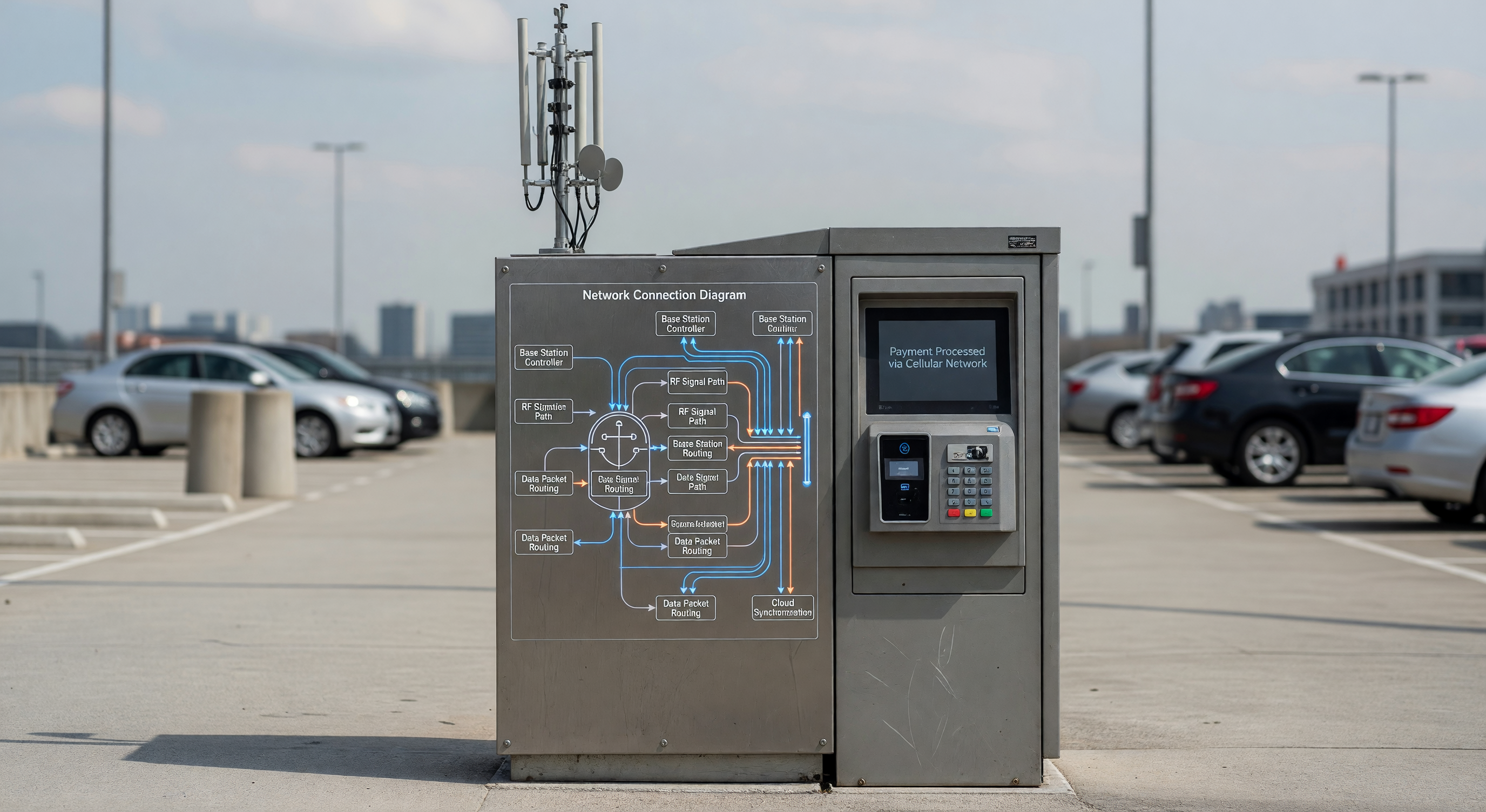
4G LTE-connected pay stations contain a cellular modem and SIM card. The station communicates over the carrier’s cellular network, requiring no local networking infrastructure — just power.
Performance characteristics:
- Bandwidth: 10–100 Mbps — more than adequate for pay station traffic
- Latency: 20–100ms — adequate for payment processing; slightly higher than wired
- Reliability: High in areas with good cellular coverage; unreliable in coverage gaps or during network congestion
- Infrastructure independence: The major advantage — no local network required
When Cellular Is the Right Choice
Off-grid or remote locations: Surface lots without power or network infrastructure (combined with solar-powered pay stations)
Locations where infrastructure costs are prohibitive: Situations where the cost of network infrastructure exceeds the cost of cellular service over the equipment lifecycle
Backup connectivity: Cellular as a secondary connection when primary wired or WiFi connectivity fails
Rapid deployment: Cellular-connected stations can be deployed in hours without infrastructure work
Cellular Service Considerations
Carrier selection: Not all carriers have equal coverage at all locations. Test signal strength from each major carrier at the deployment location before selecting.
SIM management: Cellular-connected fleets require SIM card management — activation, data plan management, carrier account maintenance, and SIM replacement when cards fail. Factor this operational overhead into the total cost.
Data costs: Cellular data plans for pay stations typically cost $5–$20/station/month depending on carrier and data volume. Over 5 years, this adds $300–$1,200 per station — more than the infrastructure cost of wired Ethernet in favorable locations.
5G: 5G coverage for pay stations is not yet necessary — pay stations don’t require the bandwidth advantage of 5G. 4G LTE provides adequate performance for all current pay station applications.
Dual-Path Redundancy
The highest reliability configurations use two independent connectivity paths: a primary path (wired or WiFi) and a backup path (cellular) that activates automatically when the primary fails.
How it works:
- Primary connection handles all normal traffic
- The pay station continuously monitors primary connectivity
- When primary connectivity fails (detected within 30–60 seconds), the cellular modem activates and takes over
- When primary connectivity restores, traffic switches back automatically
Cost: Dual-path configurations add the cellular modem hardware cost ($50–$150) and the monthly cellular data cost ($5–$10 for a backup-only SIM). For revenue-critical pay stations, this is typically a justified investment.
PCI implications: Dual-path configurations require both paths to be in scope for PCI compliance — verify with your QSA.
Offline Mode: What Happens When All Connectivity Fails
All pay stations should have a defined offline mode for when all connectivity fails. Common approaches:
Card-only offline: The pay station stores card authorization data locally and submits for settlement when connectivity restores. Risk: card fraud transactions may be processed without real-time authorization.
Cashless-only offline: Temporarily disables card processing, allowing only cash transactions that don’t require network connectivity. Simpler from a fraud perspective.
Full offline with manual reconciliation: The station continues processing all transactions and stores them locally. When connectivity restores, all offline transactions are submitted. This creates a reconciliation burden and potential for settlement rejection (expired authorizations).
Out-of-service: The station displays an out-of-service message and stops accepting payments. Simplest from an operational perspective; creates revenue loss during the outage.
Document which offline mode applies to each pay station and ensure that operating staff understand how to respond during a connectivity outage.
Frequently Asked Questions
What is the required bandwidth for a parking pay station? A single pay station at full transaction load typically uses less than 100 Kbps of data — payment processing, PARCS sync, and management traffic combined. Even a single 4G LTE cellular connection provides 100x this bandwidth in good coverage. Bandwidth isn’t the bottleneck for pay stations; latency and reliability are.
Should all pay stations in a facility use the same connectivity type? Not necessarily. High-value primary stations (near building entrances, high-traffic areas) warrant wired or dual-path connectivity. Secondary stations in low-traffic areas may use cellular efficiently. Design connectivity to match the revenue criticality of each station location.
How do we monitor connectivity status across a pay station fleet? Most PARCS platforms and cellular management platforms provide connectivity status dashboards. Configure alerts for stations that go offline — prompt notification allows faster response before significant transaction loss occurs.
What is the impact of connectivity latency on payment transaction speed? Payment authorization typically adds 500–1,500ms to a transaction due to network round-trip time and payment gateway processing. Cellular latency of 50–100ms vs. wired latency of 5ms adds only 50–100ms to this total — imperceptible to the customer. Transaction speed is rarely affected by reasonable differences in connectivity latency.
Key Takeaway
Connectivity selection for parking pay stations is a reliability and cost engineering problem, not a bandwidth problem. Design connectivity to match the revenue criticality of each location, provide redundancy at high-value stations, and establish clear offline mode procedures so failures are managed rather than ignored.