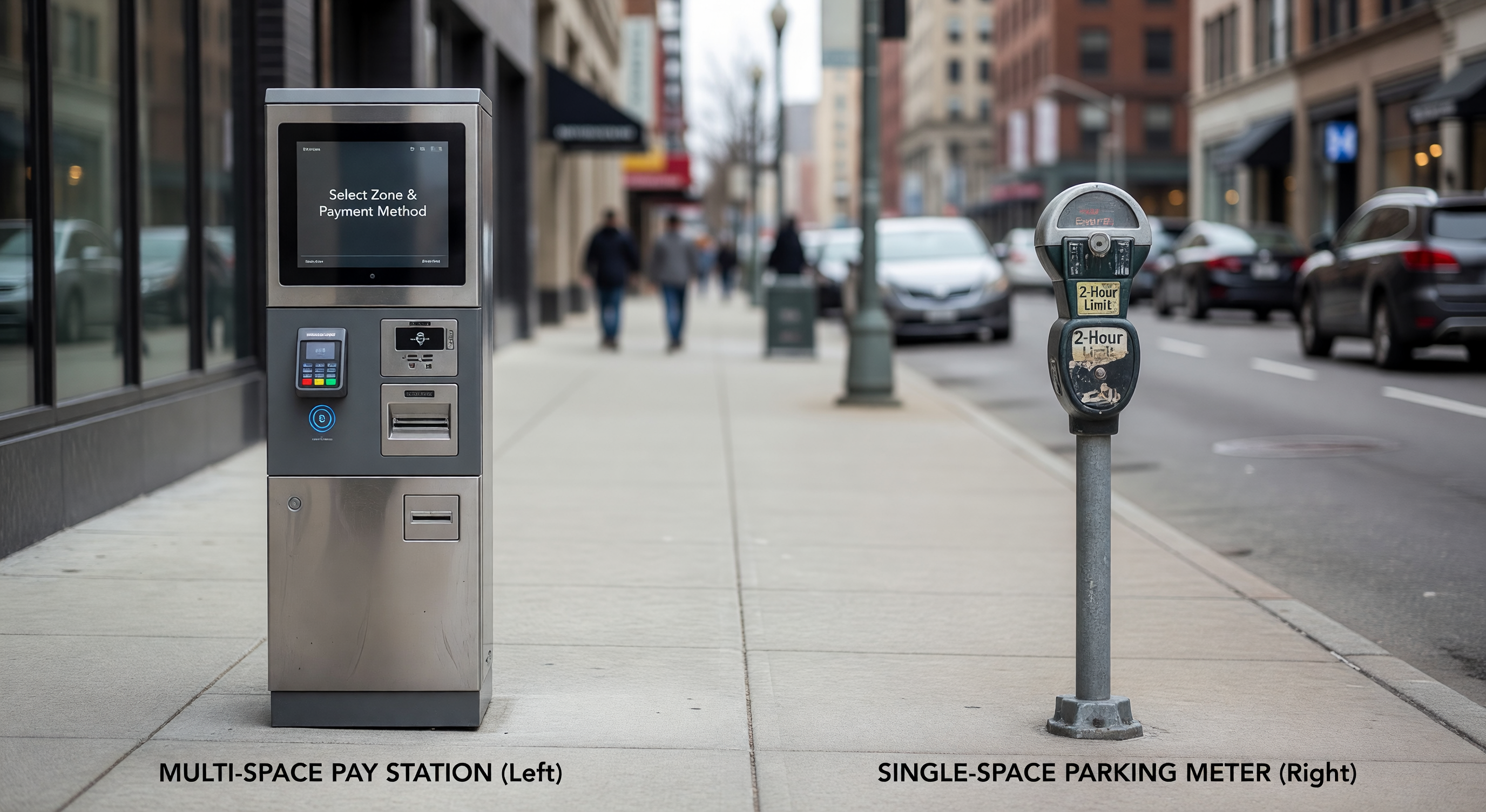
The shift from single-space parking meters to multi-space pay stations has been underway for decades, but single-space meters retain a meaningful market share — particularly in on-street environments, low-density surface lots, and municipalities that value the enforcement simplicity of the original model.
The decision between single-space and multi-space isn’t purely about technology preference. It’s an operational and economic analysis: what are the maintenance costs, enforcement effectiveness, customer experience implications, and revenue collection capabilities of each approach in your specific environment?
Single-Space Meters: Strengths and Limitations
How They Work
Single-space meters (traditional coin meters and their modern equivalents) are installed at each individual parking space. The meter indicates whether the space is paid and how much time remains. Payment is at the meter, directly associated with the specific space.
Modern single-space meter designs have evolved significantly from the original mechanical wind-up models:
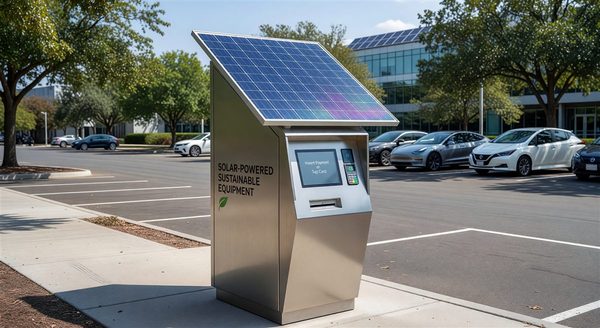
- Solar-powered smart meters accept credit card payments alongside coins
- Networked meters transmit payment status and battery alerts to a central management system
- Dual-space meters serve two adjacent spaces from a single mounted unit (reducing hardware count while maintaining space-level association)
Strengths of Single-Space Meters
Enforcement simplicity: The enforcement officer observes the meter to determine payment status — no handheld device, no database query, no LPR equipment needed. Expired meters are immediately visible. This simplicity reduces enforcement technology investment and training complexity.
Familiar customer experience: The single-space meter interaction is universally understood. Customers don’t need to find a pay station, remember a space number, or learn new interface conventions.
Visible compliance signal: A customer returning to their car can see from a distance whether their meter has expired, allowing proactive extension.
Failure containment: A single-space meter failure affects one space. A multi-space station failure affects 25–50 spaces. The downtime risk is fundamentally lower per-failure event.
Limitations of Single-Space Meters
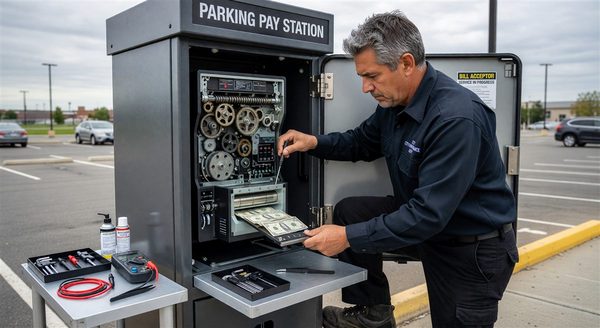
High maintenance cost per payment point: Each individual meter requires maintenance, battery replacement, and periodic mechanism service. For 100 spaces, that’s 100 maintenance points (or 50 for dual-space) versus 2–4 for a multi-space deployment.
Limited payment capabilities: Standard single-space meters accept coins. Modern solar-powered smart meters accept credit cards, but their display and interface capabilities remain limited compared to multi-space stations.
No pay-by-plate capability: Single-space meters are inherently tied to the space, not the vehicle. The pay-by-plate model that supports LPR enforcement isn’t compatible with single-space meter enforcement logic.
No revenue reporting without network connection: Traditional meters provide no transaction data unless connected to a network. Networked smart meters address this but add cost.
Multi-Space Pay Stations: Strengths and Limitations
How They Work
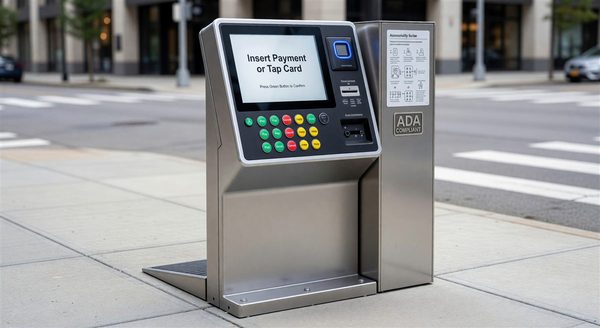
A multi-space pay station serves multiple spaces from a single location. The customer parks in any space within the station’s coverage zone, walks to the station, and pays by entering their space number (pay-by-space) or license plate (pay-by-plate) for the desired duration.
Strengths of Multi-Space Stations
Lower hardware maintenance cost per space: One station serving 25 spaces has one printer, one bill acceptor, one card reader, and one display to maintain. The per-space maintenance burden is significantly lower than single-space equivalents.
Full payment capabilities: Multi-space stations support cash, credit/debit, contactless payment, mobile app integration, and receipt options in a single unit — capabilities that single-space meters can’t practically support in a single housing.
Pay-by-plate compatibility: Multi-space stations configured for pay-by-plate integrate naturally with LPR enforcement systems — enabling more efficient patrol-based enforcement.
Rich transaction data: Every transaction is logged in the PARCS platform with full detail — time, amount, payment method, plate or space number — enabling sophisticated reporting and revenue analysis.
Remote management: Rate changes, software updates, and configuration changes can be pushed to all stations simultaneously from a management interface rather than requiring physical access to each meter.
Limitations of Multi-Space Stations
Higher single-unit failure impact: One station failure affects 20–50 spaces rather than one. Backup procedures (temporarily moving to paper receipts, designating nearest alternate station) must be established and communicated to customers.
Customer walking distance: In large lots, customers may walk 50–100 feet to the nearest pay station. Weather, physical limitations, and customer willingness to walk all affect customer experience.
Space numbering maintenance (pay-by-space): Space number markers must be maintained, visible, and matched to the station’s coverage zone. Worn, damaged, or incorrectly assigned space numbers create enforcement disputes.
Higher unit cost: A multi-space station costs $8,000–$22,000 vs. $500–$1,500 for a smart single-space meter. The per-space economics improve with coverage density, but the capital commitment is larger per unit.
Coverage Ratio Economics
The economic comparison depends heavily on the coverage ratio — spaces per station:
| Coverage | Multi-Space Station Cost | Equivalent Single-Space Cost (dual meter) | Equipment Cost Comparison |
|---|---|---|---|
| 10 spaces | $12,000 | $5,000 | Single-space cheaper |
| 25 spaces | $12,000 | $12,500 | Comparable |
| 50 spaces | $12,000 (2 stations) | $25,000 | Multi-space cheaper |
The crossover point varies by station cost and meter cost, but typically falls around 20–30 spaces per station. Above this coverage density, multi-space economics generally favor the multi-space investment when maintenance cost differences are included.
Including maintenance:
- Annual maintenance per single-space meter: $100–$300
- Annual maintenance per multi-space station: $500–$1,500
- For 50 spaces: single-space maintenance = $5,000–$15,000/year; multi-space (2 stations) = $1,000–$3,000/year
The maintenance cost advantage of multi-space grows significantly with scale.
Hybrid Deployments
Some operators use single-space meters in low-density areas (one or two isolated parking spaces) and multi-space stations in high-density areas (parking lots and dense on-street areas). This hybrid approach provides:
- Single-space simplicity where the full capabilities of a multi-space station would be underutilized
- Multi-space economics and capabilities where density supports the investment
Frequently Asked Questions
Are municipalities replacing all single-space meters with multi-space stations? Not universally. Many cities have found that the enforcement simplicity of single-space meters has value, particularly in areas without LPR enforcement capability. The replacement trend is real but not uniform — cities are making asset-by-asset decisions based on local factors.
Can a single-space meter accept credit card payments? Yes — modern solar-powered smart meters accept credit card and contactless payments. The interface is more limited than a full multi-space station, but card acceptance is available. These units cost $500–$1,200 installed.
How do we enforce pay-by-space multi-space meter compliance without LPR? Enforcement officers walk or drive the lot with a handheld device that queries the PARCS database for each space number. The officer enters the space number, the device shows whether the space is paid and for how long. More labor-intensive than LPR patrol but functional without the LPR investment.
What is the expected service life of a multi-space pay station? Well-maintained commercial pay stations have useful lives of 10–15 years. Electronic components (payment modules, display units) may require replacement before the mechanical housing needs replacement. Budget for component refresh at years 7–10.
Key Takeaway
Multi-space pay stations provide better economics at scale and more sophisticated capabilities; single-space meters offer simpler enforcement and lower per-unit failure impact. The right answer is site-specific — evaluate both options against your coverage density, enforcement approach, payment capability requirements, and maintenance capacity before committing to either model.