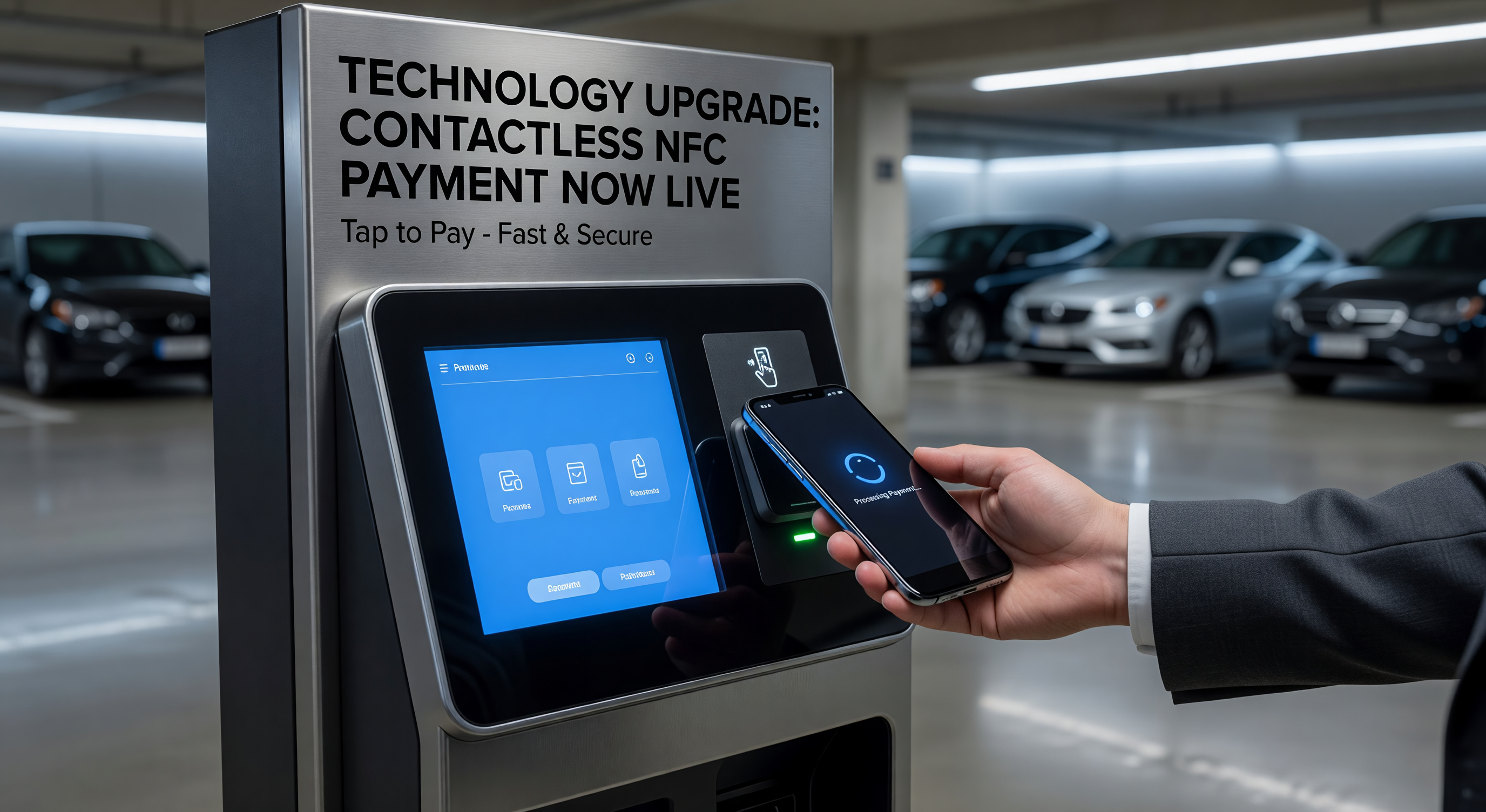
Contactless payment adoption has accelerated significantly since 2020, and parking facilities that haven’t updated their payment hardware are increasingly visible outliers to a customer base that expects tap-to-pay to work everywhere. The good news is that contactless payment upgrades are available for many existing pay station platforms — often at lower cost than full unit replacement.
This guide covers the technology behind contactless parking payments, the retrofit vs. replacement decision, certification requirements, and the operational considerations that determine whether an upgrade project will succeed.
How Contactless Payment Works in Parking
NFC Technology
Near Field Communication (NFC) is a short-range wireless communication standard that allows devices to exchange data within approximately 4 centimeters. In payment applications, the customer’s payment card or smartphone contains an NFC-enabled payment credential. The payment terminal’s NFC reader detects the credential and initiates the payment transaction without physical card insertion.
NFC payment transactions use the same cryptographic security as chip (EMV) card transactions — they generate a one-time cryptogram for each transaction that cannot be reused for fraud. The “contactless” refers to the absence of physical insertion, not a reduction in security.
What Contactless Accepts
A properly configured contactless payment reader can accept:
- NFC-enabled credit and debit cards (Visa Tap, Mastercard Contactless, American Express Expresspay)
- Apple Pay (iPhone and Apple Watch)
- Google Pay (Android devices)
- Samsung Pay and other device wallet platforms
- Some transit cards and prepaid cards with NFC capability
The customer experience is consistent: hold the card or phone near the reader, wait for the confirmation signal (light, sound, or screen indication), and the transaction is complete.
Retrofit vs. Full Unit Replacement
The Case for Retrofitting
Retrofitting an existing pay station with contactless payment capability makes sense when:
- The existing unit’s other hardware is in good condition
- The unit’s software platform supports contactless payment module integration
- The retrofit cost is significantly below full unit replacement cost
- The unit’s remaining useful life justifies the investment
Typical retrofit costs run $300–$1,200 per unit for the contactless reader hardware, plus software configuration. Compare this against $8,000–$22,000 for full pay station replacement. For units in good overall condition, retrofit is clearly preferable.
When Replacement Makes More Sense
- The existing payment terminal is a first-generation EMV reader without contactless capability — many terminals from 2012–2016 lack NFC hardware entirely and require complete payment module replacement
- The PARCS software platform doesn’t support contactless integration and would require expensive customization
- Multiple upgrades are needed simultaneously (contactless + coin removal + connectivity upgrade), making replacement more cost-effective than successive retrofits
- The unit has other significant maintenance issues that reduce its remaining useful life
EMV Contactless Certification Requirements
Contactless payment isn’t simply an NFC antenna — it’s a certified payment configuration that includes specific hardware, software, and the resulting certification from the card networks.
What Certification Involves
EMV contactless certification involves three levels:
- Level 1: Hardware interface (physical and electrical interface between the reader and the card/device)
- Level 2: Software transaction kernel (the software implementation of the EMV specification)
- Level 3: Payment network certification (each card network — Visa, Mastercard, Amex — certifies the specific terminal+software combination)
Completing this certification for a new payment module or retrofit takes 6–18 months and costs $50,000–$200,000+ — which is why only specialized payment terminal manufacturers, not parking equipment manufacturers, typically go through this process. Parking equipment manufacturers use pre-certified payment modules from specialized terminal vendors.
Practical implication: When evaluating contactless upgrades for your pay stations, confirm that the payment module is already certified for the card networks you need. Uncertified or pending-certification modules create significant timeline risk.
PCI Compliance Considerations
Contactless payment does not reduce PCI DSS scope — it changes it. The contactless reader must be a P2PE (Point-to-Point Encryption) certified device or be within a properly scoped PCI environment. Work with your payment processor and PCI QSA to verify that the upgraded configuration maintains your compliance status.
Retrofit Project Planning
Step 1: Inventory Audit
Before beginning any retrofit project, create a complete inventory of pay station makes, models, and current payment hardware. The retrofit path differs significantly by unit:
- What payment module is currently installed?
- What software version is the unit running?
- Does the manufacturer offer a certified contactless retrofit for this model?
- What is the manufacturer’s support status for this model?
Units from manufacturers who no longer offer retrofit support for older models may have no economical contactless upgrade path.
Step 2: Vendor Engagement
Contact each pay station manufacturer for units in your fleet and request:
- A list of certified contactless upgrade kits for your specific model
- Compatibility requirements (software version minimums)
- Installation requirements (can your staff perform the upgrade, or is factory technician required?)
- Estimated cost per unit
- Current certification status for the upgrade kit
Step 3: Pilot Installation
Before committing to a full fleet upgrade, install and test the contactless upgrade on 2–3 units. Verify:
- Transaction processing with physical contactless cards
- Apple Pay and Google Pay transactions
- Transaction speed (end-to-end time should be comparable to chip card insertion)
- Receipt generation (the receipt process doesn’t change for contactless transactions)
- Back-office reporting (contactless transactions should report identically to chip transactions in your PARCS platform)
Run the pilot for 30 days before proceeding with fleet deployment.
Step 4: Fleet Deployment
Deploy the upgrade in phases:
- Highest-traffic locations first (fastest return, most customer impact)
- Train staff on the new interface and on assisting customers unfamiliar with contactless payment
- Update signage at each unit to indicate contactless payment acceptance (the universal contactless payment symbol)
- Monitor transaction success rates and report any failures to the vendor within the first week
Operational Benefits of Contactless Parking Payment
Transaction speed: Contactless transactions are faster than chip insertion — typically 2–3 seconds for tap vs. 8–12 seconds for chip insertion. In high-volume facilities, this reduces queue time at pay stations and exit lanes.
Reduced card reader maintenance: Chip card readers have moving parts and insertion slots that accumulate wear and debris. Contactless readers have no insertion mechanism — reducing card reader maintenance.
Customer satisfaction: Particularly for premium facilities (airports, hotels, urban garages), contactless payment is an expected feature. Absence of contactless creates visible friction compared to retail environments where tap-to-pay is universal.
Reduced cash dependency: Customers who carry primarily digital payment methods and lack cash may use card or phone for parking when contactless is available, even if they would have left the facility without a contactless option.
Frequently Asked Questions
Will contactless payment work for my monthly permit holders? Contactless payment for parking transactions is a one-time payment mechanism — it doesn’t inherently change how monthly permit access works (which is typically handled through RFID, LPR, or app-based credentials rather than payment card tap). Contactless payment is primarily relevant for transient (pay-per-use) parking transactions.
Can mobile wallets replace physical payment cards at parking pay stations? Functionally, yes — Apple Pay, Google Pay, and Samsung Pay process identically to contactless credit cards at a properly configured terminal. Some customers prefer the convenience of not carrying their physical card; others prefer having the card as backup. Both work at a properly configured contactless reader.
How do we communicate the contactless upgrade to our customers? Update website and app information about accepted payment methods. Add contactless payment decals or stickers to the upgraded units (card network logos and the universal contactless symbol). If you send communications to permit holders or frequent parkers, include a mention of the new payment capability.
What is the transaction fee difference between contactless and chip transactions? Transaction processing fees for contactless and chip EMV transactions are generally the same — both are fully authenticated card-present transactions. The fee structure is determined by your merchant services agreement and is based on the transaction type (debit vs. credit, card brand), not the contactless vs. chip distinction.
Key Takeaway
Contactless payment upgrade projects succeed when they start with a thorough inventory audit and manufacturer engagement before any commitment to hardware. The certification status of the upgrade kit — not the NFC antenna itself — is the critical variable. A retrofit installed with a non-certified or pending-certification module may not process all card types reliably, creating exactly the customer friction the upgrade was intended to eliminate.