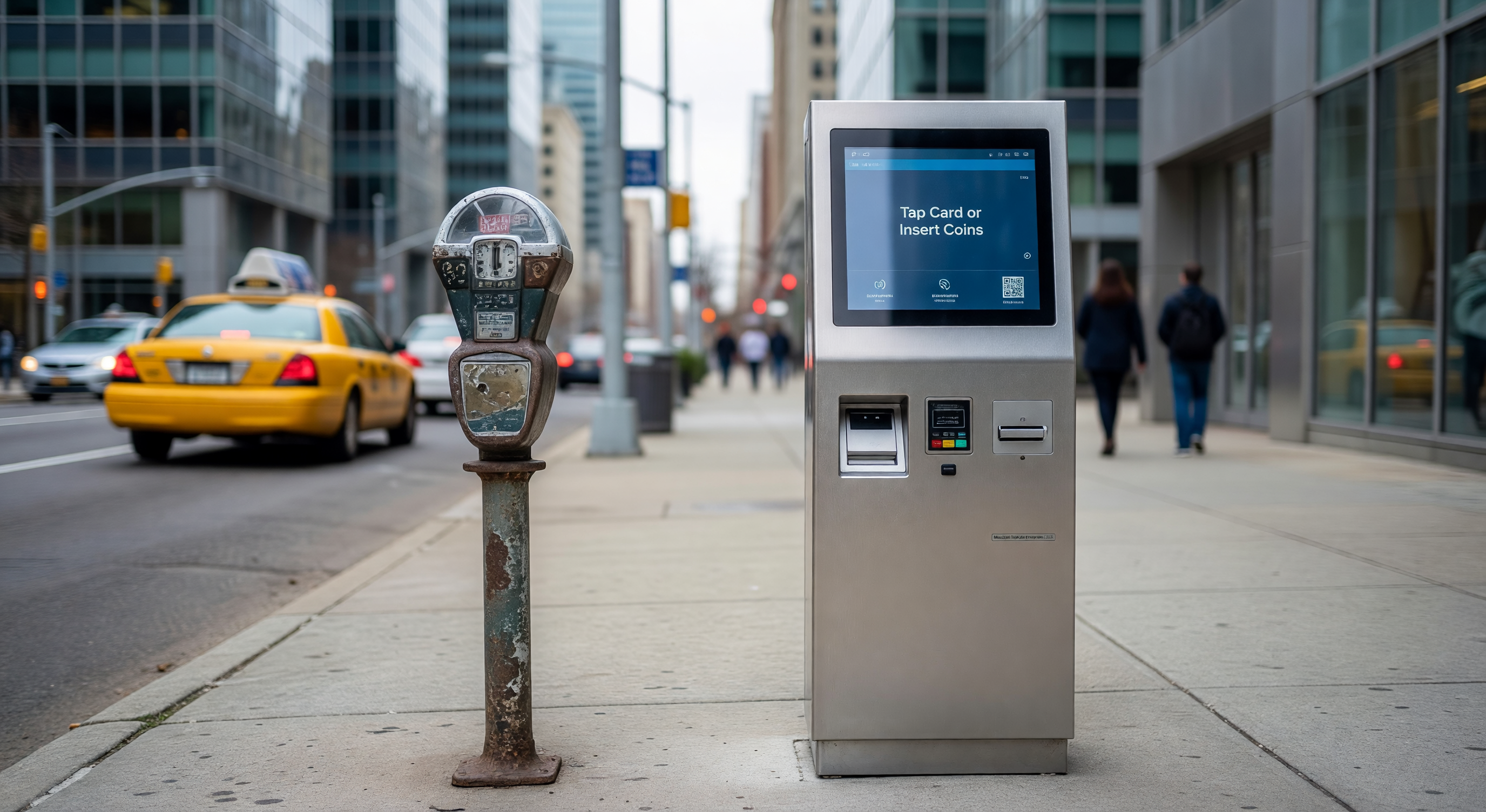
The repair-vs-replace decision for parking meters and pay stations is one of the most consequential lifecycle management calls a facility manager makes. Repair the wrong unit and you spend recurring maintenance costs on equipment that will fail again in six months. Replace equipment that could serve another five years and you’ve committed capital unnecessarily.
This guide provides a structured framework for making this decision, with the specific factors that shift the balance toward repair or replacement in different scenarios.
The Fundamental Decision Variables
Five variables determine whether repair or replacement makes economic sense:
- Equipment age relative to useful life
- Cumulative repair cost over the past 12–24 months
- Parts availability for the specific unit
- Technology obsolescence status
- Functional gap between current and replacement equipment
Each variable can be assessed independently, but the final decision requires weighing them together against your specific operational requirements and budget situation.
Equipment Age and Useful Life
Most commercial parking meters and pay stations have rated useful lives of 10–15 years for basic mechanical models and 7–12 years for electronics-heavy units. These ratings assume regular preventive maintenance; deferred maintenance significantly shortens functional life.
Age thresholds as decision guides:
Under 5 years: Repair unless there is a fundamental design defect or the repair cost approaches replacement cost. Equipment in this age range should be well within its useful life.
5–8 years: Evaluate repair cost against a 36-month projected maintenance forecast. If projected maintenance over the next 3 years exceeds 50% of replacement cost, begin planning replacement.
8–12 years: Default toward replacement unless repair cost is very low (under 20% of replacement cost) and the unit will meet functional requirements for the next 3–5 years.
Over 12 years: Replace unless the unit is in excellent condition with full parts availability and has no functional gap relative to current requirements. The exception is simple single-space meters with basic mechanical components that have demonstrated extreme longevity.
The 50% Rule
A common industry guideline: if the cost of a single repair exceeds 50% of the unit’s current replacement cost, replace rather than repair. This threshold acknowledges that units requiring expensive single repairs are likely to continue requiring repairs.
Example calculation:
- Pay station replacement cost: $9,000
- 50% threshold: $4,500
- Proposed bill acceptor assembly replacement cost: $3,200 (parts + labor)
- Decision based on 50% rule: repair is within the threshold
Adjustment factors:
- If the unit has needed two repairs in the past 12 months, apply the rule to the cumulative 12-month repair cost, not just the current repair
- If parts availability is declining (indicated by backordered parts or discontinuation notices), apply the rule more aggressively
Parts Availability: The Hidden Decision Maker
Equipment that no longer has available parts has a finite and unpredictable service life. The next failure may be unrepairable.
How to assess parts availability:
Contact the manufacturer’s parts department directly (not through a dealer) and ask: “Is this model still in active production? Are all parts available for [specific serial number/year of manufacture]?”
Ask specifically about high-failure components: payment card readers, bill acceptor assemblies, main processing boards, display modules. These are the components most likely to fail and most likely to be discontinued first.
If parts are available, ask about inventory levels — “backorder” on a critical component means weeks of downtime per future failure.
If parts availability is declining or unavailable:
- Plan for replacement in the next budget cycle
- Order a supply of critical parts for existing inventory if cost-effective
- Don’t invest in major repairs for units where parts won’t be available for the next failure
Technology Obsolescence Assessment
A pay station that is mechanically sound but no longer meets operational requirements presents a different decision than a mechanically failing but functionally current unit.
Technology gaps that justify replacement even in functioning equipment:
Payment standards: Equipment that cannot process EMV (chip card) transactions, contactless payments (NFC/tap-to-pay), or mobile payment creates compliance risk (PCI liability shifts for non-EMV equipment) and customer friction. If upgrading payment hardware to current standards would cost more than 60% of replacement cost, replacement makes more sense.
Software platform end-of-life: If the PARCS software platform running on the equipment is no longer supported or cannot be updated to current versions, the equipment becomes a security liability and operational island. Platform end-of-life triggers replacement evaluation regardless of hardware condition.
Connectivity: Equipment without cellular or Ethernet connectivity cannot participate in real-time monitoring, remote rate updates, or integrated payment systems. Connectivity retrofits are sometimes possible; when not possible, the equipment is functionally limited regardless of its mechanical condition.
Accessibility compliance: ADA requirements for reach ranges and audio output have evolved. Equipment that doesn’t meet current ADA standards creates legal exposure. Retrofits are sometimes possible for specific elements.
Cumulative Maintenance Cost Analysis
Track maintenance costs by individual unit, not just by fleet. A unit that has required three repairs in 18 months represents a different risk profile than a unit that has been repair-free for five years.
How to calculate cumulative maintenance cost:
- Pull maintenance records for each unit for the past 24 months
- Total parts cost and labor cost for each unit
- Annualize: (24-month cost) / 2 = annual maintenance cost
- Calculate maintenance cost as a percentage of replacement cost
- Units with annual maintenance costs exceeding 15–20% of replacement cost are candidates for replacement planning
For units without individual maintenance records (a common situation in facilities that have tracked maintenance only at the fleet level), institute unit-level tracking immediately. You can’t make informed lifecycle decisions without this data.
The Functional Gap Analysis
Even economically repairable equipment may be worth replacing if replacement equipment provides significant operational improvement.
Questions to evaluate the functional gap:
- Would a replacement unit generate additional revenue (through improved uptime, additional payment methods, faster transaction speed)?
- Would a replacement unit reduce operating costs (through lower maintenance requirements, remote management, or better connectivity)?
- Would a replacement unit improve customer experience (through faster transactions, better receipt options, or improved reliability)?
- Would a replacement unit reduce compliance risk?
If the answers to these questions represent significant financial or operational improvement, the replacement may be justified even when repair economics alone would support continued service.
Repair-vs-Replace Decision Matrix
| Scenario | Recommendation |
|---|---|
| Unit under 5 years, low repair cost | Repair |
| Unit under 5 years, repair exceeds 50% of replacement | Evaluate — likely repair but investigate reliability |
| Unit 5–10 years, repair under 30% of replacement, parts available | Repair |
| Unit 5–10 years, repair exceeds 50% of replacement | Replace |
| Unit over 10 years, any significant repair needed | Replace (unless parts abundant and no technology gap) |
| Any unit with declining parts availability | Plan replacement within 12–18 months |
| Any unit failing EMV or current payment standards | Replace |
| Any unit with software platform end-of-life | Replace |
Frequently Asked Questions
Can we get a trade-in value for old equipment when replacing? Some manufacturers and remarketing companies offer trade-in credit for functioning older equipment that they can refurbish and resell. Trade-in value is typically 5–15% of new equipment price for units under 10 years in operating condition. Equipment over 10 years or with significant damage typically has no trade-in value.
How do we budget for equipment replacement if we don’t know when units will fail? Build a replacement reserve based on fleet age and expected useful life. Divide the fleet into age cohorts and project replacement needs by year. A 50-unit fleet with an average age of 7 years and a 12-year useful life projects roughly 4–6 replacements per year over the next 5 years.
Is it worth repairing equipment in the final year before a planned system replacement? Generally no. Spending significant money on units you plan to replace within 12 months is poor capital allocation. For units in the final 12–18 months before planned replacement, minimize repair investment — accept reduced functionality or temporarily take units out of service rather than investing in repairs.
How do we know if a repair is addressing the root cause or just the symptom? Ask the service technician: “What caused this failure, and could the same cause produce another failure in another component?” A thoughtful technician can often identify whether a repair addresses the failure root cause or just replaces the most recently failed component in a deteriorating system.
Key Takeaway
The repair-vs-replace decision becomes straightforward when you have good unit-level maintenance cost data, clear visibility into parts availability, and an honest assessment of technology gaps. Facilities that track these variables make better capital allocation decisions than those that evaluate each repair in isolation. Build the data infrastructure first; the decisions follow.