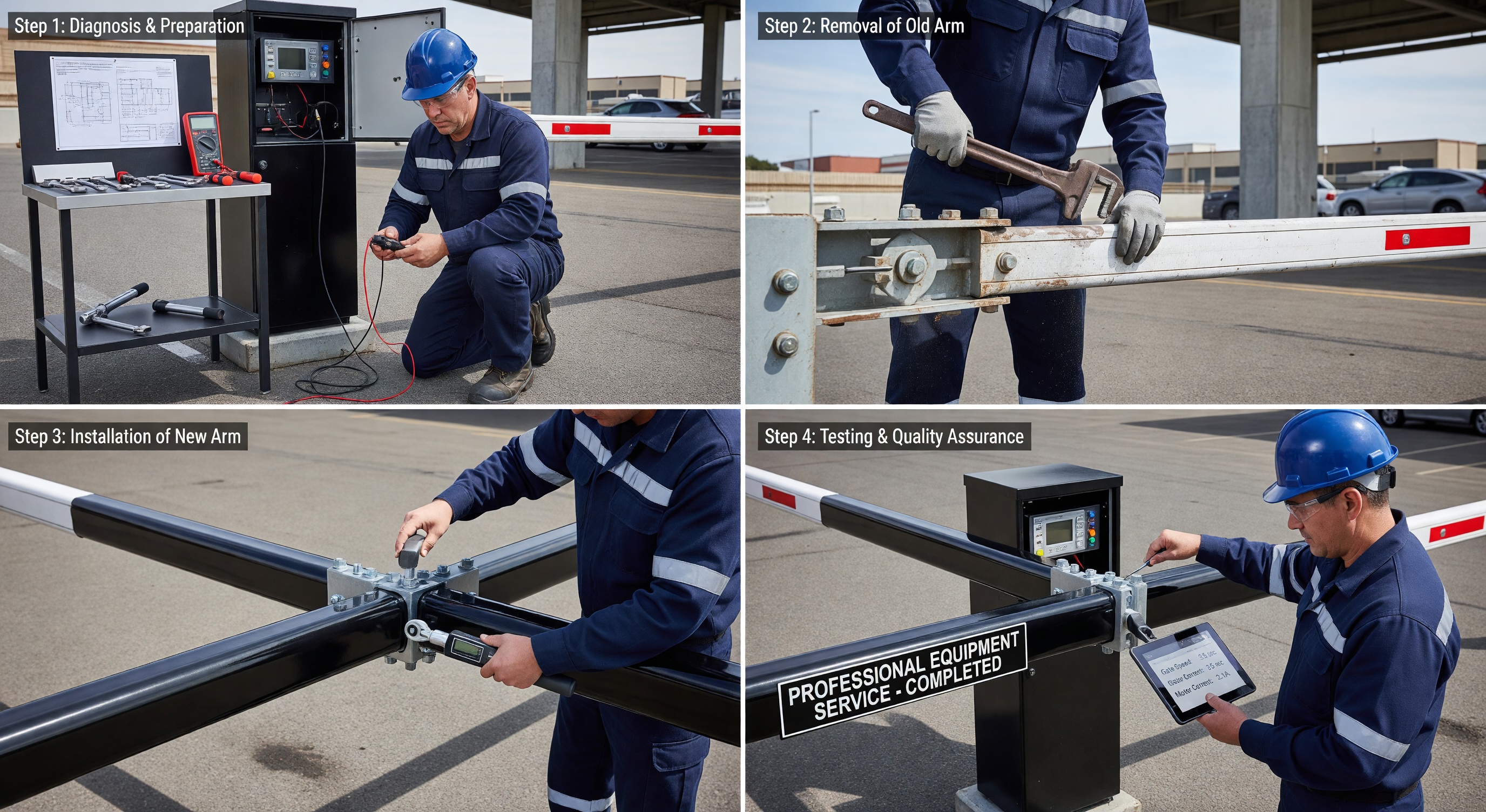
Gate arm replacement is among the most frequent maintenance tasks in parking operations. A standard barrier gate in a busy parking facility cycles thousands of times per week — arms wear at pivot points, degrade from UV exposure, crack from low-temperature brittleness, and break from vehicle collisions. Keeping the right replacement arms in stock and knowing how to replace them efficiently reduces lane downtime from hours to minutes.
This guide covers gate arm material types, length selection, the installation procedure, and sourcing options for common barrier gate brands.
Gate Arm Materials
Aluminum Arms
Aluminum gate arms are the standard for commercial parking applications. They offer:
- Light weight: Reduced motor load and faster cycle times compared to heavier arms
- Corrosion resistance: Appropriate for coastal, high-humidity, and salted-pavement environments
- Flexibility: Aluminum arms deflect slightly on impact before breaking — reducing the impact force transmitted to the motor and gearbox
- Ease of replacement: Common lengths are widely stocked; custom lengths are easily manufactured
Standard diameter for commercial aluminum arms is 1.5 to 3 inches (38 to 76mm), depending on the arm length and gate manufacturer specifications.
Plastic/PVC Arms
Lightweight PVC or HDPE arms are used in lower-traffic applications and for aesthetic applications where painted arms are preferred. They break cleanly on vehicle impact (acting as a breakaway designed to protect the vehicle more than the equipment) but typically cost less to replace than aluminum.
PVC and plastic arms degrade from UV exposure over time — plan for replacement every 2–4 years in sunny climates regardless of collision damage.
Foam-Filled Arms
Foam-filled gate arms have a rigid exterior shell (typically aluminum or plastic) with a foam core. The foam fill reduces vibration and noise during gate operation and provides more uniform flexibility across the arm length. These are common in high-cycle applications where gate arm noise is a concern.
Wooden Arms
Decorative wooden arms are used in residential communities and facilities where aesthetics match the property design. They require periodic sealing/finishing to prevent moisture damage and have shorter service lives in wet climates. Not appropriate for high-cycle commercial applications.
Arm Length Selection
Gate arm length must match the lane width being controlled. An undersized arm leaves a gap that vehicles can pass through; an oversized arm cannot fully close to a horizontal position or encroaches on the adjacent lane.
Standard arm lengths:
Most manufacturers offer arms in incremental lengths from 8 to 20 feet. Common configurations:
- 8–10 feet: Single-lane entries/exits in tight parking structures
- 12–14 feet: Standard 12-foot commercial lane width with clearance margin
- 16–18 feet: Wide lanes or two-traffic-lane control gates
- 20+ feet: Special applications; require counterweight systems or articulated arm designs
Measuring for replacement: Measure from the center of the gate arm mount (the pivot point on the barrier gate cabinet) to the closed position endpoint. Standard measurement is to the near edge of the travel lane or to the curb/bollard on the far side, with 6–12 inches of clearance.
For replacement arms, confirm the measurement matches the existing arm length. A gate that operated with a 12-foot arm requires a 12-foot replacement — don’t assume the length is standard without measuring.
Articulated Arms
Long spans (over 14 feet) often use articulated or folding gate arms with a fold point near the middle. The arm raises in a folded position rather than as a single rigid span, reducing the height clearance required above the gate and allowing longer controlled distances with standard gate motors.
Articulated arm replacement is more complex: the pivot joint hardware, the control cable or spring that triggers the fold, and the coordination of both arm sections must be addressed. Follow the manufacturer’s specific procedure for articulated arm replacement — general gate arm replacement guidance doesn’t fully apply.
Replacement Procedure
Preparation
Before starting arm replacement:
- Set the gate to the open position or disable the gate motor at the circuit breaker
- Lock the gate in the open position using the manual release or a physical prop — never work under a gate that could fall
- Verify the replacement arm length matches the existing arm
- Have the correct mounting hardware ready (arm clamp, pivot bolt, counterweight if used)
Removal
- Remove the gate arm mounting clamp or clamp bolts at the arm pivot point
- Slide or lift the arm from the mount
- Inspect the pivot point for wear — if the mount is worn, address it before installing the new arm
- For arms with counterweights, note the counterweight position and balance configuration before disassembly
Installation
- Slide the new arm onto the mount with the manufacturer’s specified engagement (typically 6–12 inches)
- Tighten the mounting clamp or bolts to the manufacturer’s specified torque
- For counterweighted arms, position the counterweight at the same location as the previous arm
- Restore motor power and test operation: open and close cycle three times
- Verify the arm reaches horizontal closed position accurately
- Test safety loop/sensor response: ensure the gate reopens when an object breaks the safety beam or presence loop while closing
Torque Specifications
Over-tightening the arm clamp can crush aluminum arms; under-tightening allows the arm to slip. Use a torque wrench to the manufacturer’s specification. Most manufacturers specify 15–25 ft-lbs for standard arm clamps; check the documentation for your specific gate model.
Sourcing Replacement Arms
OEM (Original Equipment Manufacturer) Parts
The most reliable source for compatible arm specifications is the gate manufacturer’s parts program. OEM arms are confirmed to match the mounting system, length increments, and material specifications.
OEM arm availability varies by manufacturer age and product line. Manufacturers who committed to 7–10 year parts availability honor this through their dealer/distributor network. For discontinued models, OEM availability may be limited.
Aftermarket Arms
Third-party arm manufacturers produce compatible arms for many common gate models. Quality varies: some aftermarket suppliers produce to manufacturer specifications; others use lower-grade materials that result in shorter service life.
For aftermarket sourcing:
- Confirm compatibility with your specific gate model and mount type
- Request material specifications (alloy grade for aluminum, wall thickness)
- Request reference customers who use the same arms on the same gate models
On-Site Fabrication (Custom Lengths)
Custom-length arms are available from local fabricators for non-standard spans. An aluminum extrusion shop can cut and fabricate custom lengths with the specified end caps and mounting collars. This is appropriate for legacy equipment with uncommon arm lengths where stock replacements aren’t available.
Frequently Asked Questions
How often should gate arms be replaced proactively (not due to collision)? Arms without collision damage typically require replacement every 5–10 years due to UV degradation, fatigue at the mount point, and cosmetic wear. Inspect arms annually for cracks, especially near the mount collar where stress concentrates.
What should I do immediately after a vehicle strikes the gate arm? Raise the gate to the open position and inspect: the arm for fractures or bends, the pivot mount for deformation, the motor coupling for slippage, and the safety sensors for misalignment. Replace visibly damaged arms before resuming normal gate operation. Continuing to operate a bent or cracked arm transmits uneven loads to the motor.
Can I repair a bent aluminum arm rather than replacing it? No. Bent aluminum arms have internal stress fractures that are not visible on the surface but significantly reduce the arm’s structural integrity. A repaired or straightened arm will fail, typically in a subsequent low-force impact. Replace damaged arms rather than attempting repair.
How do I keep replacement arms in stock without excessive inventory cost? For common gate models, keep two standard-length arms on-site. Arms in use break most often from vehicle collisions, which are unpredictable in timing. Two arms cover the typical incident interval for most facilities without excessive inventory commitment.
Key Takeaway
Gate arm replacement is a routine maintenance task that becomes disruptive only when facilities aren’t prepared. Knowing your gate model, having the correct replacement arm in stock, and following a standard replacement procedure reduces lane downtime to 15–30 minutes rather than hours of waiting for a service call. Treat gate arms as a managed consumable, not an unpredictable capital expense.