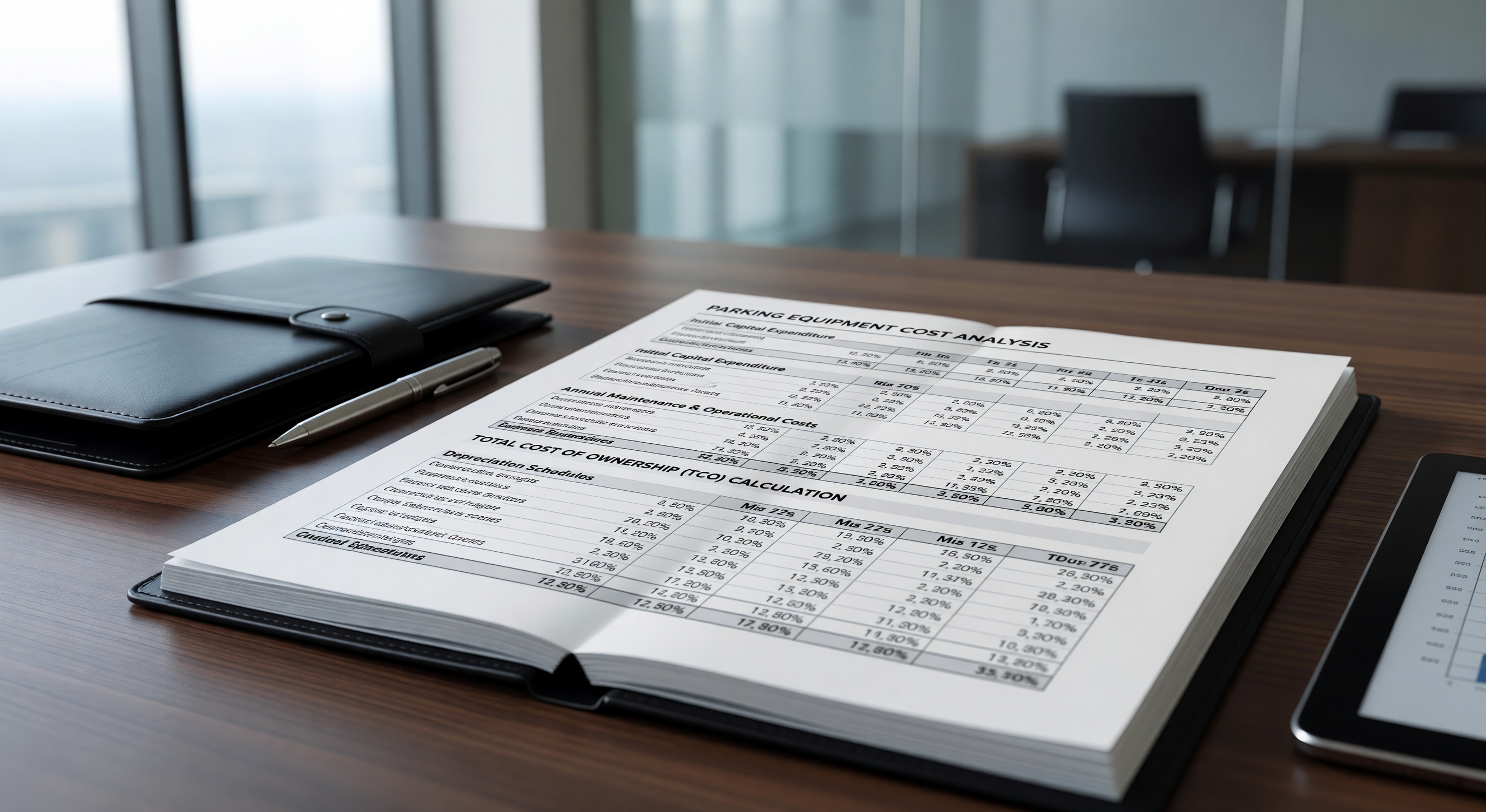
The purchase price of a barrier gate or pay station is rarely more than half of what you’ll spend on that equipment over its operational life. Procurement teams that evaluate parking equipment on upfront cost alone routinely end up with the most expensive systems — just spread across a budget timeline where the overruns are harder to trace back to the original sourcing decision.
This guide builds a structured framework for calculating true 10-year total cost of ownership (TCO) for parking equipment. It covers all six cost categories, shows worked examples for common equipment types, and gives you the vendor questions that surface TCO risks early.
Why Purchase Price Understates True Cost
For most capital equipment in industrial or commercial settings, purchase price represents 60–80% of 10-year TCO. For parking equipment, the ratio is worse — purchase price typically accounts for 40–60% of true 10-year cost, sometimes less for equipment categories with high software dependency or complex mechanical components.
The gap comes from several parking-specific factors:
High transaction volume causes accelerated wear. A pay station in a busy urban garage may process 200–400 transactions per day. Bill acceptors, card readers, receipt printers, and coin mechanisms all wear at rates that shock facility managers who calculate maintenance based on equipment age rather than transaction count.
Outdoor exposure is relentless. Barrier gates, pay stations, and access control equipment operate in sun, rain, ice, and road salt spray. Components that would last 10 years in a climate-controlled environment fail in 4–6 years outdoors.
Software licensing is increasingly unavoidable. Cloud-connected parking management systems — pay stations, access control, LPR, occupancy — increasingly require ongoing software subscriptions that can add $50–$200+ per device per year in perpetuity.
Parts pricing is vendor-controlled. Unlike commodity equipment where replacement parts are available from multiple suppliers, parking equipment manufacturers often control the parts supply chain. A bill acceptor stacker module that costs $45 from an independent supplier may be $140+ from the OEM.
The Six TCO Cost Categories
1. Acquisition Cost
The purchase price of the equipment itself, including any bundled software licenses, initial configuration fees, and the cost of financing (if not purchased outright).
What to include:
- Hardware list price or contracted price
- Initial software licenses (one-time components)
- Factory configuration/programming fees
- Freight and delivery
- Cost of capital if financed (multiply financed purchases by your weighted average cost of capital over the term)
Common oversight: Forgetting to include the gateway or controller hardware that connects individual devices to the management network. A system of 10 pay stations may require 2–3 communication controllers or servers that add $5,000–$15,000 to acquisition cost not reflected in the per-unit price.
2. Installation Cost
The cost to get equipment from loading dock to fully operational. For parking equipment, this is frequently 20–40% of hardware cost.
What to include:
- Civil work (conduit, junction boxes, concrete pads for pay stations, pavement cutting for loops)
- Electrical connection (dedicated circuits, UPS if required)
- Network cabling or wireless infrastructure
- Equipment mounting and mechanical installation labor
- Initial configuration and system commissioning
- Staff training
Common oversight: Civil work is highly site-specific and often excluded from vendor quotes. A pay station requiring a new concrete island, 150 feet of conduit, and a dedicated 20A circuit will add $3,000–$8,000 in installation costs that don’t appear in the equipment RFP.
3. Software and Licensing Costs
This category has grown dramatically as parking equipment has become cloud-connected. What was once a one-time purchase is now an ongoing subscription.
What to include:
- Annual software subscription or SaaS fees
- Per-transaction processing fees (for payment processing integrations)
- Annual support/maintenance contracts covering software updates
- Upgrade fees for major platform versions
- Integration costs for connections to third-party systems (LPR, access control, accounting)
Benchmark ranges:
- Pay station management software: $400–$1,200/unit/year (cloud-hosted)
- Access control management platforms: $100–$400/reader/year
- LPR system subscriptions: $200–$600/lane/year
- Occupancy sensor analytics: $3–$12/space/month ($36–$144/space/year)
Over a 10-year window, software costs for a cloud-managed parking system frequently exceed hardware acquisition cost. This is the single most commonly underestimated TCO category.
4. Preventive Maintenance Cost
Scheduled maintenance performed to prevent failures — cleaning, lubrication, adjustments, consumable replacement, testing.
What to include:
- Labor hours for scheduled PM tasks (in-house labor or service contract)
- Consumables replaced on schedule (receipt paper, cleaning supplies, lubricants)
- Batteries (UPS batteries typically replaced every 3–5 years; wireless sensor batteries every 5–10 years)
- Filter replacements for climate-controlled enclosures
A structured preventive maintenance planning program typically costs $80–$200/unit/year in labor and consumables, but prevents far more expensive reactive repairs.
Service contract vs. in-house: Full-coverage service contracts from equipment manufacturers run $300–$800/unit/year for pay stations and $200–$500/unit/year for barrier gates. In-house PM programs with a trained technician cost less in direct spend but require staff investment. The break-even depends on your portfolio size — in-house becomes cost-effective when you have enough equipment to justify a full-time or part-time technician.
5. Reactive Repair and Parts Cost
Unscheduled repairs from equipment failures. This category is the most variable and the least predictable — which is exactly why it’s often excluded from budget models.
What to include:
- Emergency service labor (often billed at premium rates for after-hours calls)
- Repair parts and components
- Temporary rental equipment during extended repairs
- Revenue lost during downtime (for revenue-generating equipment like pay stations)
Industry benchmarks: For well-maintained mid-tier parking equipment, reactive repair costs typically run $150–$400/unit/year after the warranty period. For poorly maintained equipment, or equipment from manufacturers with limited parts availability, this number can reach $600–$1,500/unit/year as equipment ages into years 6–10.
Parts availability risk: Some manufacturers discontinue parts support 5–7 years after production ends. If your equipment reaches end-of-parts support before end of useful life, you face a forced replacement decision on the manufacturer’s schedule rather than yours. Always ask vendors for their stated parts support period before purchasing.
6. End-of-Life Disposal and Replacement Cost
The cost to remove, dispose of, and replace equipment at end of service life.
What to include:
- Removal labor
- Disposal costs (electronics recycling fees; some jurisdictions have requirements for certain components)
- Site restoration (concrete patching, conduit removal or repurposing)
- Replacement equipment acquisition (at future pricing — apply an inflation factor)
- Transition downtime costs
This category is almost universally ignored in initial TCO models. For a 10-unit pay station installation, end-of-life costs including removal, site restoration, and procurement/installation of replacement equipment can reach $30,000–$80,000 — effectively adding $3,000–$8,000 per unit to the original equipment’s true cost.
Building a 10-Year TCO Model
Spreadsheet Structure
A functional 10-year TCO model needs the following columns:
| Year | Acquisition | Installation | Software | PM Cost | Reactive Repairs | End-of-Life | Total |
|---|---|---|---|---|---|---|---|
| 0 (purchase) | Full amount | Full amount | Year 1 | — | — | — | |
| 1 | — | — | Annual fee | PM budget | Warranty covered | — | |
| 2–4 | — | — | Annual fee | PM budget | Low (warranty/new) | — | |
| 5–7 | — | — | Annual fee | PM budget | Moderate | — | |
| 8–10 | — | — | Annual fee | PM budget | High | EOL costs in yr 10 |
Assumptions to Make Explicit
Every TCO model involves assumptions. The most important ones to document:
- Inflation rate for parts and labor (2–4% annually is reasonable)
- Equipment lifespan (what age do you plan to replace — 8, 10, or 12 years?)
- Failure rate escalation (how much do reactive repairs increase per year after warranty? A reasonable model: +15–25%/year after year 4)
- Software fee escalation (SaaS fees typically increase 3–8% per year — use 5% as a baseline assumption)
- Discount rate if you want to calculate net present value rather than nominal costs
Worked Examples
Pay Station: 10-Year TCO
Equipment: Mid-tier multi-space pay station (single unit, 150 transactions/day average)
| Cost Category | Amount |
|---|---|
| Hardware acquisition | $8,500 |
| Installation (concrete pad, conduit, electrical) | $3,200 |
| Software (cloud management, $600/yr × 10 yrs) | $6,000 |
| Preventive maintenance ($150/yr × 10 yrs) | $1,500 |
| Reactive repairs (warranty yr 1–2, then escalating) | $4,200 |
| End-of-life removal and site work | $1,800 |
| 10-Year TCO | $25,200 |
Acquisition as % of TCO: 34%
Barrier Gate: 10-Year TCO
Equipment: Commercial-grade barrier gate with boom (single lane, high-use — 500+ cycles/day)
| Cost Category | Amount |
|---|---|
| Hardware acquisition | $4,500 |
| Installation (loop detectors, conduit, electrical) | $2,800 |
| Software (access control integration, $250/yr × 10 yrs) | $2,500 |
| Preventive maintenance ($120/yr × 10 yrs) | $1,200 |
| Reactive repairs (boom replacements, motor service) | $3,800 |
| End-of-life removal and replacement | $1,200 |
| 10-Year TCO | $16,000 |
Acquisition as % of TCO: 28%
Note: At 500 cycles/day, this gate completes roughly 1.8 million cycles over 10 years. High-cycle operations should use gates rated for 1 million+ cycles and budget accordingly for boom replacement (typically every 3–4 years at this volume, $300–$600/replacement).
The Cheap Equipment Trap
The most common TCO mistake in parking procurement: selecting lower-cost equipment with inferior specifications because the upfront saving looks compelling in a capital budget presentation.
A $6,000 pay station vs. a $9,000 pay station looks like a $3,000/unit saving. But if the lower-cost unit:
- Has a bill acceptor with a documented 18-month mean time between failure vs. 36 months on the premium unit
- Requires proprietary service calls at $350 each vs. a platform with broad service network at $180/call
- Runs on a software platform with $800/year SaaS fees vs. $500/year on the premium platform
…the “cheaper” unit costs more by year 5 and significantly more over 10 years.
Run the full TCO before making final sourcing decisions. The data frequently reverses the initial recommendation.
Vendor Questions That Reveal TCO
Ask these questions of every vendor during evaluation. Vendors who deflect or give vague answers are signaling a TCO problem:
Parts and serviceability:
- “What is your stated parts support period after a product is discontinued?”
- “What is the list price for [specific high-wear component] — bill acceptor stacker, barrier boom, receipt printer head?”
- “Are parts available from third-party suppliers, or only through you?”
Software:
- “What is the annual software/SaaS fee per unit, and what has the year-over-year fee increase been for the past 3 years?”
- “What happens to my data if I choose not to renew the software subscription?”
- “Is there a version of the system that doesn’t require a cloud subscription?”
Service network:
- “What is your average on-site response time for a service call in my area?”
- “What is your after-hours emergency service rate?”
- “Can you provide a reference from a facility that has owned your equipment for 8+ years?”
End of life:
- “What is the upgrade path when this product line is discontinued?”
- “Do you offer trade-in or buy-back on equipment being replaced?”
Connecting TCO to Budget Planning
A rigorous TCO model changes how you present parking equipment budgets to finance teams and leadership:
- Year 0 capital budget: Acquisition + installation only
- Annual operating budget: Software + PM cost (predictable, should be in annual O&M budget)
- Reserve fund: 15–20% of hardware replacement cost per year, held in reserve for reactive repairs and eventual replacement
Facilities that run this model avoid the reactive emergency: aging equipment failing in year 8, forcing an unbudgeted $400,000 replacement project because no reserves were accumulated.
For equipment-specific maintenance planning that feeds into the PM cost line of your TCO model, see our full buyers guide. When evaluating manufacturers, ask specifically about service contract options, parts availability commitments, and documented mean-time-to-repair data for your target equipment category.