Thermal cameras detect heat radiation rather than reflected light — which means they work in complete darkness, aren’t affected by glare, and can detect vehicle presence even through light fog or rain. These characteristics make them genuinely useful in parking applications where conventional cameras struggle, but they require careful application matching to deliver expected results.
This guide covers where thermal cameras provide real value in parking facilities, where they fall short, and what to specify when evaluating thermal equipment.
How Thermal Cameras Work in Parking Contexts
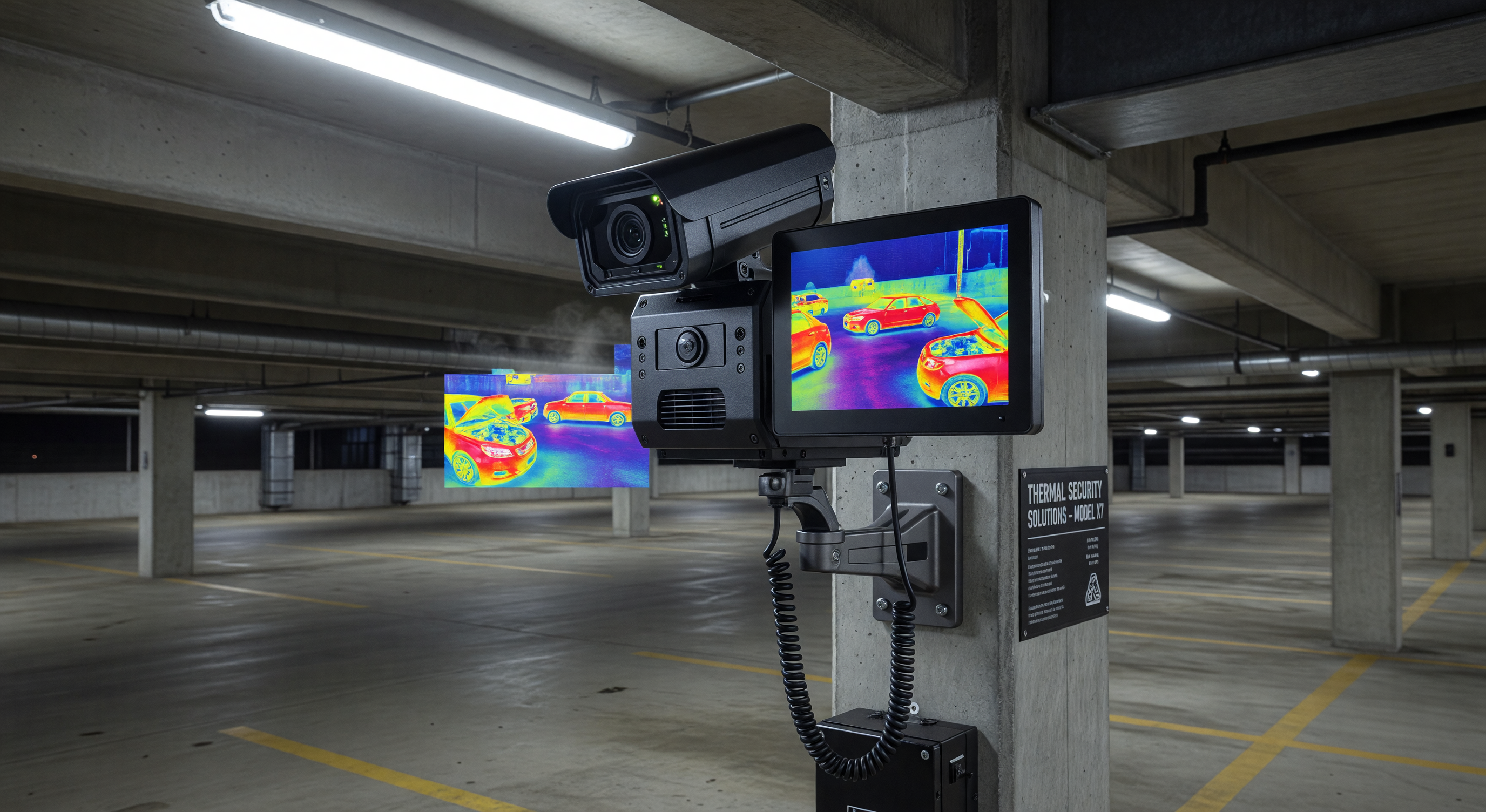
Thermal cameras (infrared cameras, or FLIR cameras after the dominant brand name) detect thermal radiation emitted by objects. All objects emit heat — vehicles, people, and pavement — at intensities that vary with temperature. The camera sensor converts these thermal emissions into a visual image where warmer objects appear brighter.
For parking applications, the primary thermal signature of interest is the heat gradient between a recently-driven vehicle and ambient temperature. A vehicle that has been parked for 30+ minutes in an ambient-temperature environment begins to equalize with surroundings — reducing the thermal contrast that makes detection reliable. This characteristic creates the key limitation for thermal cameras in parking: they detect recently arrived vehicles most reliably; extended cold-soak parking is harder to detect.
Application 1: After-Hours Intrusion Detection
Thermal cameras provide excellent perimeter monitoring for parking facilities after hours. The advantages over standard CCTV:
- Total darkness operation: Surface lots without lighting or structured garages with minimal overnight illumination are environments where visible-spectrum cameras struggle and thermal cameras excel
- Fog and light precipitation performance: Thermal imaging penetrates light fog better than visible cameras — valuable in climates with morning fog
- Heat signature alerting: People moving through a cold parking facility after hours produce clear thermal signatures that trigger detection alerts with low false-positive rates
- Vehicle entry detection: A warm vehicle entering a cold parking lot is immediately visible, even in conditions where standard cameras would produce a black or barely discernible image
For after-hours security monitoring, a small number of wide-angle thermal cameras positioned at perimeter entry points provide effective coverage at lower infrastructure cost than equivalent visible-spectrum coverage.
Specification Considerations for Security Applications
- Sensor resolution: Higher resolution (640x480 or 1024x768) improves detection range and detail; 320x240 is adequate for close-range detection (under 50 feet)
- Detection range: Manufacturer specifications for human detection range vary significantly by resolution and lens selection — verify against your site geometry
- Frame rate: 9 Hz is minimum; 30 Hz (where regulations permit) provides smoother video for incident review
- Analytics: Integrated video analytics for perimeter line-crossing and intrusion zone detection reduces false alarms from wildlife, windblown debris, and shadows
Application 2: Occupancy Counting in Low-Light Environments
Surface lots without adequate overnight lighting present a challenging environment for standard camera-based occupancy counting systems. Thermal cameras offer an alternative — the heat signatures of occupied spaces are detectable regardless of lighting conditions.
Accuracy limitations to understand:
Thermal occupancy counting accuracy depends on the temperature differential between the vehicle and the space. Considerations:
- In hot summer conditions, pavement temperature may approach vehicle temperature — reducing contrast and detection reliability
- In very cold conditions, vehicles that have been parked for several hours cool toward ambient temperature — detection reliability decreases for long-term parkers
- Rain significantly reduces surface temperature differentials due to evaporative cooling
For overnight lot occupancy counts in temperate climates, thermal cameras provide acceptable accuracy (85–90% in typical conditions). For real-time occupancy systems where counting accuracy directly affects wayfinding displays, ultrasonic or in-ground sensors typically provide higher accuracy.
Application 3: Vehicle Detection at Entry/Exit
Thermal cameras at entry/exit lanes detect vehicle presence for gate trigger applications. In environments where loop detectors are unreliable (locations with significant magnetic interference, facilities where pavement cutting is impractical), thermal cameras provide an alternative detection mechanism.
Performance characteristics:
- High reliability in complete darkness — functions where standard cameras or vision-based systems fail
- Not affected by small animals or windblown debris in the same way that radar or ultrasonic sensors can be
- Pavement heat from direct sunlight can create false detections in some configurations — mounting angle and detection zone calibration reduce this
For lane presence detection, thermal cameras are typically used as a supplement to or replacement for loop detectors rather than as a replacement for LPR cameras — they detect vehicle presence without capturing plate information.
Thermal vs. Standard Camera: Selection Guide
| Consideration | Thermal Camera | Standard IP Camera |
|---|---|---|
| Complete darkness operation | Excellent | Poor (without illumination) |
| License plate reading | Not capable | Capable (with LPR configuration) |
| Person identification | Poor | Good to excellent |
| Vehicle identification (make/model) | Poor | Good |
| Fog/light rain performance | Good | Poor to fair |
| Per-unit cost | $800–$5,000 | $150–$1,500 |
| Integration with VMS | Generally supported | Universal |
The cost premium for thermal cameras is significant. Justify thermal selection on specific performance requirements — after-hours intrusion detection, complete darkness operation, or high-fog environments — rather than as a general-purpose upgrade.
Regulatory Considerations
Thermal cameras that detect body temperature (as distinct from motion/presence detection) fall under different regulatory frameworks in some jurisdictions. This emerged as a concern during COVID-era fever screening discussions. For standard parking occupancy and security applications, body temperature detection is not the use case — but verify with legal counsel that your application description is accurate in any jurisdiction with thermal camera regulations.
Export controls: thermal camera sensors are subject to export licensing requirements under US regulations (EAR and ITAR in some categories). This affects procurement from certain international suppliers — verify compliance before purchasing imported units.
Integration with Parking Management Systems
Thermal cameras in parking applications integrate with:
VMS (Video Management Software): Standard ONVIF-compatible thermal cameras integrate with most VMS platforms via the same protocols as visible-spectrum cameras. Video streams are handled identically; analytics may require platform-specific plugins.
Access control: Vehicle presence detection from thermal cameras can trigger gate open signals through standard relay outputs or ONVIF Profile T analytics events.
Occupancy management software: Thermal-based occupancy counting systems typically provide occupancy data through API or serial interface to the parking management platform. Integration quality varies by vendor — verify the API specification.
Frequently Asked Questions
Can thermal cameras read license plates? No. Thermal cameras detect heat emission, not reflected light — license plates emit minimal heat differential from surrounding surfaces and the character detail necessary for plate reading is not present in thermal imagery. LPR requires specialized visible-spectrum cameras with IR illumination.
Do thermal cameras require special mounting or enclosures? Most commercial thermal cameras rated for outdoor use (IP66 or higher) can be mounted similarly to standard cameras. Verify operating temperature range — thermal camera sensors have more specific operating temperature requirements than standard CMOS sensors. Some units require heater options for extreme cold climates.
What is the cost range for thermal cameras suitable for parking facilities? Commercial outdoor thermal cameras suitable for parking security applications range from $800 to $3,000 for fixed units; PTZ thermal cameras run $3,000 to $8,000+. Integration hardware (VMS licensing, analytics modules) adds to the total system cost.
How do thermal cameras perform in cold climates? Thermal cameras generally perform better in cold climates than warm ones for vehicle detection — the contrast between a warm recently-arrived vehicle and cold ambient pavement is high. Extended cold-soak parked vehicles lose their thermal signature advantage over time.
Key Takeaway
Thermal cameras fill a specific niche in parking facility surveillance — they excel in complete darkness and low-light security applications where standard cameras fail. For most standard coverage requirements, visible-spectrum cameras with adequate IR illumination provide better value. Select thermal cameras when the specific performance requirement (darkness, fog, or perimeter detection sensitivity) justifies the cost premium.