Occupancy detection is the foundation of any real-time parking guidance system — LED indicators, wayfinding signage, mobile availability apps, and revenue optimization all depend on knowing which spaces are occupied. Picking the wrong sensor technology for your environment leads to accuracy problems that cascade: drivers ignore guidance they’ve learned to distrust, and the data becomes useless for operations.
There are three primary sensor technologies in commercial use: ultrasonic (ceiling-mounted), magnetic (in-ground), and camera-based (overhead video). Each has a specific environment where it performs best and a specific environment where it fails. This guide maps the tradeoffs.
Technology Overview
Ultrasonic Sensors
Ultrasonic sensors mount to the ceiling above each parking space and emit sound waves that bounce off the ground or vehicle surface. Detection is based on return signal distance — a vehicle occupying the space shortens the return distance.
How they work: The sensor emits ultrasonic pulses at 25–40 kHz. A clear space returns a predictable signal distance. A vehicle changes the return profile. Detection latency is typically under 1 second.
Accuracy: Well-calibrated ultrasonic sensors reach 98–99% accuracy in controlled indoor environments. Accuracy drops in open-air or partially covered facilities where wind, temperature fluctuations, and rain interfere with the signal.
LED indicator integration: Most ultrasonic sensors include onboard LED indicators (green/red) that can be viewed from the driving aisle. This is the technology most commonly paired with per-space LED guidance in structured garages.
Temperature sensitivity: This is the critical limitation. Ultrasonic sensors use sound speed to calculate distance, and sound speed varies with air temperature. Sensors compensate via temperature probes, but large rapid temperature swings (cold air intake near garage entrance in winter) can temporarily reduce accuracy. Specify sensors with active temperature compensation for facilities in climate extremes.
Best environments: Enclosed or covered structured parking with stable ambient conditions. Indoor garages, covered decks, mall parking structures.
Avoid for: Surface lots, rooftop decks with full weather exposure, facilities with high vehicle profile variation (mix of tall trucks/vans and low sedans can confuse calibration).
Magnetic Sensors
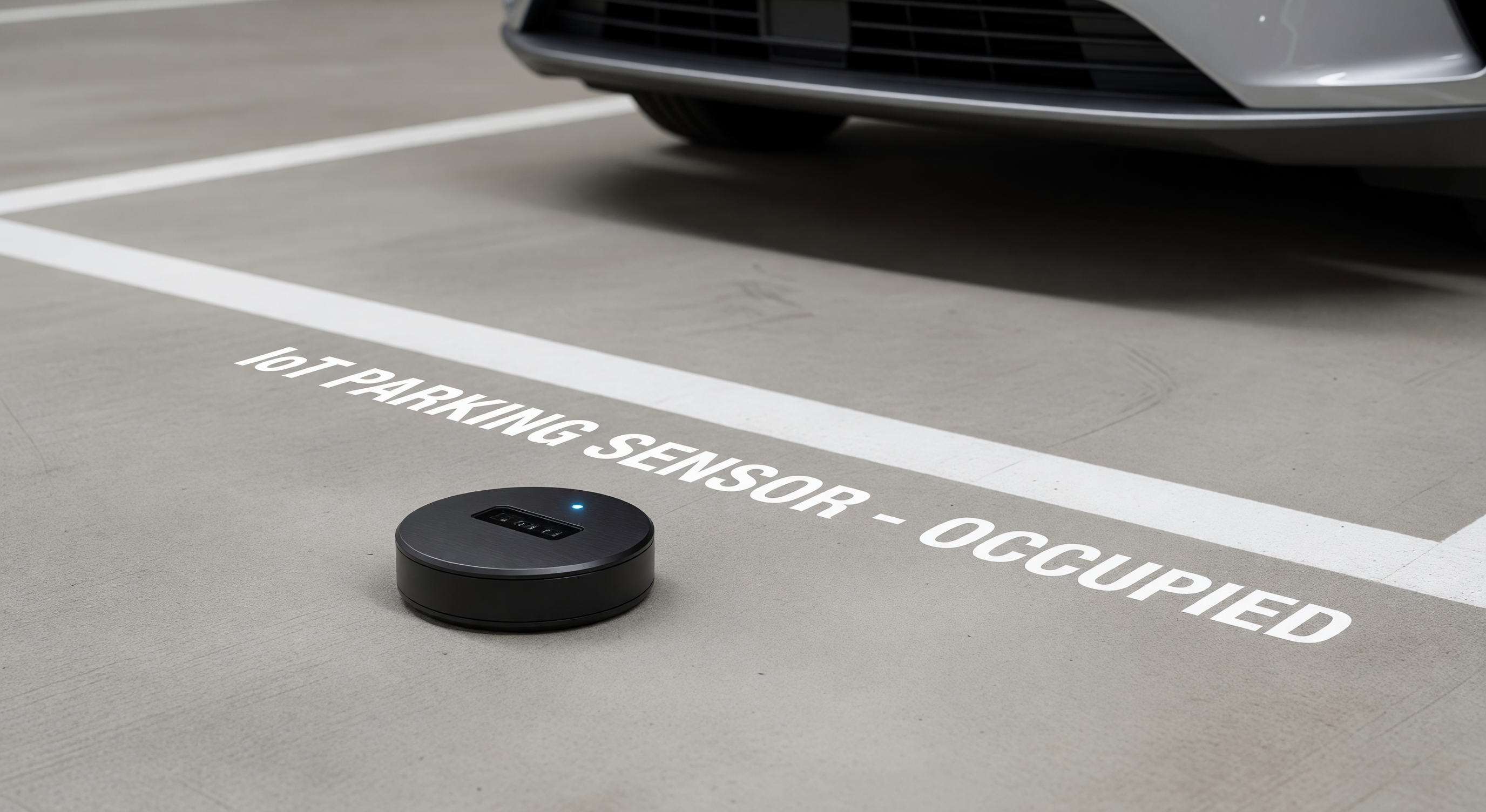
Magnetic sensors are installed in-ground, either surface-mounted (epoxy-bonded to pavement) or flush-mounted (core-drilled into the surface). They detect the magnetic disturbance caused by a vehicle’s ferrous mass passing over or parked above the sensor.
How they work: Each sensor contains a magnetometer that establishes a baseline magnetic field reading. A vehicle’s mass disturbs this field — the sensor detects the change and reports occupancy. This detection method is immune to temperature, wind, rain, and lighting conditions.
Accuracy: 97–99% accuracy across all conditions when properly installed. Magnetic detection is less susceptible to environmental interference than ultrasonic and works equally well indoors and outdoors.
Installation: Surface-mount sensors require epoxy bonding to clean, dry pavement — installation is relatively fast but leaves a visible puck in each space. Flush-mount requires core drilling to the sensor depth (typically 1–3 inches), more disruptive to install but cleaner result. Both require cable routing or wireless communication back to a gateway.
Wireless vs. wired: Most modern magnetic sensors use wireless communication (900 MHz, Zigbee, or proprietary protocols) to eliminate cable trenching. Battery life on wireless units is typically 5–10 years depending on detection frequency and reporting interval.
Best environments: Surface lots, outdoor facilities, mixed-use parking with weather exposure. Also appropriate for structural parking when installation disruption is acceptable.
Avoid for: High-vibration environments (adjacent to rail lines, heavy machinery) where false positives occur. Deep core drilling is not practical on all structural deck types — consult a structural engineer before specifying flush-mount in a parking structure.
Camera-Based Detection
Camera-based occupancy detection uses overhead cameras paired with computer vision software to monitor multiple spaces from a single sensor. Rather than per-space hardware, a single camera covers 4–20 spaces depending on mounting height and camera angle.
How they work: A fixed camera is mounted overhead (typically 10–20 feet) with a clear view of a defined zone of spaces. Computer vision software analyzes the video feed to determine per-space occupancy based on vehicle presence, color, and outline. Data updates in real time, typically with 1–3 second detection latency.
Accuracy: Varies significantly with implementation quality. Well-deployed camera systems reach 95–98% accuracy. Accuracy drops at low mounting heights (below 10 feet), in high-shadow environments, and when spaces are not clearly marked. Snow coverage on pavement markings reduces accuracy in northern climates.
Per-space hardware cost: Because a single camera covers multiple spaces, per-space hardware cost at scale is the lowest of the three technologies ($50–$150/space at scale). However, this math assumes consistent camera coverage ratios — irregular space layouts and obstructions increase camera count and erode the cost advantage.
Software dependency: Camera-based systems require ongoing software/subscription fees for the analytics engine. Cloud-processed systems run $3–$12/space/month. Edge-processed systems (processing on the camera) have lower ongoing costs but higher upfront hardware costs ($400–$900/camera vs. $150–$400 for basic cameras).
Best environments: Large surface lots, open-deck garages, new construction where structured cabling is being installed, facilities where per-space hardware installation is logistically difficult.
Avoid for: Facilities with heavy shadow patterns from trees or structures, tight garages with low ceiling heights, locations where existing space markings are faded.
Side-by-Side Comparison
| Criteria | Ultrasonic | Magnetic | Camera-Based |
|---|---|---|---|
| Accuracy (indoor) | 98–99% | 97–99% | 95–98% |
| Accuracy (outdoor) | 90–95% | 97–99% | 94–97% |
| Per-space hardware cost (installed) | $100–$250 | $150–$300 | $50–$150 |
| Installation disruption | Low (ceiling mount) | Medium–High (in-ground) | Low (overhead camera) |
| Ongoing software cost | Low | Low | Medium–High |
| Indoor suitability | Excellent | Good | Good |
| Outdoor suitability | Fair | Excellent | Good |
| Temperature sensitivity | High | None | Low |
| LED indicator integration | Built-in (most units) | Requires separate fixtures | Requires separate fixtures |
| Typical battery life (wireless) | N/A (wired) | 5–10 years | N/A (wired) |
| Typical system lifespan | 8–12 years | 10–15 years | 5–8 years (camera hardware) |
Matching Technology to Environment
Enclosed structured garage (300–1,000 spaces): Ultrasonic is the dominant choice. Stable indoor conditions maximize accuracy, built-in LED indicators simplify the guidance system, and ceiling mounts avoid pavement disruption. Expect $120–$200/space all-in for hardware and installation.
Open surface lot (100–500 spaces): Magnetic sensors are the most reliable choice where weather exposure is continuous. Camera-based detection is viable if the lot has consistent striping and mounting infrastructure is available. Avoid ultrasonic for uncovered surface applications.
Rooftop parking deck: Magnetic sensors with wireless communication are the most practical. Camera-based detection works on rooftops with adequate mounting height, but sun angle creates significant shadow variation throughout the day that reduces accuracy.
Mixed indoor/outdoor campus parking: Consider a hybrid approach — ultrasonic for enclosed decks, magnetic for surface lots — with a unified data management platform. Most major occupancy sensor vendors offer multi-technology gateways that normalize data from different sensor types.
High-turnover commercial (retail, airport): Camera-based detection at scale reduces per-space cost, but requires ongoing software investment. For facilities with 1,000+ spaces, the camera approach can save $60–$150/space on hardware at the cost of higher software overhead.
Integration with Guidance Systems
Occupancy data is only useful if it reaches drivers. The integration chain matters:
LED per-space indicators: Green/red LED units mount above each space (ceiling in garages, post-mounted in surface lots). Ultrasonic sensors often have LEDs built in. Magnetic and camera systems require separate LED fixtures ($40–$80/space additional). The LED fixture must accept occupancy signals via the sensor network’s communication protocol (typically 0-10V analog, RS-485, or IP).
Zone count displays: Digital signage panels at aisles and garage entrances show available space counts by zone. These aggregate occupancy data from the sensor system and update in real time. Standalone zone count panels run $300–$800/panel; larger integrated displays $1,000–$5,000.
Mobile/app integration: All major occupancy sensor platforms offer API-based data output for integration with parking apps, wayfinding apps, and facility management platforms. This typically requires a cloud subscription or on-premise server running the aggregation software.
Dynamic pricing integration: Some facilities connect real-time occupancy data to dynamic pricing engines, adjusting rates based on current utilization. This integration requires a payment management system capable of receiving occupancy data as an input — consult your payment vendor for compatibility before specifying the sensor platform.
For broader context on how occupancy sensors connect to the full parking technology stack, integrated parking management systems typically include data hubs that aggregate occupancy, access control, and payment data into unified reporting.
Common Installation Mistakes
Mistake 1: Under-specifying gateway density. Wireless sensors communicate to gateway units. Each gateway handles a limited number of sensors (typically 50–200 depending on vendor). Specifying too few gateways results in communication dropouts — spaces appear occupied when they’re not because the sensor can’t reach the gateway.
Mistake 2: Skipping calibration after installation. Ultrasonic sensors require individual calibration after installation to set baseline distance. Magnetic sensors require calibration to establish the local magnetic baseline. Factories pre-calibrate, but actual installation conditions vary. Budget time for on-site calibration — typically 15–30 minutes per gateway zone.
Mistake 3: Ignoring structural deck coatings. Traffic deck coatings (polyurethane, epoxy) applied after sensor installation can cover surface-mount magnetic sensors or interfere with the epoxy bond. Coordinate sensor installation timing with any planned deck coating projects.
Mistake 4: Camera mounting too low. Camera-based systems require adequate overhead clearance to cover the target number of spaces. Mounting cameras below 10 feet significantly reduces the field of view and coverage ratio. In garages with low clearances (under 8 feet at mounting points), camera-based detection often isn’t viable.
Mistake 5: Mismatched communication protocols. Occupancy sensors, LED fixtures, gateway hardware, and management software must use compatible communication protocols. Verify end-to-end protocol compatibility before finalizing the hardware spec — mixing vendor ecosystems without a confirmed integration path is a common source of project delays.
Per-Space Cost Ranges (Installed)
These ranges include hardware, installation labor, and gateway/network infrastructure amortized across total sensor count. They exclude ongoing software subscriptions.
- Magnetic sensors (surface-mount): $150–$250/space
- Magnetic sensors (flush-mount, core drill): $200–$300/space
- Ultrasonic sensors (with LED): $120–$220/space
- Ultrasonic sensors (without LED, LED purchased separately): $80–$150/space sensor only
- Camera-based (at scale, 500+ spaces): $50–$100/space hardware
- Camera-based (small installation, under 100 spaces): $100–$150/space
For ongoing total cost of ownership analysis, factor in software subscriptions, battery replacement (magnetic wireless units), and platform refresh cycles (camera-based analytics software typically requires hardware refresh every 5–7 years).
Buying Checklist
Before issuing specs or requesting quotes:
- Indoor vs. outdoor environment confirmed for each zone
- Temperature range documented for outdoor zones
- Gateway coverage zones mapped against sensor count
- LED indicator requirement defined (built-in vs. separate fixture)
- Communication protocol verified from sensor to management software
- Pavement condition assessed for magnetic sensor installation (coating, core drill feasibility)
- Camera mounting heights verified for camera-based zones (10 foot minimum)
- Software subscription costs factored into 5-year budget
- API availability confirmed for any downstream integration (mobile, dynamic pricing)
Review camera-based detection options if you’re evaluating combining general surveillance cameras with occupancy detection in the same hardware layer — most facilities find it more effective to keep surveillance and occupancy detection as separate systems.
For the facility-matching decision framework — which technology to choose based on environment, budget, and integration requirements — see Parking Occupancy Sensor Buying Guide: Matching Detection Tech to Your Facility.