There is no universally best parking occupancy sensor technology. There is only the technology that performs well in your specific facility environment, integrates with your existing systems, and fits your budget for installation and ongoing support. Buyers who start with a technology preference instead of a facility assessment regularly end up with sensors that work adequately in controlled demos and fail in their specific environment.
This guide gives you the decision framework: how to read your facility’s characteristics, what each technology does well and where it fails, cost benchmarks for 2026, and the integration questions to resolve before you issue an RFP. For a detailed breakdown of how each technology works technically, see our companion parking occupancy sensor equipment guide.
Step 1: Define What You Actually Need From Occupancy Data
Before choosing a technology, be clear about what you’re using the occupancy data for. The use case determines the accuracy and latency requirements — and those determine which technologies are in contention.
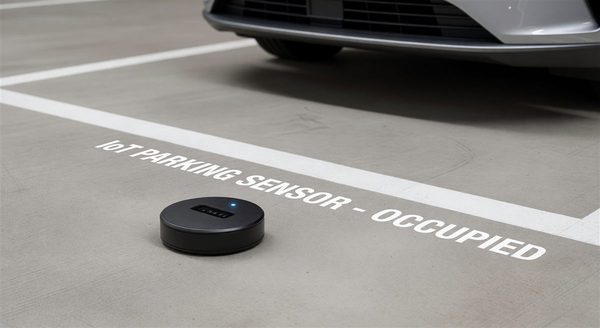
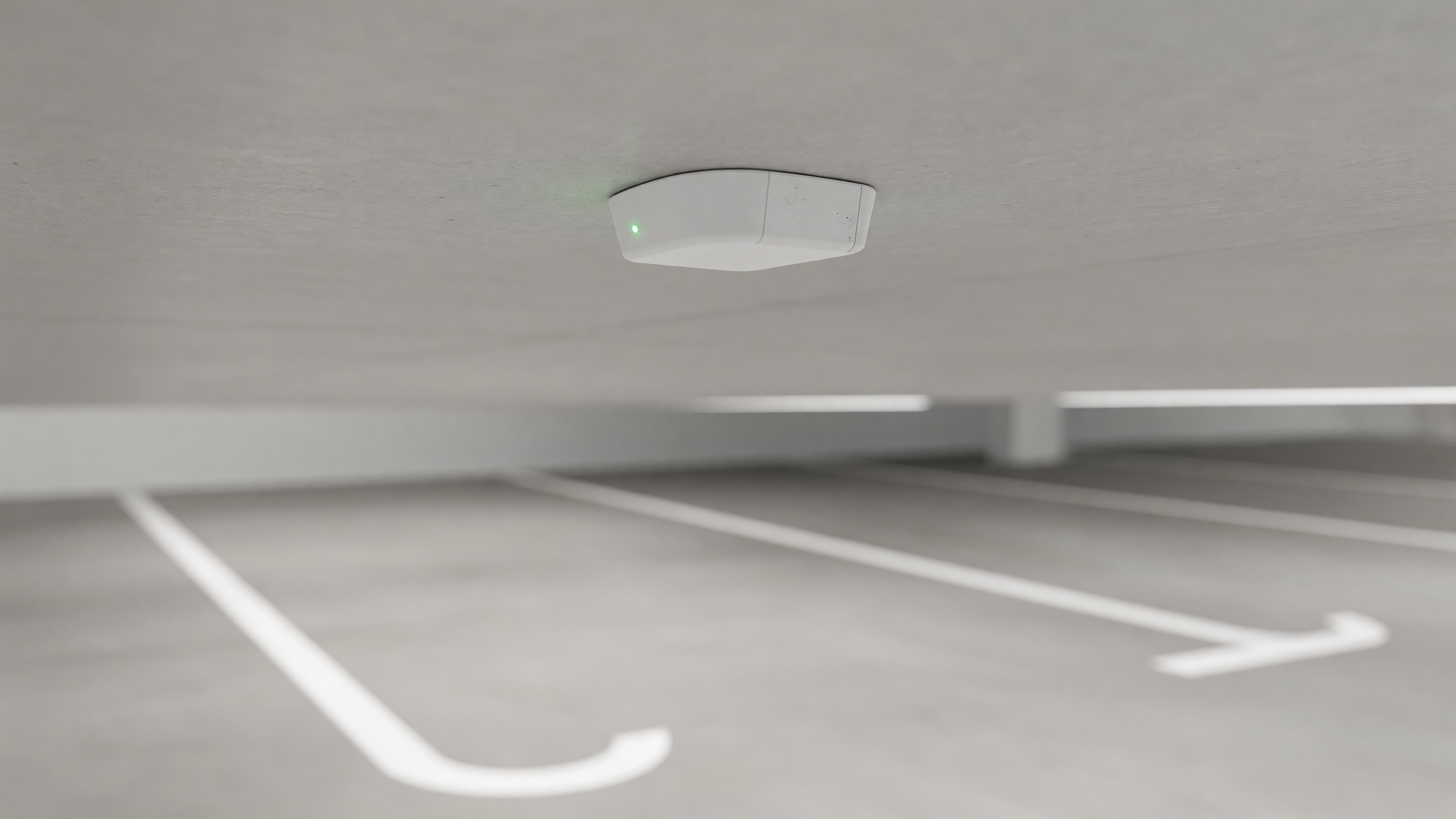
Use case 1: Per-space LED guidance for drivers. If you need green/red indicators above each space visible from the driving aisle, you need per-space sensors with onboard or closely integrated LED outputs. Ultrasonic sensors are the most common choice for this use case in covered garages because they mount overhead, include LEDs, and reach 98–99% accuracy indoors.
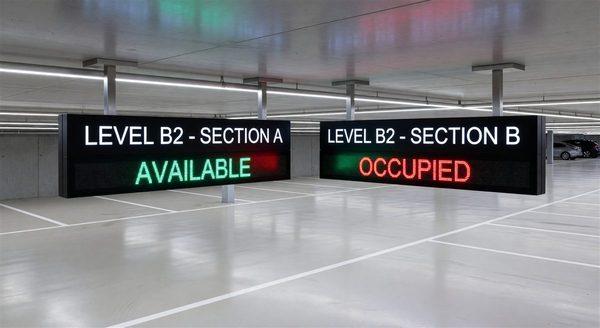
Use case 2: Zone-level counts for entrance signage. If you need aggregate “X spaces available” counts at zone or level entrances, you don’t need per-space precision — you need accurate net counts. Camera-based systems that count at zone boundaries (counting entries and exits by zone, rather than per-space sensors) can meet this requirement at lower per-space cost. Magnetic per-space sensors also feed zone count displays effectively.
Use case 3: Utilization analytics and reporting. If the primary use case is historical data — occupancy by hour, day, month, space type — accuracy thresholds can be slightly looser than real-time guidance, because aggregate statistical accuracy matters more than instant per-space accuracy. Systems that occasionally miscategorize a space for a few minutes produce clean aggregate data even if real-time display has minor noise.
Use case 4: Revenue and dynamic pricing input. When occupancy data feeds pricing engines or revenue optimization software, data integrity matters at the system level, and network reliability and API availability become critical evaluation criteria alongside sensor accuracy.
Step 2: Assess Your Facility Environment
The physical environment is the first filter. Technologies that perform well in one environment fail in another.
Covered Structured Garage (Multi-Level Concrete)
This is the strongest environment for ultrasonic sensors. Consistent temperature, controlled airflow, no direct precipitation, and overhead mounting surfaces for every space make ultrasonic the default recommendation for covered garages. The accuracy advantage (98–99% under controlled conditions) holds reliably here.
Magnetic in-ground sensors are also viable in covered garages but require core-drilling or sawcutting pavement for installation. This adds installation cost and complexity compared to ultrasonic, with no material accuracy advantage in this environment.
Camera-based detection works in covered garages but requires careful lighting management. Existing garage lighting creates variable shadow conditions that can challenge camera-based systems at accuracy levels competitive with ultrasonic. Best used for zone-level counting at aisles rather than per-space detection in garage environments.
Open-Air Surface Lot
Surface lots are the most challenging environment for ultrasonic sensors. Direct sunlight causes surface temperature variations that affect sound speed calculations. Wind disrupts signal paths. Rain and snow create reflective conditions. Even with temperature compensation, ultrasonic accuracy in exposed surface lots typically drops to 90–95% — sufficient for some applications, marginal for guidance displays that drivers will trust.
Magnetic in-ground sensors perform well in surface lots because they are below the pavement surface and unaffected by weather conditions above. Installation is disruptive (requires pavement core drilling), but the resulting sensor is weather-agnostic. For surface lots without overhead mounting structures, magnetic is the baseline recommendation.
Radar sensors are an emerging option well-suited to surface environments. Operating on microwave frequency rather than ultrasound, they are not affected by temperature, precipitation, or airflow. Radar sensors can also cover multiple spaces from a single unit depending on mounting height, reducing per-space sensor count. Hardware costs ($80–$150/unit) are competitive with magnetic sensors.
Partially Covered or Mixed Environment
Many real-world facilities combine covered and uncovered zones — covered levels above grade, open rooftop, covered entries with uncovered overflow areas. Mixed environments require a hybrid approach: ultrasonic for the covered zones where accuracy is reliable, magnetic or radar for exposed zones.
The management software must support heterogeneous sensor types on the same platform. Confirm vendor support for mixed-technology configurations before committing.
Open-Air with Structures for Mounting
Some surface facilities have overhead canopy structures, light poles, or canopy shade structures that provide mounting points above spaces without providing full weather protection. This enables ultrasonic mounting but does not provide the temperature and airflow stability that makes ultrasonic accurate. These environments typically perform better with magnetic or radar than with overhead ultrasonic.
Step 3: Compare Technology Options With 2026 Cost Benchmarks
The following cost ranges represent typical installed costs in 2026 for commercial-grade parking occupancy sensor systems. Pricing varies by vendor, project scale, and installation complexity.
| Technology | Hardware Cost/Space | Install/Space | Total Installed/Space | Best For |
|---|---|---|---|---|
| Ultrasonic (per-space) | $100–$200 | $30–$60 | $130–$260 | Covered garages, LED guidance |
| Magnetic (in-ground) | $50–$100 | $80–$150 | $130–$250 | Surface lots, mixed environments |
| Camera-based | $20–$50* | $15–$30* | $35–$80* | Zone counting, open-plan coverage |
| Radar | $80–$150 | $40–$80 | $120–$230 | Open-air, weather-exposed sites |
| Hybrid (magnetic + ultrasonic) | $100–$180 | $80–$150 | $180–$330 | High-accuracy surface requirements |
*Camera cost amortized across the 10–20 spaces covered per camera unit
Five-year total cost of ownership (TCO) adds:
- Software/network subscriptions: $10–$30/space/year on most cloud-connected platforms
- Maintenance and calibration: $5–$15/space/year for ultrasonic; $8–$20/space/year for magnetic (pavement access required for replacement); $5–$10/space/year for camera (firmware and lens cleaning)
Battery replacement is the primary ongoing cost for wireless magnetic sensors. Most commercial-grade in-ground magnetic sensors have 5–10 year battery life, but high-traffic facilities where sensors report more frequently can see battery life reduced to 3–5 years.
Step 4: Evaluate Integration Requirements
The sensor hardware is only one part of the buying decision. The management software, API availability, and integration points with your existing systems may constrain your technology choice.
Existing PARCS platform compatibility. Major parking management system vendors (TIBA, Genetec, IPS Group, T2 Systems, among others) support specific occupancy sensor brands and protocols. If you have an existing PARCS platform, check which sensor manufacturers are certified integrations before shortlisting. Forcing a non-certified integration adds time and cost that may exceed the difference between sensor vendors.
Communication protocol. Occupancy sensor networks operate on several protocols: wired RS-485, Ethernet, wireless 433 MHz, LoRaWAN, Zigbee, and proprietary RF. Your facility’s infrastructure (existing conduit, wireless frequency environment) constrains which options are practical. Facilities with existing conduit infrastructure often favor wired sensors for reliability; facilities without conduit lean toward wireless.
Gateway coverage and network topology. Wireless sensors require gateway devices that aggregate signals from a group of sensors and transmit to the management server. Gateway coverage zones vary by protocol and obstruction level — concrete columns and floors reduce wireless range significantly. Require vendors to provide a coverage map for your facility’s floor plan before finalizing sensor counts.
API and downstream integration. If occupancy data will feed dynamic pricing, mobile apps, wayfinding signs, or smart city platforms, API availability is essential. Most commercial platforms offer REST APIs with real-time and historical data. Verify authentication method, rate limits, data format, and documentation quality during the evaluation process.
Step 5: Build the RFP Evaluation Criteria
A structured evaluation prevents post-installation surprises. For occupancy sensor procurement, the International Parking & Mobility Institute recommends that RFPs specify accuracy requirements, environmental conditions, and integration requirements before soliciting vendor responses — rather than evaluating vendor claims against undefined criteria.
Key RFP requirements to specify:
- Minimum accuracy under your environmental conditions (not in a controlled lab). Specify the accuracy requirement as a field performance standard: “minimum 97% space-level accuracy under conditions including [describe your environment].”
- Battery life guarantee for wireless magnetic sensors, with replacement cost structure.
- Communication protocol and gateway specifications, with coverage map requirement.
- API documentation and sandbox access as part of the proposal deliverable.
- Reference sites in similar environments to yours, with contact information.
- Pilot or pilot zone option before full facility commitment.
The pilot requirement is the most important protection for large procurement decisions. A vendor who is unwilling to demonstrate performance in a pilot zone at your facility under your conditions is telling you something about their confidence in real-world performance.
Frequently Asked Questions
Which parking occupancy sensor is most accurate?
Ultrasonic sensors in covered, temperature-stable environments reach 98–99% accuracy — the highest of any technology in that setting. In open-air or weather-exposed environments, magnetic in-ground sensors are more accurate (typically 97–99%) because their performance is unaffected by temperature, wind, and precipitation.
How much does a parking occupancy sensor system cost?
Total installed costs in 2026 run $130–$260/space for ultrasonic, $130–$250/space for magnetic, and $35–$80/space for camera-based systems (amortized across spaces per camera). Add $10–$30/space/year for software subscriptions and $5–$20/space/year for maintenance.
What is the difference between ultrasonic and magnetic parking sensors?
Ultrasonic sensors mount overhead and detect vehicles using reflected sound waves — accurate in covered garages, less reliable outdoors. Magnetic sensors install in-ground and detect vehicles via electromagnetic field disruption — unaffected by weather, ideal for surface lots. Installed cost is similar; the right choice depends on your environment.
Can camera-based systems replace per-space sensors?
For zone-level counting and guidance (floor-level available space counts), camera systems are a cost-effective alternative to per-space sensors. For per-space LED guidance visible from the driving aisle, camera systems are less suited than overhead ultrasonic or magnetic per-space sensors — they don’t have the per-space output path.
How long do parking occupancy sensors last?
Ultrasonic sensors have a typical hardware life of 7–10 years. Magnetic in-ground sensors last 10–15 years for the sensor body, with battery replacement every 5–10 years (less in high-traffic deployments). Camera-based detection systems follow camera hardware lifecycle, typically 7–10 years before sensor-relevant software or resolution limitations require replacement.
What should I ask for in an occupancy sensor pilot?
Specify a representative pilot zone that includes your most challenging environment (outdoor section, high-traffic aisle, or mixed coverage area). Run the pilot for 4–6 weeks. Measure space-level accuracy independently (manual observation vs. system reporting) during peak and off-peak periods. Require the vendor to explain any accuracy gaps before procurement decision.
Hero image: “Components of parking guidance and information system” by Z22, CC BY-SA 4.0, via Wikimedia Commons (cropped).