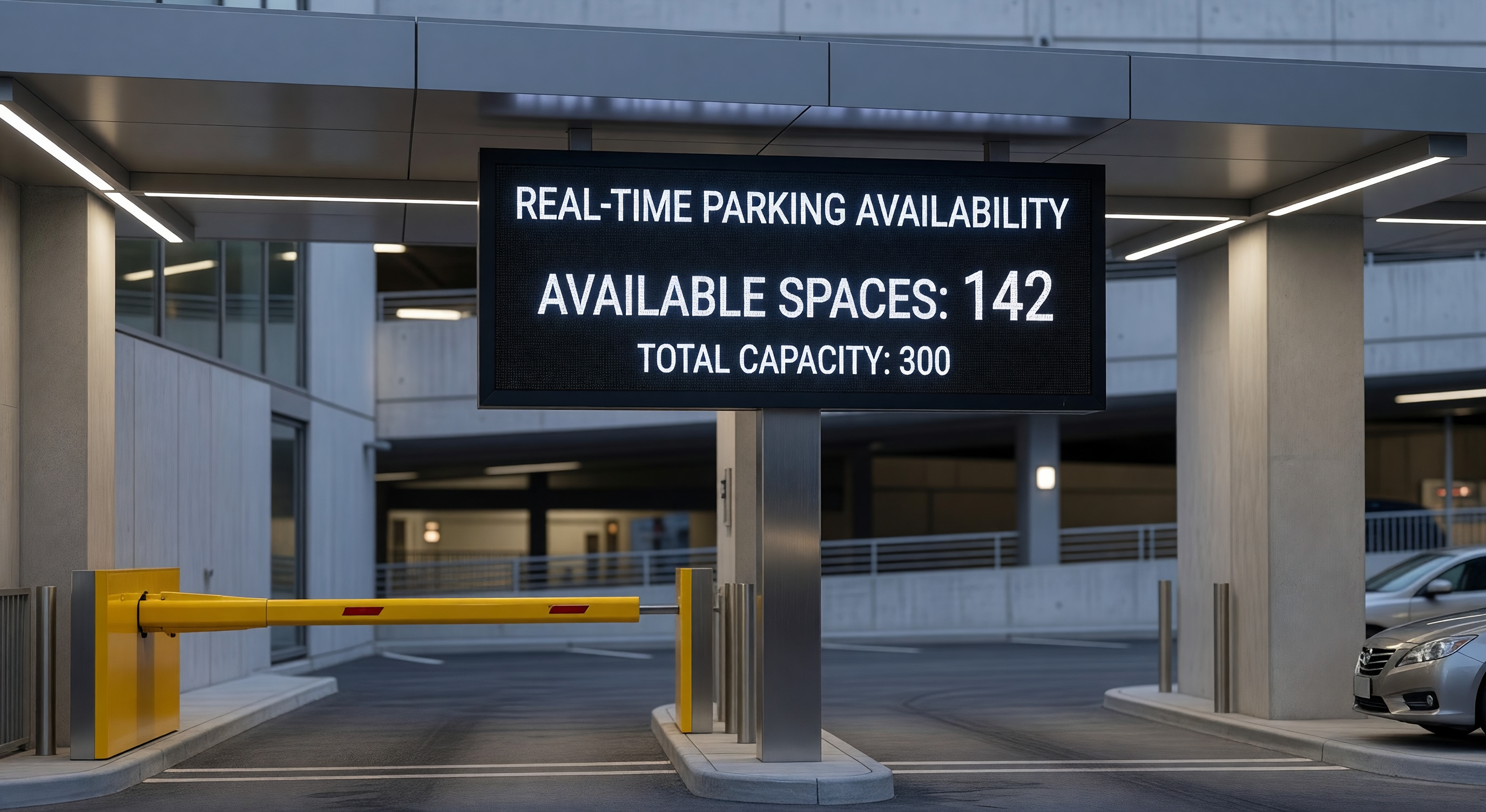
Parking occupancy counting serves two distinctly different functions depending on the granularity of the system. Zone-level counting answers the question “how many spaces are available on Level 2?” Single-space systems answer “is stall 247 available?” The operational value differs significantly, and so does the cost.
Most facilities need only one of these answers. Deploying single-space sensor density for an application that only requires zone counts means spending $200+ per space on a $50-per-space problem.
This guide compares single-space and zone counting approaches, the technology options within each, and the decision criteria for selecting the appropriate system.
Zone Counting: Entry/Exit-Based Systems
Zone counting tracks vehicles entering and exiting a defined zone (a lot, a floor, or a section) rather than monitoring individual spaces. The count starts at zero and increments with each vehicle entry; it decrements with each vehicle exit. Available spaces = total capacity minus current count.
How Entry/Exit Counting Works
Loop detector counting: Inductive loops at the entry and exit points of each zone count vehicle entries and exits. Two loops per lane (entry and exit) with directional logic provide the count. This is the traditional approach for structured garages — reliable, inexpensive, and well-understood.
Camera-based counting: Video analytics applied to cameras positioned at zone entry/exit points count vehicles entering and exiting. No pavement modification required; the camera serves dual purposes (counting and surveillance). Accuracy is high (95–98%) under adequate lighting.
LPR-based counting: LPR cameras at entry and exit provide both a count and a vehicle identity (plate). This enables features beyond simple counting: vehicle dwell time analysis, violation detection for time-limited zones, and searching for a specific vehicle by plate.
Zone Counting Accuracy and Drift
A fundamental limitation of entry/exit counting is error accumulation over time. Each miscounted transaction moves the count one position away from reality. Over a busy day with thousands of transactions, small error rates accumulate into meaningful discrepancy.
A 99% accurate counter making 2,000 transactions per day accumulates an expected error of 20 transactions per day. After several weeks without a manual reset, displayed count may differ from actual occupancy by 50–100 spaces.
Solutions:
- Manual reset: Staff count actual vehicles periodically and reset the counter to match reality. Daily for high-volume facilities.
- Automated recalibration: Some systems use period camera snapshots or sensor sweeps to recalibrate the count without manual intervention.
- Differential detection: In low-volume facilities, the error rate is low enough that recalibration is infrequent.
Single-Space Detection Systems
Single-space detection monitors each parking space individually, providing real-time status for every space in the facility. The system knows the status of every space at all times — not just an aggregate count.
Technology Options for Single-Space Detection
Ultrasonic sensors (ceiling-mounted): The standard for structured parking. One sensor per space, mounted 7–10 feet overhead. High accuracy (98–99.5%); requires ceiling infrastructure; excellent for covered garages. Cost: $150–$300 per space installed.
Camera-based space detection: A single wide-angle camera covers multiple spaces (typically 4–12) using computer vision to assess each space’s status. Lower per-space cost ($30–$80 per space for camera amortized over covered spaces); requires adequate lighting and calibration; accuracy 92–97% in typical conditions.
Magnetic puck sensors (in-pavement or surface-mounted): Wireless sensors detect each space. Works in surface lots without ceiling infrastructure. Battery-powered (3–7 year life). Cost: $100–$250 per space installed.
LPR-based space detection: Cameras capture plates and associate them with specific spaces. Can differentiate between “empty space” and “wrong vehicle in reserved space.” Higher per-space cost due to camera density required; provides the richest data but is most complex to configure and maintain.
Single-Space System Applications
The additional investment in single-space detection is justified when:
- Guided parking is a revenue driver: Hotels, hospitals, and airports where the parking experience is part of the service proposition benefit from precise guidance that reduces driver frustration
- Reserved and permit space monitoring: Knowing which specific spaces are improperly occupied, not just that some are, enables efficient enforcement
- High per-space revenue: When each space generates $20–$50/day, the $300 per-space sensor investment returns in under two months of improved utilization
- Operational reporting: Facilities that report space utilization to tenants or operate under capacity lease agreements need individual space data
Comparing the Approaches
| Factor | Zone Counting | Single-Space |
|---|---|---|
| Upfront cost (per space) | $5–$30 | $100–$350 |
| Accuracy | 95–99% (with resets) | 97–99.5% |
| Drift over time | Yes — requires periodic reset | No — each detection is independent |
| Individual space identification | No | Yes |
| Guided parking capability | Zone/floor only | Individual space guidance |
| Surface lot suitability | Good | Depends on sensor type |
| Maintenance complexity | Low | Medium (more components) |
The Right Fit by Facility Type
Municipal surface lots (short-term parking): Zone counting with camera-based or LPR entry/exit detection. Simple, low cost, delivers the count data needed for dynamic signage.
Urban garages (high transient, >500 spaces): Zone counting with LPR provides the best ROI — vehicle identification combined with occupancy data without single-space infrastructure investment.
Hospital and university facilities: Single-space detection, particularly for permit zones and reserved spaces. Enforcement and space monitoring justify the investment.
Hotel parking: Single-space detection if the hotel actively guides guests to available spaces as part of the arrival experience; zone counting if it’s just for operational awareness.
Airport long-term parking: Zone counting with a robust reset protocol. Accuracy at individual space level isn’t necessary; total level/section counts drive the meaningful operational decisions.
Integration with Parking Guidance
Zone counting systems feed dynamic signs at level or zone entry points — “Level 3: 47 spaces” style indicators. Drivers navigate to a zone and then find a space themselves.
Single-space systems feed individual overhead indicators (red/green LEDs above each space) that guide drivers to the specific open space. The customer experience difference is meaningful in facilities where driver satisfaction is a measurable business outcome.
Both types integrate with PARCS and parking management software through APIs or direct data connections. The data format differs (aggregate count vs. individual space status), but the integration path is similar.
Frequently Asked Questions
Can I upgrade from zone counting to single-space later? Yes, though it requires adding sensor infrastructure. If the zone counting system uses cameras for entry/exit detection, the camera network is already partially in place. Adding space-level sensors is additive to the existing system. Plan the network architecture to support single-space density when designing zone counting systems to simplify future upgrades.
How often should zone counting systems be reset? High-volume facilities (1,000+ transactions/day) should reset counters daily. Lower-volume facilities (under 500 transactions/day) can operate with weekly resets in many cases. Implement a morning verification routine where staff confirm that the displayed count matches an actual vehicle count in a sample zone.
What is the typical project cost for single-space detection in a 300-space garage? For ultrasonic sensor coverage, expect $60,000–$120,000 installed including sensors, zone controllers, network infrastructure, and management software. Camera-based single-space detection (lower accuracy, lower cost) runs $30,000–$70,000 for the same facility.
Does single-space detection work in outdoor covered parking (carports)? Ultrasonic sensors work in covered outdoor environments where the ceiling height is within the sensor’s operating range. Ensure sensors rated for outdoor temperature and humidity are selected — standard indoor sensors may fail in exposed environments.
Key Takeaway
Select occupancy counting granularity based on operational need, not aspirational capability. Zone counting delivers high value at low cost for most parking facilities. Single-space detection earns its premium in environments where guided parking, reserved space enforcement, or per-space utilization reporting drives measurable revenue or operational improvement.