Camera coverage in a parking facility is only as effective as the installation design. A $500 camera mounted at the right height, angle, and location provides more usable coverage than a $2,000 camera mounted in a position that clips the top of every vehicle in its view. Installation planning — coverage calculation, mounting height selection, lighting coordination, and cable routing — determines whether the camera system provides operational value or security theater.
This guide addresses the planning and execution considerations for parking lot camera installation, focusing on the decisions that most commonly determine real-world system quality.
Coverage Planning Fundamentals
Field of View Calculation
Camera field of view (FOV) is determined by three variables: focal length, sensor size, and mounting distance. The relationship between these is fixed by lens physics — wider angles cover more area but with less detail per square foot; narrower (telephoto) angles cover less area with more detail.
Practical approach: Use the intended subject detail level to determine lens choice, then plan coverage accordingly.
For parking lot applications, subject requirements vary by purpose:
- General area surveillance: Identify vehicles and general activity; wide-angle lenses (2.8mm–4mm) at 10–15 foot mounting height
- Vehicle identification: Capture make, model, and color; standard lenses (4mm–6mm) positioned for clear vehicle approach
- License plate capture: Readable plate characters require either specialized LPR cameras or precisely positioned standard cameras within a tight distance range
Coverage Overlap
Effective camera coverage planning targets 15–20% overlap between adjacent cameras. This overlap ensures:
- No dead zones between camera FOVs
- Continuous tracking as subjects move from one camera’s view to the next
- Redundancy if one camera is offline or obstructed
Coverage maps should be drawn for each camera in the plan before installation. Software tools (many VMS vendors provide coverage planning modules) can generate FOV footprints on an overhead lot map.
Mounting Height Recommendations
Mounting height is the single most impactful variable in parking camera performance.
Surface Lot Pole Mounts
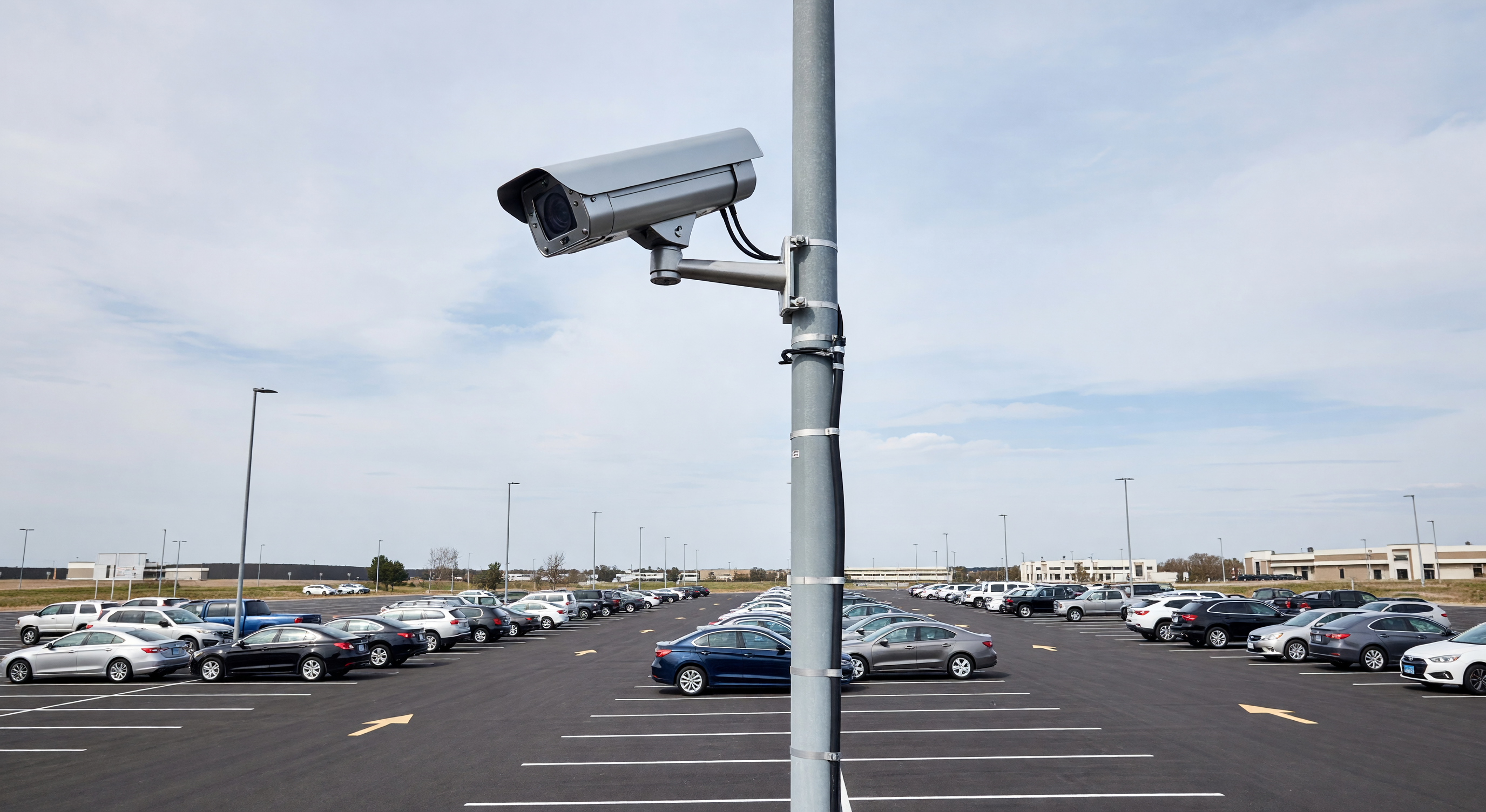
For open surface lots, camera poles typically range from 12 to 25 feet. The appropriate height depends on the coverage area and the subject detail requirement.
12–15 feet: Optimal for identifying individuals on foot and close vehicle activity. Good for entry/exit lanes and pedestrian paths.
18–22 feet: Best balance of area coverage and detail for general parking lot surveillance. A camera at 20 feet with a moderate wide-angle lens covers 40–60 spaces with adequate detail for vehicle identification.
25–35 feet: Area overview only — useful for occupancy monitoring and incident detection but not for vehicle or individual identification. Often paired with PTZ (pan-tilt-zoom) cameras that can zoom to provide detail.
Avoid mounting parking cameras above 30 feet for any application requiring vehicle or individual identification. At that height, the angle is too steep to capture useful facial or plate detail from most camera types.
Structured Parking Wall and Ceiling Mounts
In structured parking garages, mounting locations are constrained by structural elements. Key considerations:
- Ceiling height: Most parking structures have 7–10 foot clear heights. Cameras must be mounted to avoid vehicle impact while providing useful angles. Dome cameras flush-mounted or recessed in the ceiling are the standard solution.
- Column mounts: Structural columns provide mounting points but limit FOV to one direction. Corner-mounted cameras cover more approach angles.
- Coverage at low height: At 8 feet, cameras are shooting nearly horizontally — angle selection is critical to avoid capturing primarily vehicle rooflines rather than aisles and occupants.
For structured parking, lower mounting heights require more cameras to achieve equivalent coverage compared to surface lots. Budget accordingly.
Camera Types and Selection by Application
Fixed Dome Cameras
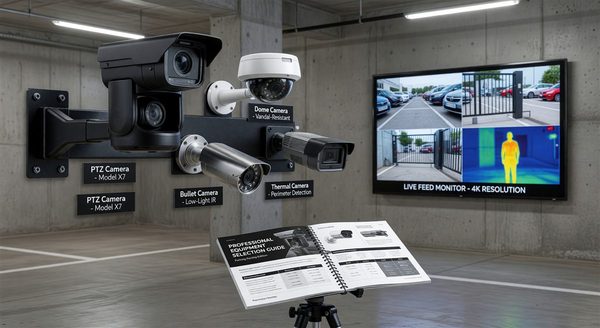
Dome cameras with fixed (non-motorized) lenses are the workhorse of parking facility surveillance. The dome housing provides vandal resistance, the flush-mount profile reduces snagging risk, and the fixed lens provides consistent FOV without the reliability concerns of motorized components.
Appropriate for: general area coverage, level surveillance in structured parking, pedestrian pathway monitoring.
PTZ Cameras
Pan-tilt-zoom cameras allow remote operators to steer the camera view and zoom in on events. They cover large areas from a single mounting point but require active operator monitoring to deliver value — an unattended PTZ camera in a fixed position is effectively just a fixed camera.
Appropriate for: command center monitoring, high-value areas with active security personnel, flexible coverage for event parking or changing lot configurations.
License Plate Recognition (LPR) Cameras
Specialized LPR cameras use narrower angle lenses, higher frame rates, and built-in IR illumination optimized for plate capture. They’re not interchangeable with general surveillance cameras for plate reading applications. See our guide on LPR camera mounting for specific installation guidance.
Thermal Cameras
Thermal cameras detect heat signatures and function effectively in complete darkness. See our guide on thermal camera applications in parking for specific coverage planning guidance.
Lighting Coordination
Camera performance and lighting are inseparable. A camera specified for adequate performance in the lighting environment you planned for will fail in the actual lighting conditions if planning was inaccurate.
Minimum illumination ratings: Camera manufacturers specify minimum illumination in lux. Typical values:
- Color mode: 0.1–1 lux for low-light cameras; 3–10 lux for standard cameras
- Black-and-white mode: 0.01–0.05 lux for wide dynamic range cameras
- IR mode (camera with built-in IR illumination): 0 lux, illuminated by the camera itself
Common lighting mistakes:
- Specifying cameras for the average illumination rather than the darkest zones in the coverage area
- Placing cameras where parking lot lighting is directly behind subjects (backlit subjects require WDR cameras)
- Failing to account for headlight wash at night that creates overexposed zones at lane entries
Conduct a nighttime site walk before finalizing camera specifications and placement. Conditions that are obvious at night are not visible in a daytime planning session.
Cable Routing and Infrastructure
PoE vs. Coaxial
Power over Ethernet (PoE) simplifies installation significantly — a single Cat6 cable carries both data and power to the camera. PoE is the standard for modern IP camera deployments.
Maximum PoE cable run: 328 feet (100 meters) without a mid-span injector or switch. For longer runs, plan for network switches at intermediate distribution points or use fiber with a PoE injector at the camera.
Coaxial cable (for legacy analog cameras) allows longer runs but doesn’t carry power — cameras require separate power drops. New installations should use IP/PoE unless integrating with an existing analog system.
Conduit Planning
All outdoor cable runs should be in conduit. Common mistakes:
- Installing flexible conduit where rigid conduit was specified
- Inadequate conduit fill (leaving no room for future cable additions)
- Skipping conduit at penetrations through exterior walls or between structures
- Not including pull strings for future cable replacement
For surface lot pole installations, underground conduit runs from a central equipment building or electrical room to each pole base are the standard. Plan conduit route and depth before pole placement.
Frequently Asked Questions
How many cameras do I need for a 200-space surface lot? A 200-space rectangular surface lot typically requires 8–14 cameras for adequate coverage, depending on lot shape, pole availability, and coverage standard (overview vs. identification quality). Coverage planning software using your lot dimensions will give a more accurate estimate than any rule-of-thumb.
Can I reuse existing camera infrastructure when upgrading from analog to IP cameras? Existing coaxial cable can be reused with IP-over-coax adapters (active baluns) that convert Ethernet signals to coax and back. This avoids new cable pulls in situations where conduit routing makes new cabling expensive. Performance is generally adequate for standard definition and 2MP cameras; high-resolution cameras benefit from proper Cat6 runs.
What video management system features matter most for parking applications? For parking applications: motion detection zones (alarm only on aisle activity, not every parked vehicle), license plate search capability, integration with access control and LPR systems, and remote access for off-site monitoring. Cloud VMS platforms have eliminated the need for on-site NVR hardware in most new installations.
Should cameras be visible or concealed in parking facilities? Visible cameras provide deterrent value — most security research suggests that visible surveillance reduces opportunistic criminal activity. Concealed cameras provide evidence value without deterrence. Standard practice is visible dome cameras for general parking areas and concealed cameras in cash handling areas.
Key Takeaway
Camera coverage planning is a discipline distinct from camera selection. The best camera in the wrong location provides poor coverage; a modest camera in the right location with the right mounting height and lighting provides excellent operational value. Invest in coverage planning before committing to hardware specification.