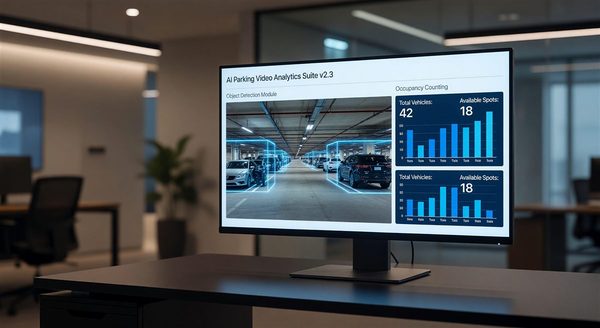
Vehicle detection technology in parking facilities is undergoing a transition that started roughly a decade ago and continues today. Inductive loop detectors — the embedded wire loops that have been the standard for parking gate triggers and occupancy counting since the 1960s — are being supplemented and in many cases replaced by above-ground sensor technologies.
The transition isn’t complete, and loops aren’t obsolete. In many applications, loops remain the most reliable and cost-effective detection solution. But the sensor alternatives have matured to the point where they’re genuinely superior in specific scenarios. This guide provides a technical comparison to support selection decisions.
Inductive Loop Detectors
How They Work
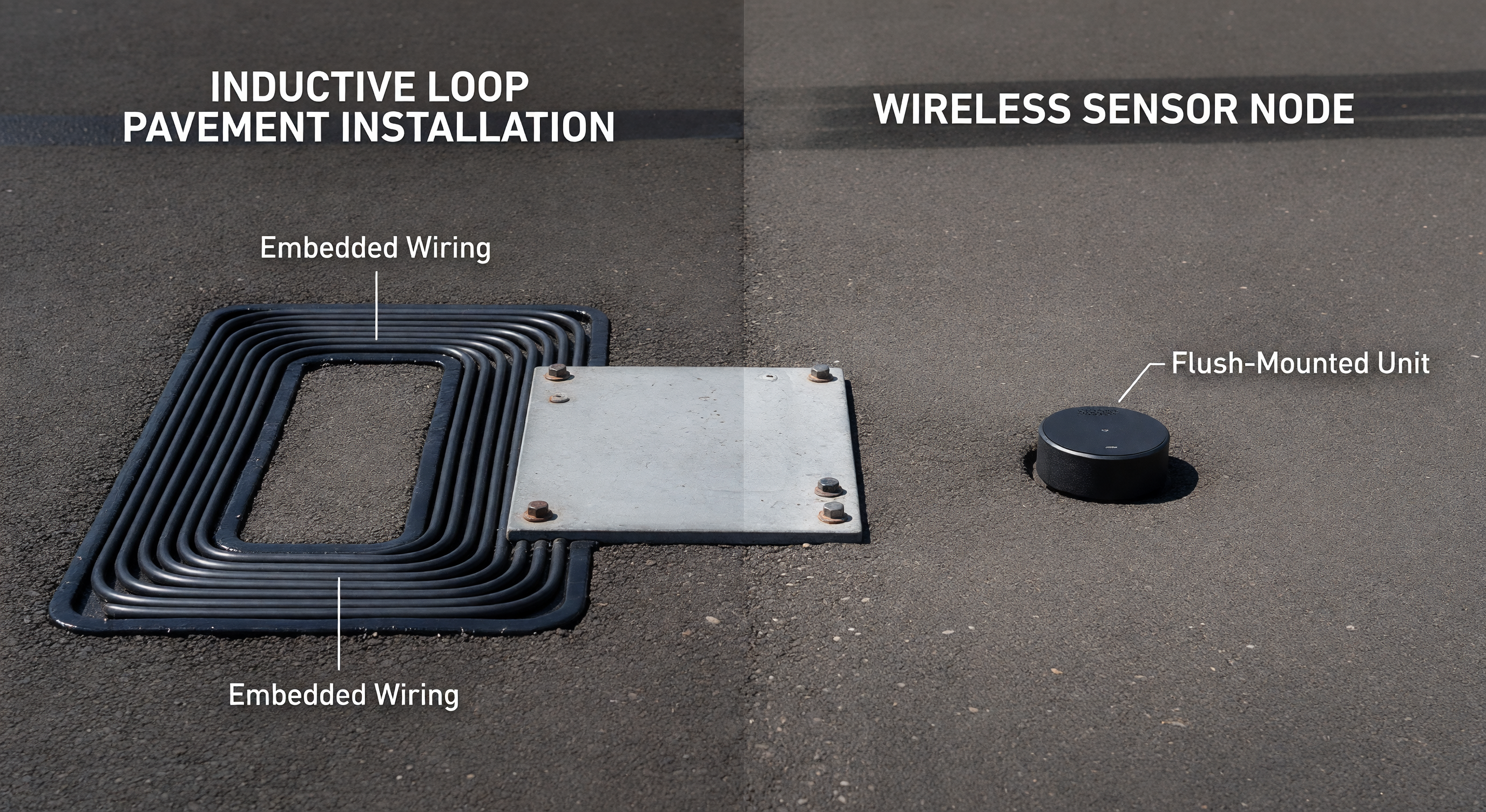
Inductive loops are wire coils embedded in pavement cuts (sawcuts). When a conductive metal mass (a vehicle) passes over or rests above the loop, it changes the inductance of the coil. The loop detector electronics sense this inductance change and output a detection signal.
The physics are simple, reliable, and well-understood. The sensitivity is adjustable — detectors can be tuned to ignore small objects (motorcycles can be an issue at high sensitivity settings) or detect very small vehicles. Loop detectors have no moving parts, no batteries, and no need for line-of-sight.
Strengths
Reliability: A properly installed loop detector in good pavement condition has essentially unlimited service life. The electronics are simple; failures are rare. Many parking facilities run loops installed in the 1990s that are still functioning reliably.
All-weather performance: Loops don’t care about weather. Snow, rain, extreme temperatures, fog — none of these affect detection. Above-ground sensors can struggle with precipitation; loops don’t.
No false positives from overhead: A loop only detects what’s directly above it. Overhead birds, windblown debris, and pedestrian traffic don’t trigger a loop.
Cost: Loop installation cost is low compared to most sensor alternatives. The electronics (the detector unit) cost $150–$400; pavement cutting and installation adds $500–$1,500 per loop depending on pavement depth and access.
Weaknesses
Pavement cutting required: Installing loops requires cutting the pavement, embedding the wire, and sealing the cut. In existing facilities, this is disruptive and creates pavement integrity concerns if done poorly.
Pavement degradation affects performance: As pavement ages, thermal cycling creates micro-cracks that allow moisture intrusion into the saw cut. Deteriorating pavement can mechanically stress the loop wire, leading to intermittent failures. Northern climate facilities with freeze-thaw cycling see shorter loop life.
Limited information: A loop tells you whether something is over it (presence) or whether something passed over it (pulse). It cannot tell you what the vehicle is, which direction it moved, or whether it’s the same vehicle that was there before.
Not retrofittable without disruption: Adding loops to existing pavement that wasn’t prepared for them is expensive and disruptive. Surface lot resurfacing or garage structural work creates opportunities; mid-life additions to otherwise good pavement are expensive.
Ultrasonic Sensors
How They Work
Ultrasonic sensors emit high-frequency sound pulses (typically 40–48 kHz, above audible range) and measure the time for the echo to return from a surface below. In a parking space, the sensor measures the distance to the floor when the space is empty and detects the presence of a vehicle when the measured distance shortens significantly.
Strengths
No pavement modification: Ceiling-mounted ultrasonic sensors require only power and data connections to the mounting surface. No pavement cutting, no surface disruption.
Individual space detection: Ultrasonic sensors excel at single-space presence detection — the application at the core of parking guidance systems. A sensor directly over each space provides high-accuracy individual space status.
Easy maintenance access: Ceiling-mounted sensors are accessible from lifts or ladders without lane closures or pavement work.
Rich data: Beyond simple presence/absence, ultrasonic sensors can measure distance, enabling detection of vehicle height (useful for height-restricted structures) and occupancy pattern analysis.
Weaknesses
Requires ceiling or overhead structure: No ceiling, no ultrasonic sensor. Open surface lots without overhead infrastructure can’t use ceiling-mounted ultrasonic sensors without building infrastructure.
Acoustic interference potential: In environments with significant noise at the sensor’s operating frequency, false triggers are possible. This is uncommon in typical parking structures but can occur near industrial equipment.
Mounting height limits: Accuracy degrades at heights above 12 feet. For structures with high clearances, sensor selection requires careful attention to the specified operating range.
Cost per space: At $150–$350 per installed space, full single-space ultrasonic coverage in a large facility represents significant investment compared to loop-based zone counting.
Infrared (IR) Sensors
Active IR
Active IR sensors emit an infrared beam and detect interruptions. They’re used for safety loops at gate edges — a vehicle or person breaking the IR beam prevents gate arm closure. They’re also used for vehicle presence at some lane entry points.
Active IR is reliable for defined-beam applications (gate safety, lane presence in a narrow channel) but limited for open-area detection.
Passive IR (PIR)
Passive IR sensors detect heat emitted by objects rather than reflecting a transmitted beam. PIR sensors are common in building motion detection but have limited parking-specific applications — they detect people reliably but vehicles present a more complex thermal signature.
PIR sensors are sometimes used in low-cost parking solutions for lot entry detection. They’re generally not appropriate as a primary detection technology in commercial parking applications.
Magnetic Puck Sensors
Magnetic puck sensors are self-contained wireless devices installed in or on the pavement at each parking space. They detect the magnetic field disturbance caused by a vehicle’s metallic mass.
Strengths
Works in any environment: Surface lots, structured parking, on-street — anywhere a sensor can be mounted in or on the pavement. No ceiling required.
Wireless: Battery-powered sensors communicate via low-power radio to controllers. No data cable runs to each space.
Good accuracy: 97–99% detection accuracy under normal conditions.
Weaknesses
Battery life management: Batteries typically last 3–7 years. Replacement requires a maintenance visit to each space — manageable in small deployments, significant operational overhead in large deployments.
Pavement installation (embedded type): Core drilling for embedded sensors disrupts pavement similarly to loop installation. Surface-mounted variants avoid this but are subject to physical damage from vehicles.
Metal interference: Near large ferrous metal structures, sensor calibration is more complex. Underground parking near steel support columns can require per-sensor calibration.
Selection Guide
| Application | Recommended Technology |
|---|---|
| Barrier gate trigger (new install) | Inductive loop (primary) or ultrasonic (if no pavement cut) |
| Barrier gate trigger (retrofit, no pavement cut) | Ultrasonic or active IR |
| Single-space guidance (structured) | Ultrasonic |
| Single-space guidance (surface lot) | Magnetic puck |
| Zone counting (surface lot) | Camera-based analytics or magnetic puck |
| Safety loop (gate closure) | Active IR |
| Long-range zone counting | Camera analytics |
Frequently Asked Questions
Can I mix loop detectors and ultrasonic sensors in the same PARCS system? Yes. Most modern PARCS platforms and parking management systems accept detection inputs from multiple sensor types. Lane gate triggers typically use loops or IR; space-level guidance uses ultrasonic or magnetic sensors. The detection hardware is largely independent of the management software.
How long do inductive loops last in northern climates? In climates with significant freeze-thaw cycling and road salt application, loop life is typically 7–12 years before the pavement-saw-cut interface degrades to the point of requiring replacement. Southern climates with stable pavement conditions see 15–25 year loop life.
Are there situations where loops are still the best choice for new installations? Yes — for gate trigger applications in new construction where pavement cutting is part of the build process, loops remain the most cost-effective and reliable choice. For existing facilities where pavement is in good condition and disruption is the primary concern, above-ground alternatives make more sense.
What is the total cost difference between a loop detector and an ultrasonic sensor system for a 100-space surface lot? Loop detectors for gate triggers in a 100-space lot (4–6 loops) costs $3,000–$8,000 installed. Adding individual space ultrasonic detection for all 100 spaces adds $20,000–$35,000. The appropriate investment depends on whether individual space guidance is a functional requirement or a preference.
Key Takeaway
No single detection technology is universally superior. The right choice depends on your installation context — new construction vs. retrofit, covered vs. open, gate trigger vs. space guidance, and budget. Loops remain excellent for gate triggering; above-ground sensors have significant advantages for space-level guidance and retrofit installations.