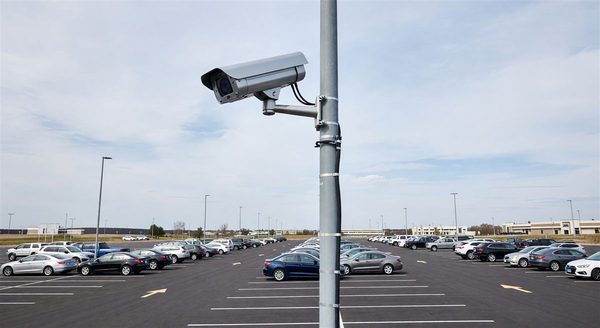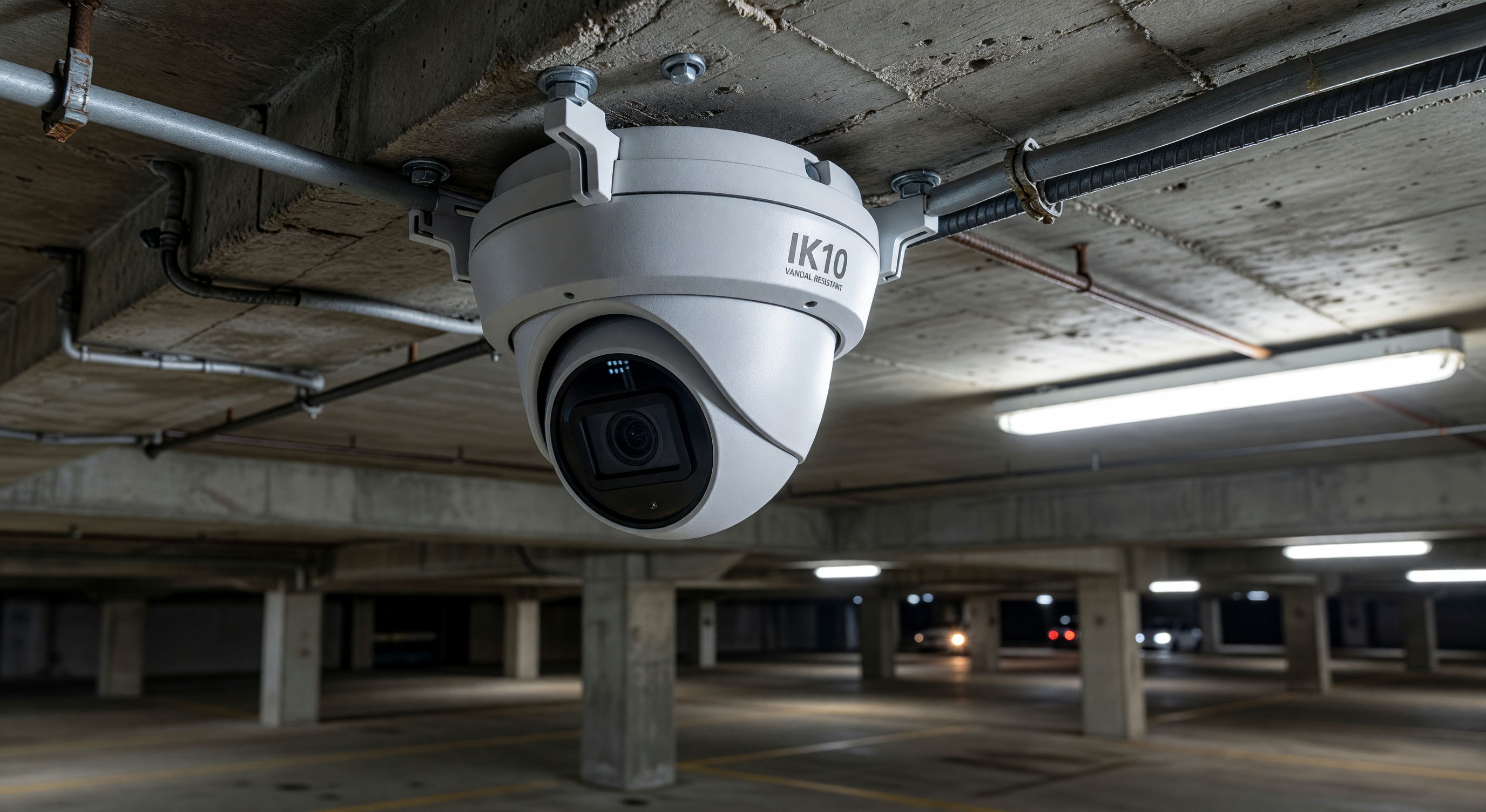
Camera vandalism in parking facilities takes two forms: deliberate targeted damage (someone who doesn’t want to be recorded) and incidental damage from vehicles, equipment, or weather. Both require different hardware responses, and the specifications that address each are often conflated in product marketing.
IK impact ratings and IP weatherproof ratings are the primary specifications governing camera resilience — but they measure different things. A camera that’s IP66 rated is fully weatherproof but may have a plastic dome that shatters with a single hammer blow. A camera with IK10 rating can withstand a significant impact but may not be sealed adequately for coastal or industrial environments.
This guide explains what each rating system measures, what specifications are appropriate for parking facility environments, and what additional mounting considerations improve resilience beyond camera ratings.
IP Ratings: What They Actually Measure
IP (Ingress Protection) ratings are defined by IEC standard 60529 and measure protection against solid particles and liquid ingress. The rating appears as “IPXX” where the first digit indicates solid protection and the second indicates liquid protection.
Solid Particle Protection (First Digit)
- IP5X: Dust-protected — limited dust ingress, not harmful to function
- IP6X: Dust-tight — no dust ingress under any condition
For parking facility cameras (outdoor or in structures exposed to dust, dirt, and airborne debris), IP6X solid protection is standard. The difference between dust-protected and dust-tight matters in high-dust environments like gravel parking areas or construction-adjacent lots.
Liquid Ingress Protection (Second Digit)
- IPX4: Splash-proof from any direction — minimum for indoor parking structures
- IPX5: Protected against water jets from any direction — minimum for outdoor cameras
- IPX6: Protected against powerful water jets — appropriate for environments with pressure washing
- IPX7: Immersion-protected to 1 meter for 30 minutes — relevant for low-mount cameras subject to flooding
- IPX8: Continuous immersion beyond 1 meter — typically not required for parking cameras
Standard specifications for parking environments:
- Indoor structured parking, no vehicle washing: IP54 minimum
- Outdoor surface lot, standard weather exposure: IP66 minimum
- Coastal or high-humidity environments: IP66 with additional housing corrosion resistance
- Locations subject to pressure washing: IP66 minimum; IP67 preferred
IK Ratings: Impact Resistance
IK ratings (defined by IEC 62262) measure impact resistance against external mechanical blows. The scale runs IK00 (no protection) to IK10 (maximum).
IK Scale Reference Points
| IK Rating | Impact Energy | Equivalent Blow |
|---|---|---|
| IK07 | 2 joules | Small tool drop |
| IK08 | 5 joules | Moderate vandal attempt |
| IK09 | 10 joules | Hard vandal attempt |
| IK10 | 20 joules | Sustained vandal attack |
A 20-joule blow approximates a significant hammer strike. IK10 cameras can withstand this without housing penetration or camera damage.
Appropriate IK Ratings by Environment
Low-risk indoor structured parking (monitored, low vandalism history): IK07 or IK08 provides adequate protection against incidental bumps and minor tampering.
Urban surface lots, unmonitored areas, or facilities with vandalism history: IK10 cameras with metal (aluminum or stainless steel) housings are the appropriate specification. Plastic domes that achieve IK10 are available but less common than polycarbonate or glass dome options.
High-risk environments (transit hubs, high-crime areas, overnight unmonitored lots): IK10 with metal dome cameras mounted above reach height, combined with reinforced mounting hardware.
Housing Materials
IK ratings specify impact energy tolerance but don’t fully describe the housing material or the nature of the resistance. Housing material selection matters for specific threat types.
Dome Cameras
Plastic/polycarbonate domes: Standard in most commercial cameras. Adequate for IK07–IK09 ratings; can shatter under repeated impact even when rated for single-impact tolerance. Cost-effective; widely available.
Tempered glass domes: Higher optical clarity and better scratch resistance than plastic. IK09–IK10 rated tempered glass is more resistant to sustained attack than polycarbonate. More expensive; available on higher-end cameras.
Metal dome covers: Maximum impact resistance. Some vandal-resistant cameras replace the dome entirely with a perforated or slotted metal cover. These have no optical lens exposed — the camera is completely protected. Used in extreme vandalism environments.
Body and Housing
Die-cast aluminum: Standard for commercial IP cameras. Adequate corrosion resistance for most environments with powder coat finish.
Stainless steel: Superior corrosion resistance for coastal environments, industrial facilities, or anywhere exposed to harsh chemicals. Significantly heavier and more expensive than aluminum. Specify 316 grade stainless for marine environments; 304 grade for other corrosive environments.
Polycarbonate and ABS plastic: Cost-effective for indoor applications; inadequate for outdoor high-risk environments regardless of IK rating.
Mounting Considerations for Vandal Resistance
The camera housing rating means nothing if the mounting is accessible. Mounting considerations:
Height and Reach
Mounting cameras above the practical reach of a standing person (7+ feet for most environments) significantly reduces vandalism exposure. Standard parking camera mounting heights of 10–22 feet are generally above reach height, but transit and pedestrian-scale environments may require lower mounting with corresponding higher IK ratings.
Tamper-Resistant Fasteners
Camera mounting brackets and housing access panels should use tamper-resistant fasteners (Torx, pentalobular, or security hex) rather than standard Phillips or slotted screws. Standard fasteners allow anyone with a screwdriver to remove mounting hardware.
Cable Protection
Camera cabling is a common attack vector — cutting or pulling cables disables the camera and may access network infrastructure. Conduit protects external cable runs; internal cable routing through building structures eliminates external exposure.
Mounting Base Strength
Camera poles and mounting brackets need to be specified for the vandalism and wind load environment. A camera rated IK10 mounted on a flimsy bracket that bends under lateral force defeats the camera rating. Use schedule 40 or heavier steel pipe for pole mounts in vandalism-risk environments.
Corrosion Protection for Coastal and Winter Environments
Cameras in coastal or salt-spray environments fail primarily from corrosion, not impact — even cameras that are never vandalized. Specification requirements:
- Aluminum housing with sacrificial anode or marine-grade anodizing
- Stainless steel hardware (304 or 316 grade) for all exposed fasteners
- UV-stable external cable jackets (standard black PVC yellows and cracks within 3 years in direct sunlight)
- Conformal coating on internal electronics where possible
- Regular housing inspections and gasket replacement to maintain IP rating
In winter environments with road salt, cameras positioned near lanes experience road salt mist accumulation. Plan for quarterly cleaning and annual gasket inspection to maintain weatherproofing.
Frequently Asked Questions
Is IK10 always better than IK07? IK10 cameras are heavier, more expensive, and sometimes have reduced optical performance due to the robust housing design. In low-risk indoor environments, IK07 or IK08 provides adequate protection at lower cost and weight. Match IK rating to actual risk, not the highest available specification.
Do security camera housings affect image quality? The dome or window material in front of the lens affects image sharpness, particularly at wide angles. Low-quality plastic domes introduce chromatic aberration and reduce resolution. High-quality tempered glass or optical-grade polycarbonate domes minimize this effect. Review sample images from cameras in their housings — not just spec sheets — before purchase.
What is the difference between a vandal-resistant camera and a vandal-proof camera? “Vandal-proof” is a marketing term with no technical definition. “Vandal-resistant” cameras have certified IK ratings. Specify the IK rating rather than accepting vague marketing claims.
How often should outdoor camera housings be inspected? Quarterly inspection is standard for outdoor cameras in parking facilities. Check housing integrity, gasket condition, lens contamination, and mounting hardware tightness. Replace housing gaskets annually or whenever the housing is opened for maintenance to maintain IP rating.
Key Takeaway
Specify IP and IK ratings together — a camera that’s weatherproof but fragile fails in vandalism-risk environments, and an impact-resistant camera with inadequate weatherproofing fails in harsh climates. Match both ratings to your actual environment rather than defaulting to either minimum or maximum specifications.