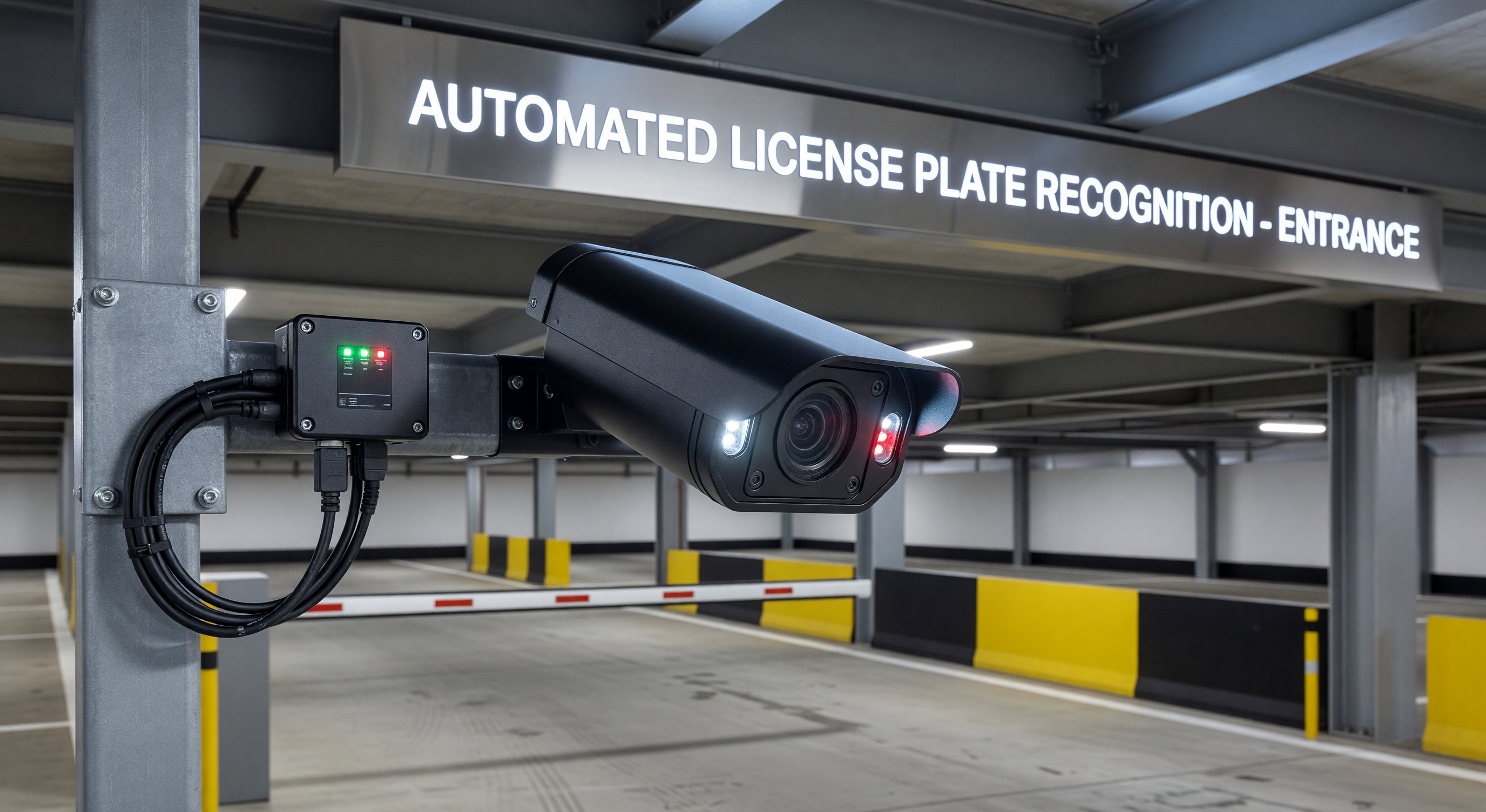
License plate recognition cameras are not general-purpose security cameras with software bolted on. The optics, sensor, shutter speed, and IR illuminator in an LPR camera are engineered specifically for one job: capturing a sharp, readable plate image from a moving vehicle in any lighting condition. Buying a standard IP camera and running ALPR software on it is a false economy — accuracy will suffer, and accuracy is the only metric that matters.
This guide covers every hardware and software spec you need to compare before committing to a system.
LPR Cameras vs Standard Security Cameras
The distinction matters before anything else. A standard surveillance camera is optimized for wide-area scene capture at moderate frame rates. An LPR camera is optimized for a 12-inch target (a license plate) moving at vehicle speed through a controlled capture zone.
Key hardware differences:
Shutter speed. LPR cameras use extremely fast electronic shutters — typically 1/1000 second or faster — to freeze plate motion without blur. A standard IP camera at 1/30 or 1/60 second produces a blurred plate at 10+ mph.
IR illumination. LPR cameras use dedicated near-infrared (NIR) illuminators, typically 850nm or 940nm wavelength, optimized for retroreflective license plate material. Standard camera IR is designed for general scene illumination — it’s not calibrated to license plate reflectivity.
Lens focal length. LPR lenses are narrower field-of-view than surveillance lenses, concentrated on the lane width and capture distance rather than a broad scene.
Processor. Purpose-built LPR cameras run onboard OCR processing — the plate number is recognized and logged at the camera, not just streamed to a server. This matters for latency in access control applications.
Key Specifications
Resolution
Resolution determines how much pixel detail is available to read the plate characters. More pixels on target means higher accuracy at longer distances or in more difficult conditions.
| Resolution | Practical Use Case |
|---|---|
| 2MP (1080p) | Short-range capture (under 15 ft), low-speed lanes, exit lanes |
| 5MP | Standard entry/exit lanes up to 25–30 ft capture distance |
| 8MP | Wide lanes, longer capture distances, multi-lane or highway applications |
For a standard single-lane parking entry or exit at normal approach speeds, 2MP to 5MP is appropriate. Do not overbuy resolution to compensate for poor mounting position — a 2MP camera in the right location will outperform an 8MP camera mounted too high or at the wrong angle.
Capture Speed (Frames Per Second)
LPR accuracy at speed depends on how many frames the system captures during the window when the plate is in the optimal capture zone. Most facility LPR cameras run at 15–30 fps for capture, though some high-speed applications (parking enforcement on arterials, highway tolling) use 60+ fps.
For parking facility entry and exit applications where approach speeds are 5–15 mph, 15–25 fps is adequate. The critical factor is that the shutter speed per frame is fast enough to eliminate blur — fps alone does not determine image quality.
IR Illumination Range
The IR illuminator is what makes LPR work at night and in low light. Illumination range is specified as the maximum distance at which the camera can produce a readable plate image in darkness.
Typical ranges by product tier:
- Entry-level: 15–25 ft effective IR range
- Mid-range: 25–50 ft
- Long-range/highway: 50–150 ft
For a standard parking barrier gate installation where the camera is mounted 10–15 feet from the plate capture point, even entry-level IR range is technically sufficient. The practical issue is IR uniformity — a cheap illuminator will have hot spots in the center and fall-off at the edges of the lane. Specify cameras with wide-angle uniform IR illumination rather than maximum range you don’t need.
Note: 940nm IR illuminators are invisible to the naked eye (preferred for aesthetically sensitive sites). 850nm illuminators emit a faint red glow that is visible at night.
Operating Temperature
Most commercial LPR cameras are rated for −40°C to +60°C (−40°F to +140°F). This is a wider range than most CCTV cameras because LPR cameras are frequently installed outdoors in direct exposure without housing.
For Canadian installations or northern US climates, verify that the rated minimum temperature applies to the full camera (including the IR illuminator board), not just the sensor. Some units specify a narrower guaranteed operating range with a broader “storage” temperature range.
Lens Type: Varifocal vs Fixed
Varifocal lenses allow adjustment of focal length after mounting — typically via a motorized zoom mechanism (motorized varifocal, or MVF) or a manual adjustment ring. This is the practical choice for most installations because it allows precise focus calibration at the actual capture distance after the camera is mounted in its final position.
Fixed focal length lenses are pre-configured for a specific distance. They are less expensive and optically simpler, but require accurate knowledge of the capture distance before purchase and leave no room for adjustment after installation. Better suited for standardized, templated deployments where the geometry is identical across all sites.
For a first installation or any site with non-standard geometry, varifocal is worth the premium.
Fixed vs Mobile LPR
Fixed Facility LPR
Fixed LPR cameras are permanently mounted at entry and exit lanes. The camera captures every approaching vehicle, the OCR engine reads the plate, and the result is logged and compared against an access list or permit database in real time. The gate opens (or doesn’t) based on the result.
Fixed installations are the standard for:
- Gated parking structures and lots
- Permit-based employee/resident parking
- Pay-by-plate parking enforcement (fixed cameras cover specific zones)
- Revenue control integration at entry/exit
Mobile LPR (Handheld Enforcement)
Mobile LPR systems use cameras mounted on enforcement vehicles or handheld units carried by parking officers. The camera reads plates as the officer drives or walks through a lot, and the system flags unpermitted or overstayed vehicles against a permit database or time-limit record.
Mobile systems have different hardware requirements:
- Wider capture angle to read plates at various approach angles
- Faster processing to handle continuous movement
- GPS integration for timestamped location logging
- Different software architecture (offline-capable with sync)
A facility implementing both permit control (fixed) and enforcement (mobile) will typically use different hardware and software for each function, though some platform vendors offer unified management dashboards.
Software Integration: ALPR Platforms and Hardware Compatibility
The camera hardware reads the plate; the software decides what to do with it. Most commercial facilities need both to interoperate with existing access control, parking management, or payment systems.
Major ALPR software platforms in commercial parking include Genetec AutoVu, Vigilant (Motorola Solutions), OpenALPR (now Rekor), Plate Recognizer, and vendor-proprietary systems bundled with parking management platforms.
Compatibility considerations:
- ONVIF compliance: Most LPR cameras support ONVIF Profile S for basic video stream integration, but LPR metadata (plate reads, timestamps, confidence scores) is transmitted via proprietary SDKs or REST APIs. Confirm the camera’s SDK is supported by your software platform before purchasing.
- On-camera OCR vs server-side OCR: Some cameras transmit raw video to a server for OCR processing; others process onboard and transmit only the plate read result. On-camera OCR reduces bandwidth and latency but ties you to the camera manufacturer’s OCR engine. Server-side OCR gives you more software flexibility.
- Database integration: For access control applications, confirm whether the system connects to your existing access database (LDAP, Active Directory, or a parking management system) or requires a separate permit database.
For a broader view of how LPR integrates with sensors and detection systems across a facility, see our guide to occupancy detection options.
Installation Considerations
Mounting Height
Optimal LPR camera mounting height is typically 3–4 feet above the ground — low enough to capture the plate at a shallow angle, high enough to avoid obstructions. Mounting too high creates a steep downward angle that compresses plate characters and reduces read accuracy.
For entry lane installations at a gate cabinet, many manufacturers offer integrated camera brackets that mount the LPR camera directly on or adjacent to the gate operator housing at the correct height.
Capture Angle
The camera axis should be within 30 degrees of horizontal (both laterally and vertically). Beyond 30 degrees of skew, character distortion begins to affect accuracy. This is the most common installation error — cameras mounted too high and angled steeply down.
Lighting Conditions
While IR illumination handles darkness, LPR cameras must also handle glare — direct sunlight at sunrise and sunset creating washout in the image. Anti-glare coatings on the lens housing and correct positioning relative to sun angle are important for sites with east-west oriented entry lanes.
For sites with extreme backlight conditions (a lane facing directly into morning sun), WDR (wide dynamic range) sensor capability becomes a required spec, not a nice-to-have.
Lane Width
A single LPR camera can cover lane widths up to approximately 12 feet at typical mounting distances. Wider lanes — or multi-lane captures — require wider-angle lenses with correspondingly higher resolution to maintain plate pixel density across the full width.
Read Accuracy: What’s Realistic
Vendor marketing materials cite accuracy figures of 98–99%. Here is what those numbers mean in practice.
95%+ accuracy is achievable under controlled conditions: consistent lighting, standard plates, clean plate surfaces, approach speed under 20 mph, optimal mounting position.
Factors that reduce accuracy:
- Dirty or damaged plates (most common real-world degradation factor)
- Non-standard plates (vanity plates with unusual fonts, motorcycle plates, international plates)
- High approach speed (above 25 mph)
- Poor mounting angle
- Tinted plate covers (illegal in most jurisdictions but present in the field)
- Temporary paper plates
For access control applications (opening a gate for an authorized plate), a 95% read rate means 5% of transactions require a fallback — intercom call, ticket backup, manual override. Size your staffing and fallback flow accordingly. Enforcement applications can tolerate a lower read rate more easily since a missed read is a missed citation, not a blocked vehicle.
Price Ranges
Entry-Level ($800–$2,000 per camera)
Typically 2MP fixed lens, 15–25 ft IR range, on-camera OCR with proprietary software only. Suitable for small lots (under 100 spaces), low-throughput lanes, or enforcement applications where occasional misreads are acceptable. Limited third-party software integration.
Mid-Range ($2,000–$5,000 per camera)
2MP–5MP with varifocal lens, 25–50 ft IR range, on-camera OCR with SDK for third-party integration. This is the most common tier for commercial parking structures and managed surface lots. Most major ALPR software platforms have validated integrations with mid-range hardware from Genetec, Axis, and similar vendors.
Enterprise ($5,000+ per camera)
5MP–8MP, motorized varifocal, 50+ ft IR range, multi-lane capable, advanced WDR, redundant storage. Required for high-throughput environments: airports, transit hubs, large mixed-use developments, highway enforcement. Also includes purpose-built enforcement vehicle systems.
For most facility managers evaluating LPR for a standard gated lot or parking structure, the mid-range tier is the right starting point.
Buying Checklist
Before issuing an RFP or purchase order, confirm you have answers to:
- Lane width and capture distance at each installation point
- Approach speed (mph) for vehicles in the lane
- ALPR software platform (or requirement for vendor-bundled software)
- Required SDK or API for integration with access control system
- Minimum operating temperature for the site
- Night/low-light condition severity (determine IR range requirement)
- Fallback/override plan for misreads (intercom, ticket backup, staffed booth)
- Number of lanes × cameras × software license seats
Integrated LPR Systems
For facilities that want LPR integrated with barrier gate control, payment, and management software in a single platform, purpose-built integrated systems remove the integration complexity — combining AI-based plate recognition with access control hardware and management software in a unified commercial platform.
For a full overview of equipment categories across entry, exit, payment, and detection, see our complete equipment buyers guide.
parkingequipmentguide.com is an independent buyer’s reference. We cover equipment from multiple manufacturers. Sister resources: barriergatesystems.com | parkingtech.org | facilityparkingguide.com