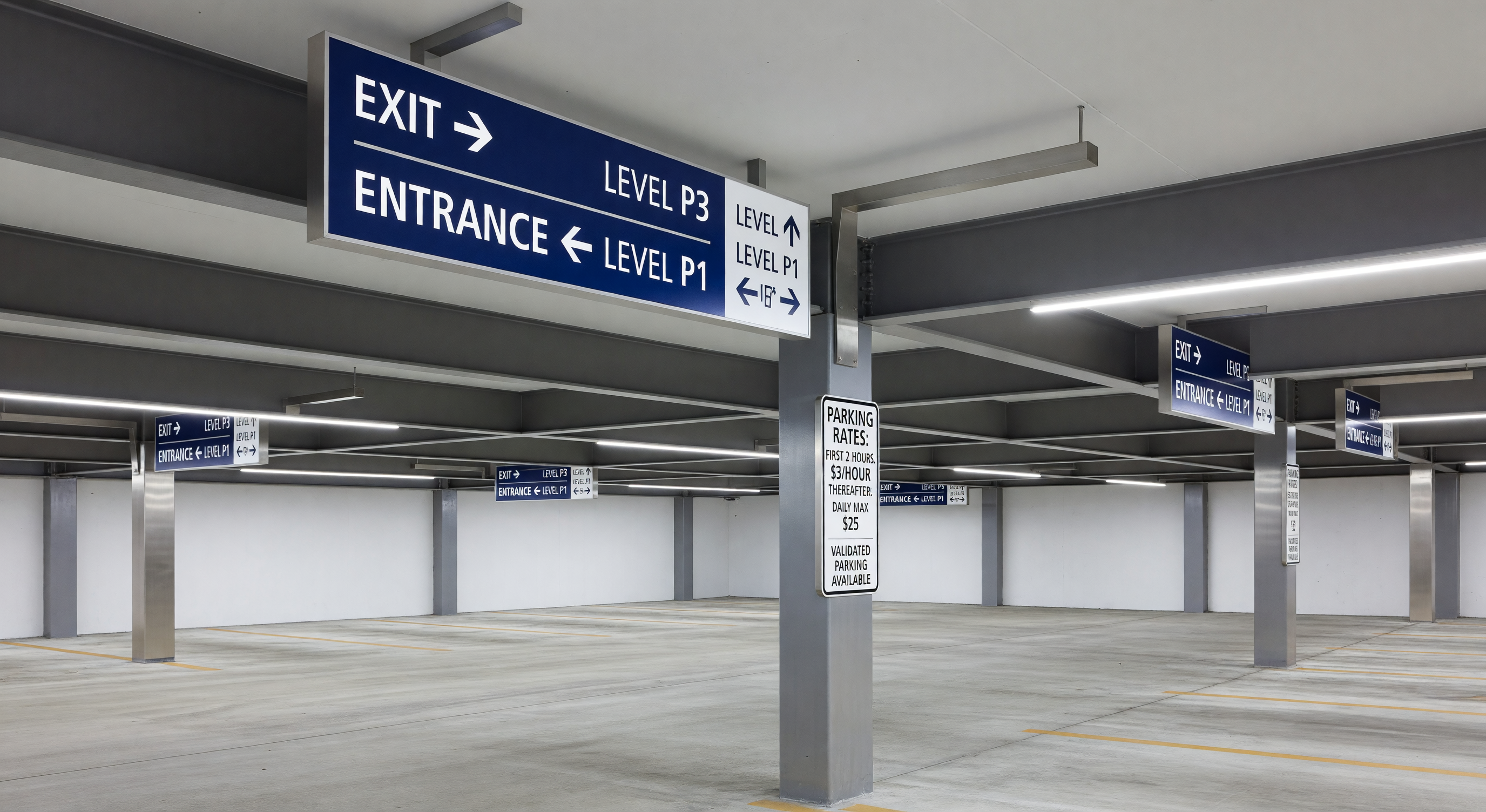
Parking signage exists at the intersection of driver communication and operational management. Static signs direct traffic and define rules. Dynamic signage goes further: it tells drivers where spaces are available in real time, reduces circling, and — when integrated with the parking management system — becomes a data-driven operational tool.
The procurement landscape spans basic LED count displays, full-color programmable panels, and networked wayfinding systems that update in seconds based on sensor data. This guide covers equipment categories, specifications, and integration requirements for parking facilities evaluating signage upgrades or new installations.
Static Signage: The Foundation
Static parking signage doesn’t require a buyer’s guide — it requires a manufacturer and an installation crew. But static signage decisions made poorly create operational problems that no dynamic system can fix downstream.
Common static signage failures:
Inadequate height for driver sightlines: Signs positioned for pedestrian reading height are often invisible to drivers in tall vehicles or when sun glare is present. Minimum mounting height for driver-facing signs is 7 feet; overhead signs on structures should be clearly visible from the driver’s seated position with no obstruction.
Missing regulatory compliance: ADA-compliant accessible parking signs have specific requirements: blue and white International Symbol of Accessibility, mounting between 5 and 7 feet on post-mounted signs, specific text requirements for van-accessible spaces. Non-compliant signage creates liability.
Insufficient reflectivity ratings: Outdoor parking signage should meet MUTCD (Manual on Uniform Traffic Control Devices) reflectivity standards where applicable. Sheeting grades: Engineer Grade (Type I) for low-speed parking environments; High Intensity (Type III) for higher-speed approach areas.
For new installations, work with a signage manufacturer who understands MUTCD, ADA, and local code requirements — not just graphics production.
Dynamic Count Displays
Dynamic parking count displays are the most common active signage in structured parking. They show the number of available spaces for a zone, floor, or facility entrance and update as vehicles enter and exit.
Exterior Count Signs
Mounted at facility entrances and on approach streets, exterior count signs direct drivers to facilities with available spaces before they commit to entering. They’re the primary application for reducing circling and approach traffic in multi-facility environments.
Specifications for exterior count signs:
- Display type: Seven-segment LED for count-only displays; LED matrix for text plus count; full-color P-series LED for mixed messaging
- Pixel pitch: Outdoor signs in pedestrian or traffic environments require larger pixel pitch (P16–P20 for sign widths under 6 feet viewed from 50+ feet); tighter pitch (P6–P10) for close-range or higher-resolution applications
- Brightness: 6,000–10,000 nits for direct-sunlight outdoor applications; auto-dimming for nighttime conditions
- IP rating: IP65 minimum for outdoor installations; IP66 for environments with pressure washing or heavy precipitation exposure
- Operating temperature: Verify the range for your climate — extreme cold or heat requires appropriate component ratings
Interior Zone and Floor Signs
Interior count signs within a structure direct drivers to floors or zones with availability. Standard configurations show a space count with directional arrows.
Interior environments allow lower brightness (1,500–3,000 nits) since direct sunlight is not a factor. Mounting options: ceiling pendant, wall bracket, or overhead truss. Consider cable management and power routing in the early planning phase — retrofit installations in existing structures often discover that getting power to optimal mounting locations is the primary cost.
Programmable LED Matrix Displays
LED matrix displays provide flexibility beyond simple count numbers — they can display text, directional arrows, rates, events, and custom messages. They’re appropriate for facilities that change messaging based on operational state: event parking, special rates, overflow direction.
Evaluation criteria:
- Content management system: How is messaging updated? Web interface, mobile app, scheduled programming, or API? Evaluate ease-of-use for non-technical staff.
- Remote management: Can signs be updated from a central management console, or does each sign require individual programming?
- Dayparting and scheduling: Can the sign automatically switch messages based on time of day or day of week without manual intervention?
- API connectivity: For integration with parking management systems that push real-time data, the sign must have an accessible API or compatible integration.
Wayfinding Systems for Multi-Level Structures
Full wayfinding systems guide drivers through complex structures by showing directional arrows combined with space availability at each decision point — typically at ramp entrances, level transitions, and aisle entrances.
System Architecture
A complete wayfinding system consists of:
- Occupancy sensors (ultrasonic, camera-based, or magnetic) at each space or zone
- Zone controllers that aggregate sensor data for their assigned area
- Display units at each decision point showing directional indicators and zone availability
- Central management software that provides real-time occupancy visualization and historical reporting
The display units and sensors are interconnected — a wayfinding system without accurate, real-time sensor data is worse than no guidance at all, because it actively misdirects drivers.
Integration with PARCS
The most sophisticated parking wayfinding installations integrate with the PARCS platform, allowing availability data to reflect not just physical occupancy but also reserved spaces. A reserved space that’s physically empty should still show as unavailable in the wayfinding system.
This integration requires an API connection between the wayfinding management software and the PARCS platform. Verify this integration is production-tested for your specific PARCS platform, not just listed as a theoretical capability.
Exterior Wayfinding: Approach Signage
Directing drivers to your facility from the surrounding street network is often more impactful than sophisticated in-structure guidance. A driver who can’t find the facility entrance doesn’t benefit from perfect in-structure wayfinding.
Exterior approach signage options:
- Fixed street signs: Require local transportation department or municipal approval for placement in the right-of-way. Low cost, permanent, effective.
- Dynamic message signs (DMS): Variable message signs that can display parking availability to approaching drivers. Often require municipal partnership or roadway authority approval for placement.
- Digital kiosks: Pedestrian-scale interactive kiosks at street level that provide facility maps and space availability. Common in urban entertainment districts.
Coordinate exterior signage design with local authority requirements before specifying hardware — the regulatory approval process often constrains placement, dimensions, and illumination.
Frequently Asked Questions
How often do dynamic parking signs need to be updated? LED outdoor parking signs have rated lifespans of 50,000–100,000 hours, translating to 10–15 years of service at standard operating hours. Plan for software and control system refresh cycles more frequently than hardware — count display logic and network protocols may need updating every 5–7 years as management software evolves.
What is the typical project cost for a dynamic wayfinding system in a 500-space garage? A complete wayfinding deployment in a 500-space garage — sensors, floor-level count displays, and exterior entrance signs — typically runs $150,000–$350,000 installed depending on sensor technology, display quality, and network infrastructure requirements.
Can we start with just exterior count signs and add interior guidance later? Yes, and this phased approach makes sense for facilities evaluating ROI before full investment. Exterior count signs are independently useful and require less infrastructure than full interior wayfinding. Plan cabling and network routing for future interior deployment when installing exterior signs.
How do dynamic signs handle power outages? Signs should default to a safe state (off, or displaying a fixed message) rather than displaying erroneous availability data during power interruptions. Verify the default behavior in your procurement specification.
Key Takeaway
Parking signage equipment quality is evaluated primarily at night and in adverse weather — conditions where cheap displays wash out, dim signs become invisible, and poor weatherproofing causes early failure. Specify brightness, IP rating, and operating temperature ranges from the start, not as afterthoughts.