Choosing a parking occupancy sensor is not a straightforward equipment purchase. Four distinct detection technologies — ultrasonic, magnetic, camera-based, and LiDAR — each carry different accuracy profiles, infrastructure requirements, installation costs, and failure modes. Selecting the wrong one for your facility type can result in inaccurate data that erodes driver trust, stranded capital in hardware that doesn’t fit your structure, or ongoing maintenance costs that weren’t visible at procurement. This guide walks through each technology on terms that matter to buyers: how it works, where it performs well, where it breaks down, and what the full cost picture looks like.
The Four Core Technologies
Ultrasonic Sensors
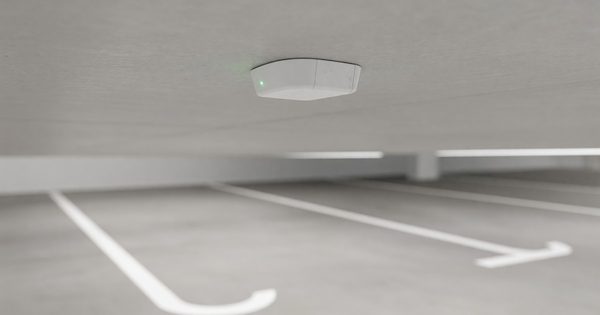
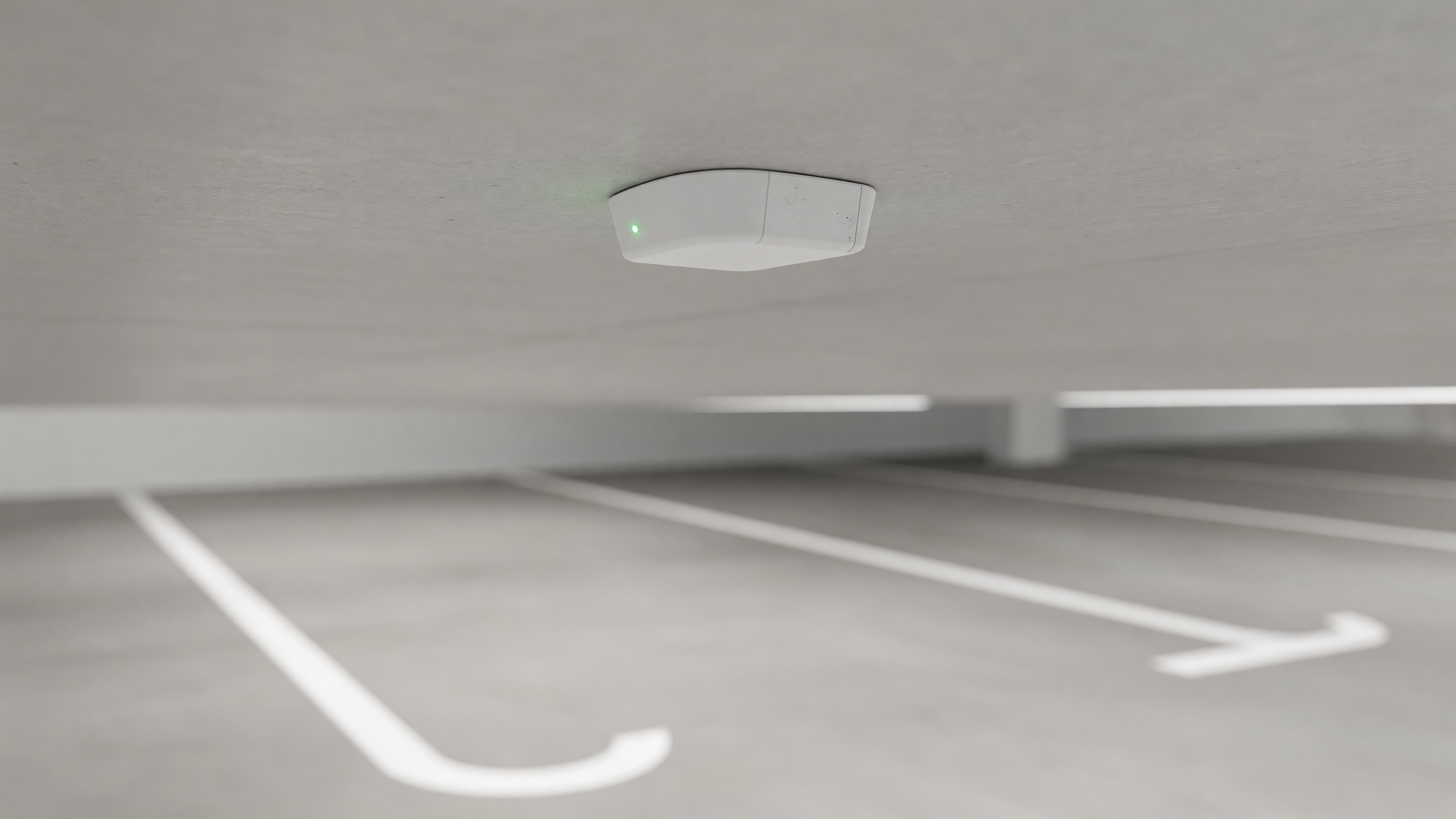
Ultrasonic sensors emit high-frequency sound waves downward from a ceiling-mounted unit and measure the reflected signal to determine whether a space is occupied. They are among the most common sensors in structured parking facilities — garages and decks — where ceiling mounting is practical.
Accuracy for ultrasonic sensors is generally high under controlled conditions, and dual-detection units that combine ultrasonic with infrared can reach 99% accuracy or better. Single-modality ultrasonic sensors are more cost-effective but can produce false readings when a vehicle partially occupies a space or when a large object (shopping cart, trash bin) sits in the stall.
Best fit: Multi-level garages with consistent ceiling heights, facilities with existing conduit infrastructure, operators prioritizing per-space visibility.
Watch for: Interference in very noisy acoustic environments; sensitivity calibration requirements when ceiling height varies across zones.
Magnetic Sensors
Magnetic sensors — typically wireless, in-ground units — detect the disruption a vehicle’s metal mass creates in the local magnetic field. They are the most widely deployed technology for on-street and surface lot applications and are frequently cited as the most common choice for municipal deployments.
These sensors sit flush with or just below the pavement surface, transmit via low-power radio to a gateway, and require no external power wiring at each space. Battery life on modern units typically runs several years before replacement. The trade-off is installation: cutting pavement for each sensor adds per-space labor cost and requires a road or lot to be temporarily out of service during installation.
Magnetic sensors are vulnerable to electromagnetic interference from high-voltage power lines or heavy equipment operating nearby, which can produce false occupancy readings. They are also blind to bicycles and motorcycles — only metal mass above a certain threshold registers.
Best fit: Surface lots, on-street applications, retrofit projects where running conduit is impractical.
Watch for: Cut-in installation cost and disruption; reduced reliability near electrical infrastructure; no detection of two-wheelers.
Camera-Based Systems
Camera-based systems use image processing — increasingly machine learning-based — to classify individual spaces as occupied or vacant from overhead or angled cameras. A single camera can typically cover multiple spaces, reducing the per-space hardware cost compared to one-sensor-per-space approaches.
The economics look attractive on paper, but performance is more variable than the other technologies. Camera systems frequently underperform in low-light conditions, during heavy rain, when windshields reflect glare, or when vehicles partially overlap lane markings. Shadows from adjacent vehicles or structural elements can produce misclassifications that a rule-based system struggles to handle. Modern AI-enhanced systems improve on this, but accuracy depends heavily on camera placement, lighting design, and the quality of the inference model.
Camera systems also introduce data considerations that magnetic and ultrasonic sensors do not: video feeds or still captures of a parking structure may be subject to privacy regulations depending on jurisdiction, and footage retention policies need to be established at procurement.
Best fit: Open-plan surface lots with good ambient or artificial lighting; facilities where per-space sensor installation is cost-prohibitive; operators who also want license plate capture as a secondary function.
Watch for: Accuracy degradation in adverse lighting or weather; privacy and data retention compliance requirements; ongoing software licensing costs in SaaS-model systems.
LiDAR Sensors
LiDAR (Light Detection and Ranging) sensors emit laser pulses and build a three-dimensional point cloud of the environment below, enabling occupancy detection across a wide coverage area from a single unit. A single LiDAR sensor can monitor up to 50 parking spaces simultaneously, which substantially changes the hardware-per-space math relative to ultrasonic or magnetic approaches.
Because LiDAR performs 3D spatial recognition rather than simple presence/absence detection, it can distinguish between vehicles, pedestrians, and other objects more reliably than ultrasonic sensors and more reliably than cameras in low-light conditions. It also performs well in covered structures where GPS or ambient light are limited.
LiDAR hardware costs remain higher than ultrasonic or magnetic sensors on a per-unit basis, though the coverage ratio improves the per-space effective cost. This technology is gaining traction in large-format facilities — airports, stadiums, large municipal garages — where the coverage efficiency justifies the unit cost and where data quality requirements are high.
Best fit: Large-format covered facilities with high space counts; operators with complex traffic flow analysis needs; facilities requiring high accuracy with minimal per-space hardware.
Watch for: Higher upfront hardware cost; specialized commissioning requirements; fewer installers with deep LiDAR deployment experience compared to ultrasonic or magnetic.
Decision Criteria by Facility Type
Structured Parking Garages
Ultrasonic sensors are the standard choice for most structured garages. They integrate cleanly with overhead guidance displays, per-space LED indicators, and zone-level count displays without requiring pavement work. For large garages where coverage efficiency matters, LiDAR is an increasingly practical alternative — particularly if the facility also needs pedestrian flow data or if per-space wiring would be expensive to run.
Camera systems work in garages but require careful lighting design and positioning to maintain accuracy across all weather and lighting conditions. Budget for additional lighting infrastructure if evaluating cameras in a covered structure.
Surface Lots
Magnetic sensors dominate surface lot applications because they require no ceiling infrastructure and transmit wirelessly. The installation disruption is a one-time cost, and multi-year battery life keeps ongoing operational costs low. For surface lots with a small number of high-value reserved spaces, in-ground magnetic sensors are often the most cost-effective path.
Camera coverage from elevated mast or pole mounts is an alternative that avoids pavement cutting entirely, but requires adequate lighting and accepts the accuracy trade-offs noted above.
On-Street Applications
Magnetic in-ground sensors are the established standard for on-street occupancy detection, which is reflected in their prevalence in municipal deployments globally. The wireless architecture fits well with the distributed nature of on-street infrastructure. Some cities have trialed radar-based systems as a non-invasive alternative that avoids cutting pavement, but magnetic sensors remain the most commonly specified technology for this use case.
Total Cost of Ownership: What Buyers Miss
Hardware unit price is rarely the number that drives long-term cost. The US Department of Transportation has documented installation costs for ultrasonic in-ceiling sensors in the range of $300–$500 per space, inclusive of labor — and that figure does not include back-end software, network infrastructure, gateway hardware, or ongoing maintenance contracts.
For magnetic sensors, add the cost of pavement cutting and restoration per space, plus gateway installation to collect wireless signals. For camera systems, factor in software licensing (many systems are sold as a recurring SaaS subscription), server or cloud infrastructure, and the cost of retraining or updating the inference model if the vendor changes its pricing model.
Key line items to request from any vendor at procurement:
- Per-space hardware cost (unit + mounting hardware)
- Installation labor estimate per space for your facility type
- Gateway and network infrastructure cost
- Back-end software: one-time license vs. annual SaaS
- Maintenance contract terms and average annual cost
- Battery replacement schedule and cost (magnetic sensors)
- API access: is integration with your parking management system included or a separate line item?
Request API documentation early. Systems that don’t expose a clean API for integration with your existing parking management software, revenue control system, or wayfinding application create lock-in and limit your options when you want to expand or replace components later.
Accuracy, Reliability, and What Happens When Sensors Fail
Any sensor deployment will experience failures. The question is whether the system degrades gracefully — defaulting to an “unknown” state rather than a confidently wrong “vacant” or “occupied” reading. Confirm with vendors how individual sensor failures are surfaced in the management console, how quickly they can be identified, and what the field replacement process looks like.
Dual-detection sensors that combine two modalities — ultrasonic with infrared, or magnetometer with radar — offer higher baseline accuracy and better failure redundancy than single-modality units. They cost more per space but reduce false readings in edge cases. For facilities where inaccurate occupancy data carries high operational cost (airport cell phone lots, high-turnover garages, enforcement-dependent on-street programs), the accuracy premium is generally worth it.
Making the Decision
No single sensor technology outperforms the others across all facility types and operational requirements. Ultrasonic sensors are the practical default for most structured garages. Magnetic sensors are the right starting point for surface lots and on-street. Camera systems are worth evaluating when per-space sensor installation is impractical and lighting conditions are controllable. LiDAR belongs in the conversation for large-format facilities with high space counts where coverage efficiency offsets the higher per-unit cost.
Before issuing an RFP, define the accuracy threshold your operation actually requires, identify which existing systems the sensors must integrate with, and build a full lifecycle cost model — not just the hardware line item. Vendors who can provide reference sites comparable to your facility type and allow third-party accuracy verification before full commitment are the ones worth shortlisting.