Parking guidance systems reduce circling traffic by 30–50% in structured parking environments — but only when the sensor network is accurate, the indicators are reliable, and the software gives operators actionable data. Buying these systems piecemeal, or from vendors who underestimate installation complexity, routinely produces facilities that know roughly how many cars are parked but not where.
This guide walks facility managers through the technology choices, specification requirements, and procurement considerations for parking guidance systems in garages and surface lots.
What a Parking Guidance System Actually Does
A parking guidance system (PGS) serves two simultaneous functions: guiding drivers to available spaces, and giving operators real-time occupancy data for operational decisions. These functions share the same sensor infrastructure but have different requirements for display hardware and software.
Driver guidance depends on indicator accuracy and display visibility. If a space shows green but is occupied — or red when empty — drivers stop trusting the system and begin checking manually, defeating the purpose. Accuracy requirements for functional guidance are generally stated as 98%+ at steady state. Vendors who cite accuracy without specifying conditions (outdoor vs. indoor, lighting conditions, vehicle types) are using marketing figures.
Operator data is generated from the same sensors but consumed in software dashboards. Facilities use this data for yield management, staffing decisions, enforcement prioritization, and monthly reporting. The data value compounds over time — multi-year occupancy trends support lease renegotiations, capital planning, and rate optimization.
Sensor Technology Options
Ultrasonic Sensors
Ceiling-mounted ultrasonic sensors are the dominant technology in structured parking. They emit high-frequency sound pulses and measure return time to detect vehicle presence. Standard mounting height ranges from 7 to 10 feet; accuracy degrades at heights above 12 feet.
Advantages: no pavement cutting, easy access for maintenance, suitable for covered environments. Limitations: performance can degrade with heavy acoustic interference, and they require a ceiling or overhead structure — making them unsuitable for open surface lots without infrastructure.
Per-space installed cost ranges from $150 to $350 depending on mounting complexity, cabling runs, and network architecture.
Optical/Camera-Based Sensors
Camera-based systems use machine vision to identify occupied spaces. A single camera can cover multiple spaces, reducing per-space cost in wide aisles. They provide a visual record of the space state — useful for dispute resolution — and can often be upgraded via software to add license plate reading without new hardware.
Accuracy is generally high under adequate lighting but can degrade with low-angle sun, shadow patterns, or heavy precipitation for outdoor applications. Camera-based systems typically require more network bandwidth and compute resources than ultrasonic alternatives.
Magnetic Puck Sensors
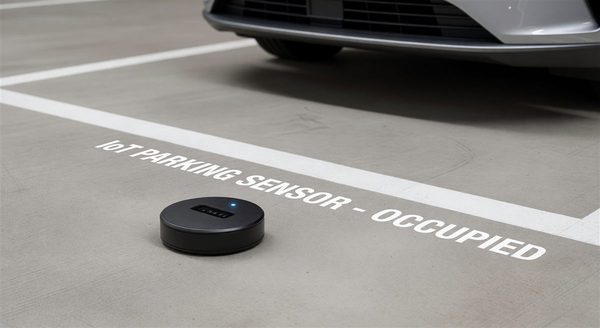
Wireless magnetic sensors embedded in or on the pavement detect the metallic mass of parked vehicles. Each sensor is self-contained with a battery life typically rated 3–7 years. They work in both structured and surface environments and require no ceiling infrastructure.
Installation requires pavement coring (for embedded units) or surface mounting (non-invasive). Battery replacement scheduling is the primary ongoing maintenance consideration.
LED Indicator Hardware
Single-Space vs. Zone Indicators
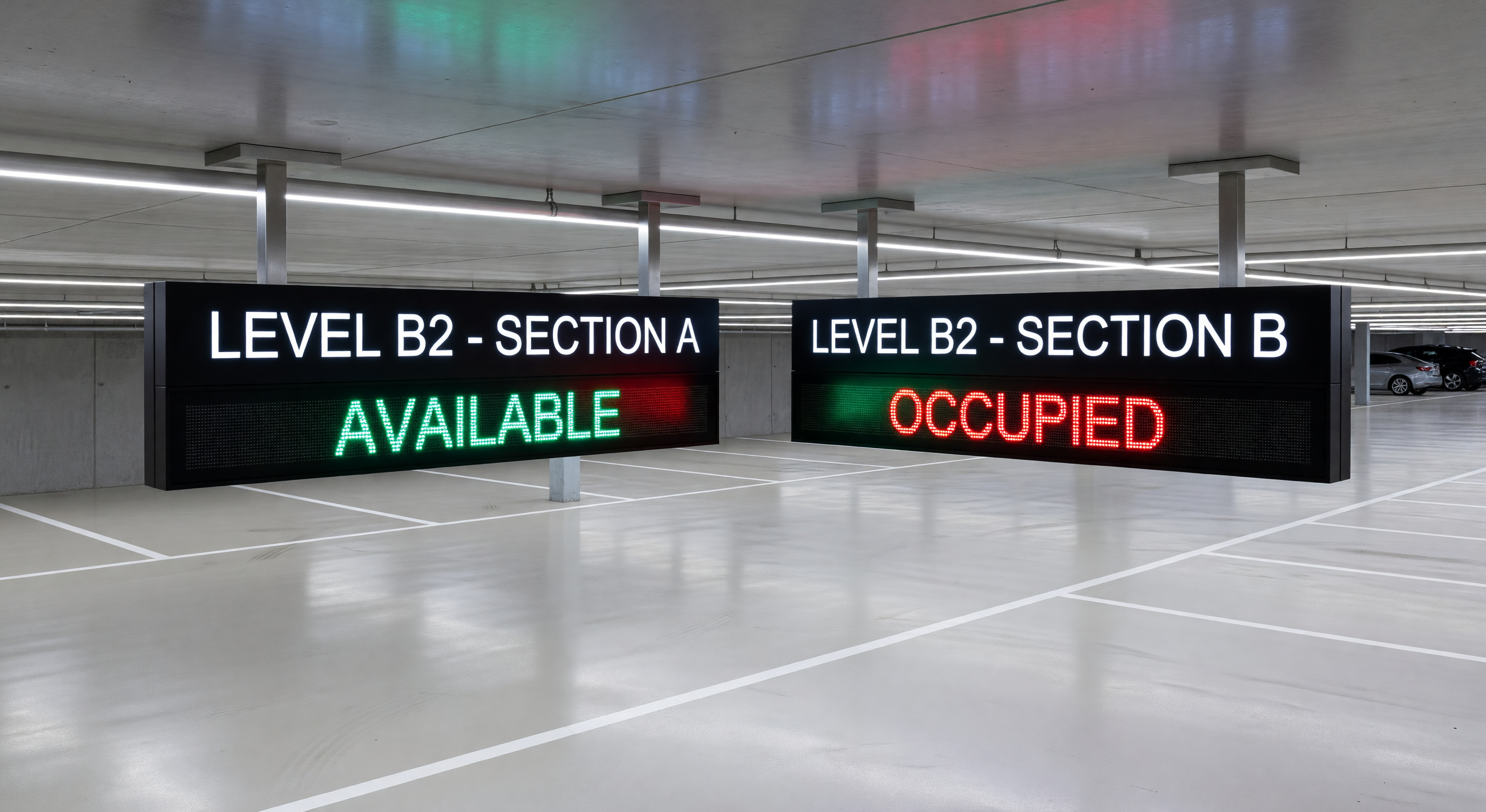
Single-space indicators mount above each parking space and show red/green status. They provide the most precise guidance but require one unit per space — a significant capital commitment in large facilities.
Zone indicators summarize available spaces in a section or row rather than indicating individual space status. They’re lower cost but less precise — a zone indicator showing “3 available” doesn’t tell the driver which three spaces are open.
Most modern deployments combine both: zone or entry-point indicators to direct drivers to the right floor or section, with single-space indicators in premium or high-value zones.
Specifications to Compare
- Visibility angle: Minimum 120°; 160° preferred for wide aisles
- Brightness: Adequate for ambient light conditions — garage lighting and surface lot sunlight are very different requirements
- IP rating: IP54 minimum for indoor garages; IP66 for semi-exposed or outdoor applications
- Color rendering: Ensure red and green are distinguishable by color-impaired drivers; some systems add directional arrows as a secondary cue
- Communication protocol: Wired (RS-485, Ethernet) vs. wireless — each has tradeoffs for installation cost and reliability
Network Architecture Considerations
A parking guidance system with 500 sensor nodes generates meaningful real-time data traffic. Network planning is often underestimated in early-stage procurement.
Wired systems use RS-485 bus topology or Ethernet runs. RS-485 is cost-effective for long cable runs but requires careful termination and is limited in bandwidth. Ethernet provides more bandwidth and easier troubleshooting but increases cabling cost in large facilities.
Wireless systems use proprietary 900 MHz mesh networks, Zigbee, or LoRaWAN. Battery-powered magnetic sensors require wireless. Wireless reduces installation cost but introduces RF planning requirements — concrete and rebar attenuate signals significantly in structured parking.
Edge controllers aggregate sensor data at zone or floor level before transmitting to a central system. They provide local processing resilience — if cloud connectivity drops, the system continues operating with locally stored data.
Software and Integration Requirements
The guidance system software should provide at minimum: real-time space availability by floor/zone, historical occupancy reports, sensor health monitoring with fault alerts, and a configurable API for third-party integrations.
Integration priority list to verify before purchase:
- PARCS platform (revenue control system) — allows rate adjustments based on occupancy
- Mobile parking apps — enables app-based guidance to open spaces
- Digital signage — feeds dynamic exterior signs showing available counts
- Building management systems — for reporting and energy management in automated facilities
Request a full API specification, not a list of “supported integrations.” The actual API documentation reveals whether the integration is production-ready or aspirational.
Total Cost Considerations
Published per-space costs for parking guidance systems ($150–$400 installed) often exclude:
- Network infrastructure (switches, controllers, cabling conduit)
- Software licensing (annual SaaS fees of $3,000–$15,000 depending on facility size)
- Installation labor in complex environments (low ceiling heights, limited cable routing paths)
- Commissioning and calibration time — large systems require significant on-site tuning
A realistic all-in cost for a 500-space garage with single-space indicators throughout runs $200,000–$350,000, depending on sensor type and installation complexity.
Frequently Asked Questions
What accuracy rate should I require in the contract? Specify 98% or higher at steady state in your RFP. Define steady state clearly — vendors sometimes measure accuracy during calibration periods or in ideal conditions. Require ongoing accuracy reporting from the live system.
Can I install parking guidance in phases? Yes, but plan the network architecture for full build-out from the start. Adding zones to a network not designed for expansion is expensive. Design the backbone for final capacity even if you deploy sensors incrementally.
How long do parking guidance sensors last? Ceiling-mounted ultrasonic sensors typically have rated service lives of 7–10 years. Wireless magnetic pucks vary by battery type — 3–7 years before replacement cycle. Factor replacement cost and access requirements into long-term budget planning.
Do parking guidance systems work in surface lots? Sensor options are more limited in open surface environments. Camera-based systems mounted on poles and wireless magnetic pucks are the primary options. Expect higher per-space costs due to infrastructure requirements and weather-resistant hardware.
Key Takeaway
A parking guidance system is only as good as its sensor accuracy and network reliability. Before committing to any platform, require a pilot installation in a representative section of your facility — 30 to 60 days of live operation will reveal accuracy issues, network gaps, and software limitations that no demo can expose.