Parking equipment purchasing fails most often not because a buyer chose the wrong product — but because they bought a collection of products that don’t work as a system. A pay station that can’t communicate with the access control software. A barrier gate that uses a proprietary loop detector your new sensor vendor won’t support. A camera system with no API for your PARCS platform. These are the real costs: rework, custom integrations, and years of operational friction.
This guide gives you the framework to buy parking equipment as an integrated system, covering every major category, a six-step procurement process, realistic budget ranges, and the mistakes that routinely cost facilities $20,000–$100,000 in post-installation corrections.
Equipment Categories: What You’re Actually Buying
Entry/Exit Equipment
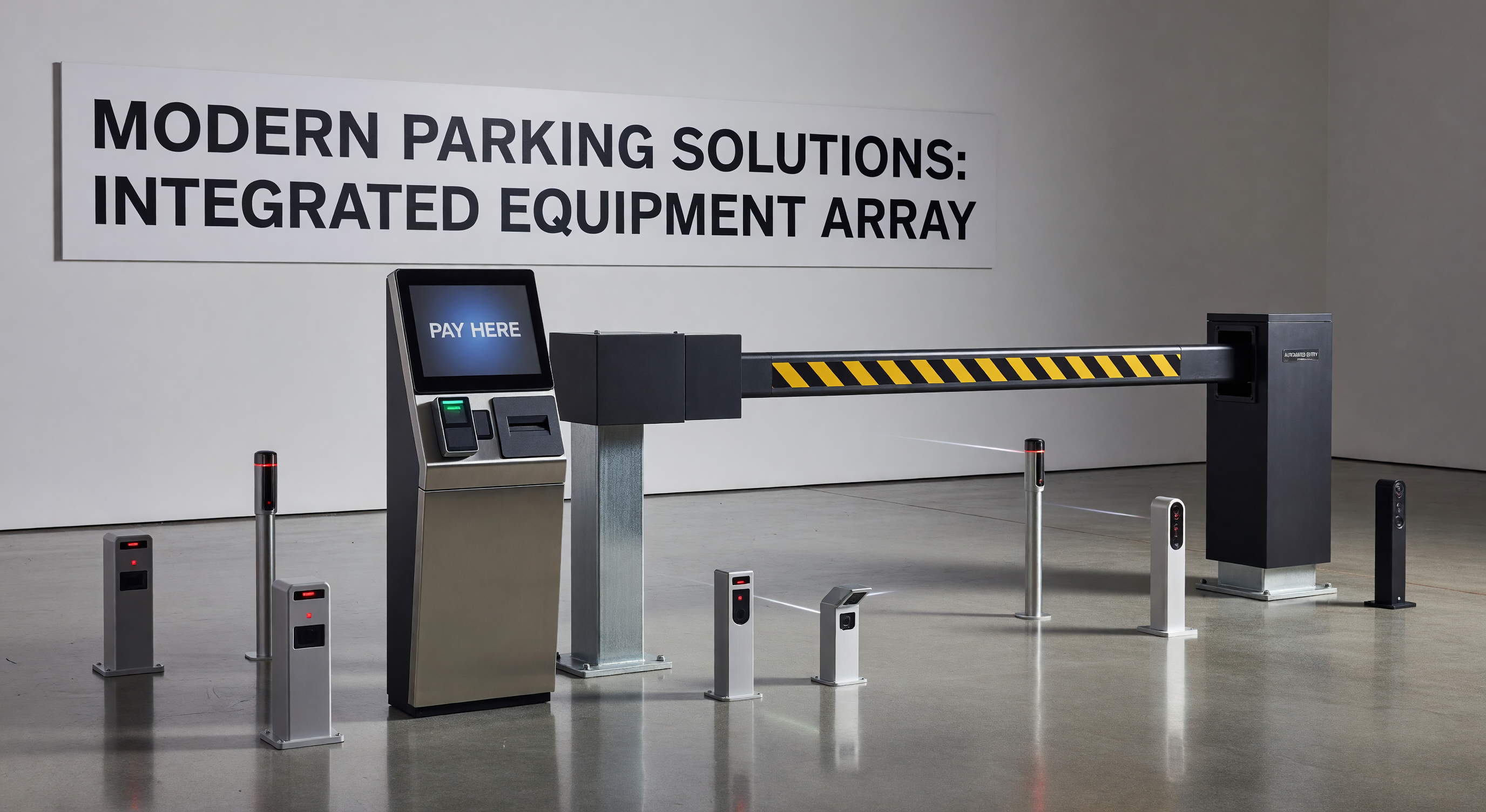
Barrier gates are the mechanical enforcement layer at lane entry and exit points. Key spec ranges: gate arm lengths run 8–20 feet; cycle times vary from 1.2 seconds (high-speed traffic gates) to 3–4 seconds (standard). Motor types split between AC and DC — DC motors provide smoother operation and are more common in high-volume installations. Loop detector inputs, safety loops, and anti-crash sensing are standard on commercial units. Budget: $2,500–$8,000 per lane for hardware; installation typically adds $1,500–$3,500 per lane.
Ticket dispensers (entry terminals) issue proximity tickets, QR codes, or magnetic stripe tickets at unstaffed entry lanes. Modern dispensers increasingly issue paper-free QR tickets via thermal printer or push to a mobile app. Evaluate thermal printer cycle life (rated in tickets — look for 2M+ print head ratings), card reader compatibility, and network connectivity (cellular vs. Ethernet vs. Wi-Fi redundancy).
Payment Equipment
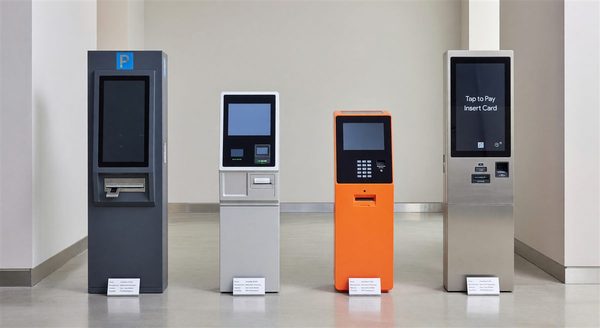
Pay-on-foot (POF) stations are the highest-value single line items in most garage builds — ranging from $8,000 to $28,000 per unit. Spec differences that justify price variance: bill acceptor capacity (400–2,000 notes before service), coin hopper capacity, EMV/NFC contactless payment certification, receipt printer type, and UL/ETL listing for outdoor exposure. For open-lot installations, look for NEMA 4X-rated enclosures minimum.
Pay-by-plate and mobile payment integrations are increasingly standard, but “integration” varies widely. True integration means your software platform receives payment confirmation and can validate license plates or tickets in real time — not just a separate mobile app that doesn’t talk to your gate logic. Verify this at the software level, not the sales brochure level.
Access Control
RFID credential systems are the baseline for monthly permit management. Long-range RFID (UHF, 902–928 MHz) reads transponders at 10–20 feet for hands-free access. Short-range (HF, 13.56 MHz proximity cards) requires card presentation within 2–4 inches. Migrating between credential formats is expensive — plan your credential standard before purchasing readers.
License plate recognition (LPR) cameras at lanes have become the dominant access control method for permit lots and garages moving away from physical credentials. Camera resolution requirements: minimum 2MP per lane, ideally 5MP; frame rate 15–30 fps; IR illumination rated for the lane depth and ambient conditions. LPR accuracy claims of “99%+” from vendors need to be verified in your specific environment — weather, plate condition, and vehicle speed all affect real-world read rates.
Detection and Monitoring
Inductive loop detectors are the legacy detection standard — wire loops embedded in asphalt detect vehicle presence for gate triggers and counting. Reliable, low-cost, and ubiquitous, but require cutting pavement for installation and periodic replacement as asphalt ages.
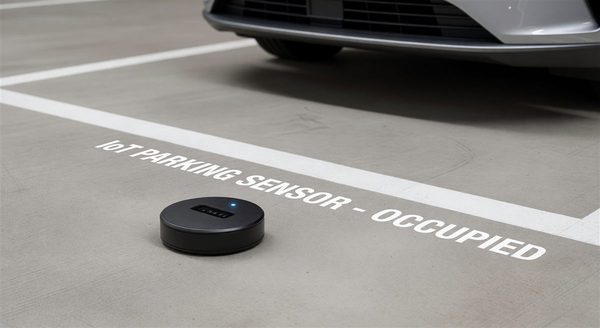
Above-ground sensors (ultrasonic, radar, magnetic puck) avoid pavement cuts and are increasingly common in retrofit installs and structured parking. Accuracy and false-trigger performance vary significantly by technology and installation height — validate with a pilot before full deployment.
Parking guidance cameras (for individual space availability) run $150–$400 per space installed, making them economical only for high-turnover facilities where revenue per space justifies the cost.
Back-Office and Management Software
PARCS (Parking Access and Revenue Control Systems) software is where the entire system comes together — and where purchasing mistakes have the longest operational tail. PARCS platforms centralize transaction processing, reporting, permit management, rate configuration, and event management. Cloud-hosted platforms have largely displaced on-premise server installations. Evaluate: transaction processing capacity (TPS), API availability and documentation quality, PCI DSS compliance scope, and offline resilience (what happens if cloud connectivity drops at the lane).
The Six-Step Procurement Framework
Step 1: Capacity and Use-Case Analysis
Before evaluating any equipment, define the operational requirements that will govern every other decision.
- Peak throughput: Calculate vehicles per hour at peak for each lane. A standard barrier gate with reliable loop detection handles 200–300 vehicles/hour. High-speed gates with RFID or LPR pre-authorization can process 600+/hour at express lanes.
- Permit vs. transient split: A facility with 90% monthly parkers has fundamentally different equipment needs than a 90% transient garage. Permit-heavy facilities can simplify payment infrastructure; transient-heavy facilities need robust POF coverage ratios (typically 1 POF per 50–100 spaces for comfortable throughput).
- Validation workflow: Will tenants, hotels, or retail customers receive validated parking? Validation integrations — whether physical stamp, QR, or integrated POS — need to be mapped before choosing a PARCS platform.
- Staffing model: Attended, partially attended, and fully unattended operations have completely different equipment requirements, particularly around intercom systems, CCTV coverage, and remote management capabilities.
Step 2: Technology Requirements and Integration Map
Build an integration map before the RFP. List every system the parking equipment must connect with: property management software, hotel PMS, event ticketing, EV charging management, wayfinding signage, financial/accounting platforms. For each integration, determine whether a native connector exists or custom API work will be required — and who bears that cost.
This step catches the integrations that vendors gloss over during demos. Get written confirmation of specific integration capabilities, not general assurances.
Step 3: Vendor Shortlist and RFP
Limit the shortlist to 3–4 vendors who can supply the full system or have demonstrated, working integrations with your required third-party systems. A vendor who supplies only one component but promises integrations they’ve never actually deployed is a risk.
Your RFP should require vendors to respond with: full bill of materials with part numbers, specific integration documentation (not marketing copy), service territory confirmation, parts stocking locations, and reference customers in your facility type and size range.
For a detailed framework on writing and scoring vendor responses, see our guide on writing the RFP.
Step 4: Site Visit and Demo Evaluation
Evaluate equipment at a comparable operating facility, not a showroom. Key things to verify on-site:
- Gate arm cycle time and crash sensitivity under real traffic conditions
- POF transaction speed end-to-end (insert ticket → pay → exit in under 45 seconds is a reasonable benchmark)
- Software UI under actual operator load
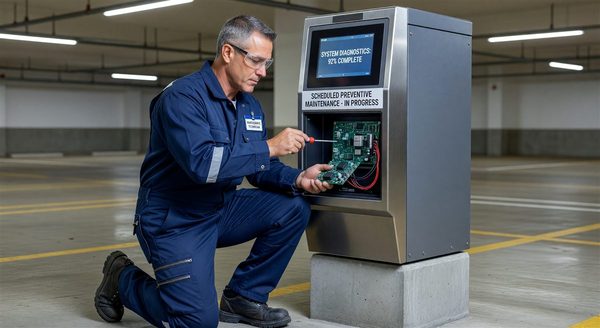
- Maintenance access panels and component serviceability — can a single technician replace a bill acceptor cassette in under 10 minutes?
Step 5: TCO Analysis and Comparison
First-year hardware cost is rarely the deciding factor in long-term value. Build a 10-year total cost model that includes:
- Hardware purchase or lease cost
- Installation and commissioning
- Annual software/SaaS licensing (cloud PARCS platforms typically run $3,000–$12,000/year for mid-size facilities)
- Annual maintenance contract or estimated break-fix costs
- Consumables (thermal paper, loop detector replacement, gate arm replacement frequency)
- Estimated downtime cost at your revenue-per-hour rate
See our total cost of ownership analysis for a detailed TCO worksheet.
Step 6: Contract Terms and SLA Review
The contract negotiation is where procurement teams most often leave value on the table. Key terms to negotiate:
- Response time SLAs: Revenue-affecting failures (gate down, POF offline) should carry 4-hour response guarantees. Get penalty provisions for breach.
- Parts availability: Require a contractual commitment for spare parts availability for a minimum of 7–10 years post-purchase. Vendors who won’t commit to this are signaling product line instability.
- Software update terms: Clarify whether major version upgrades are included in annual SaaS fees or billed separately.
- Data ownership and export: You must retain ownership of all transaction, permit, and revenue data. Require documented export capabilities before signing.
- Price lock provisions: Lock annual maintenance pricing for a minimum of 3 years or index it to a capped escalator.
Budget Planning by Facility Type
These ranges reflect complete system costs including hardware, installation, and first-year software — not hardware-only.
| Facility Type | Size | Budget Range |
|---|---|---|
| Surface lot, unstaffed | 50–150 spaces | $15,000–$50,000 |
| Surface lot with POF | 150–500 spaces | $45,000–$120,000 |
| Small garage, 2–3 lanes | 200–600 spaces | $100,000–$250,000 |
| Mid-size garage, 4–8 lanes | 600–1,500 spaces | $250,000–$500,000 |
| Large garage or campus system | 1,500+ spaces | $500,000–$2,000,000+ |
These ranges assume standard lane configurations, no parking guidance, and single-site PARCS deployments. Multi-site management platforms, LPR at all lanes, and parking guidance systems each add meaningful cost — budget 20–40% additional for fully instrumented facilities.
Common Procurement Mistakes
Buying on hardware price alone. The lowest-price barrier gate vendor who lacks local service coverage will cost more over five years than a mid-range competitor with next-day technician response. Factor service response into every comparison.
Under-specifying POF coverage. One POF station for a 400-space transient garage creates exit queues that damage customer experience and drive negative reviews. Industry standard is 1 POF per 50–75 spaces for transient facilities; 1 per 100–150 for permit-majority facilities.
Skipping the integration verification step. “Our system integrates with X” means nothing without documented API specs and a reference customer running the specific integration you need. Unverified integrations fail at go-live and become expensive custom development projects.
Choosing PARCS software last. PARCS should be chosen first or simultaneously with hardware — it determines what equipment is compatible. Choosing a POF station and then discovering the software vendor charges $15,000 for the integration is avoidable.
Ignoring offline resilience. Cloud-based PARCS is the right architecture for most facilities, but every lane must have a defined failure mode when internet connectivity drops. Vendors who can’t explain their offline mode clearly represent operational risk.
Short-term thinking on credentials. Installing a proximity card access system today that can’t migrate to mobile credentials in 3–5 years will require a full reader replacement cycle. Choose credential platforms with a clear mobile roadmap.
Getting Started
A useful starting point before issuing an RFP is completing an honest needs assessment against your current system deficiencies. Facilities replacing existing equipment often discover their problems weren’t hardware — they were software configuration, service contract gaps, or integration failures that new hardware alone won’t fix.
Before shortlisting vendors, review the vendor evaluation checklist — it identifies the non-obvious questions that distinguish strong vendor partners from equipment-only suppliers.
For facilities evaluating multiple manufacturers, some vendors offer barrier gates, pay stations, and integrated PARCS under a single platform — which simplifies integration verification and service accountability versus assembling a multi-vendor stack.