Parking access control exists at the intersection of physical security, payment systems, and building operations — which is exactly why integration failures are so common and so costly. A parking access control system that doesn’t communicate with the building access control platform means two separate credential databases, two separate security monitoring views, and manual reconciliation for every credential change.
This guide covers the integration architecture for parking access control systems, the technical requirements for connecting to other building and payment systems, and the questions to ask vendors before purchasing.
Access Control vs. PARCS: Understanding the Distinction
Parking access control and PARCS (Parking Access and Revenue Control System) are related but distinct systems that are sometimes conflated in vendor marketing.
Parking access control manages the physical entry and exit of vehicles: who can enter, when they can enter, through which lanes, and under what conditions. It enforces the rules.
PARCS adds the revenue layer: payment processing, transaction logging, rate management, and financial reporting. It handles the money.
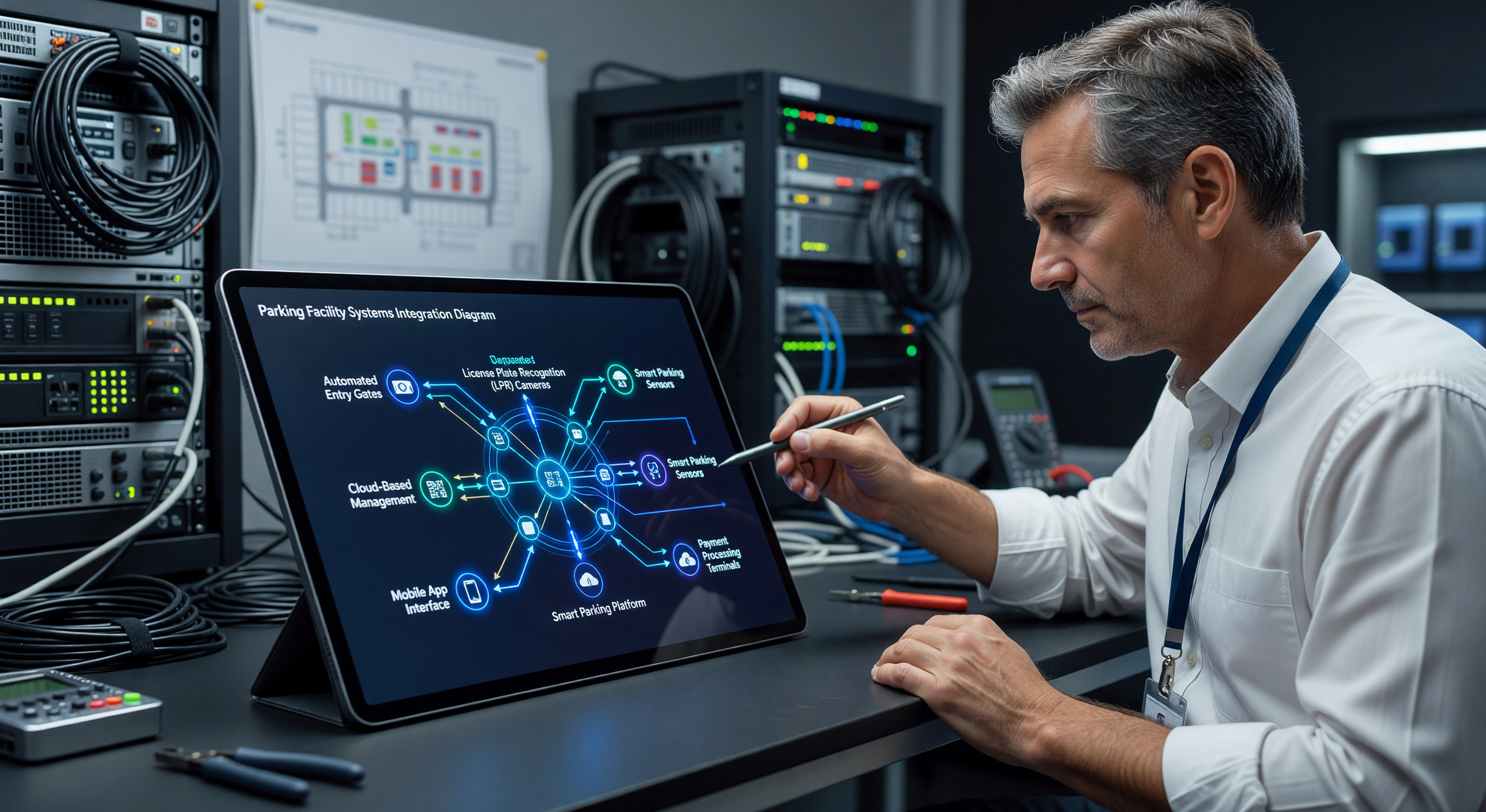
In practice, most modern parking installations use an integrated platform that handles both functions. But the integration complexity arises when parking access control must also communicate with:
- Building access control (for shared credentials)
- Hotel PMS (for guest room-charge and validation)
- EV charging management systems
- Mobile payment apps
- Enforcement LPR systems
Each of these integrations has different technical requirements and different integration patterns.
Integration Architecture Patterns
Native Integration
Native integration means the two systems are built by the same vendor or have a formally tested, production-supported connector between them. The integration is maintained by one or both vendors and breaks are addressed through standard support channels.
Native integrations are the lowest-risk option. When evaluating, confirm: the specific version of each system covered by the integration, the update policy (does a major version update break the integration?), and the support responsibility when the integration fails.
API Integration
API integration connects two systems through standardized web service interfaces. The systems communicate over HTTP/HTTPS using defined data formats (typically JSON or XML). Neither system needs to be from the same vendor; any two systems with compatible APIs can theoretically integrate.
Quality of API integration depends on API quality. Evaluate:
- Documentation completeness: Is the API fully documented with example requests/responses?
- API version stability: How often does the API change, and is backward compatibility maintained?
- Authentication: OAuth 2.0 is the current standard; API key authentication is acceptable; avoid systems that use unsecured endpoints
- Webhook support: APIs that can push events (vehicle entry, payment complete) rather than requiring the receiving system to poll are significantly more efficient for real-time integrations
Database-Level Integration
Some integrations work by reading from or writing to a shared database. This pattern is common in older systems and is generally lower quality than API integration — it creates tight coupling, is difficult to maintain across software updates, and is prone to breaking when either system updates its database schema.
Avoid database-level integrations unless no API option exists.
Building Access Control Integration
For corporate campuses, mixed-use buildings, and healthcare facilities, the parking credential should ideally be the same credential as the building access credential. An employee holds one card that opens both the parking gate and the office door.
Shared Credential Models
Wiegand card reader compatibility: Most building access control systems use the Wiegand communication protocol for card readers. Parking access control readers that support Wiegand can read the same proximity cards as building access — enabling a single card for both environments. Verify card format compatibility (26-bit, 34-bit, or custom) before purchasing.
License plate as credential: Facilities moving to LPR-based access control can use a vehicle’s license plate as the credential for both parking and, in some environments, campus access. This requires the LPR database to be shared across the parking and building access platforms.
Mobile credentials: Mobile credentials (Bluetooth, NFC on smartphones) are gaining adoption for both parking and building access. Verify that your parking access control platform supports the same mobile credential standard as your building access control system — OSDP (Open Supervised Device Protocol) or PACS (Physical Access Control System) mobile credential standards are current industry frameworks.
Directory and Identity Integration
Large organizations manage credentials through a central identity system (Active Directory, LDAP, or HR system). Integration with these systems allows:
- Automatic credential provisioning when an employee is onboarded
- Automatic credential revocation when an employee departs
- Role-based access (only managers can access executive parking levels)
Parking access control systems that lack directory integration require manual credential management — creating security gaps when employees leave and the parking credential isn’t revoked promptly.
Hotel PMS Integration
Hotel parking facilities require integration between the parking access control system and the Property Management System. The integration enables:
- Guest validation: registered guests receive complimentary or discounted parking automatically
- Room billing: parking charges post to the room folio without separate payment
- In-and-out privileges: guests can exit and re-enter during their stay without re-paying
- Stay-duration coordination: parking access automatically expires at checkout date/time
PMS integration complexity varies by PMS platform. Platforms with open APIs (Opera Cloud, Mews, Cloudbeds) support cleaner integrations. Older on-premise PMS installations may require middleware or file-based integration that introduces latency and reconciliation requirements.
Always request a reference customer running the exact PMS integration you need at a comparable property before committing to a parking system.
EV Charging Integration
As EV charging becomes standard in parking facilities, the integration between parking access control and EVSE management systems matters for:
- Reserving EV-capable spaces for EV permit holders
- Restricting charging station access to authorized users
- Coordinating billing for parking + charging as a single transaction
The Open Charge Point Protocol (OCPP) is the standard for EVSE communication. Parking access control systems that natively support OCPP or that have certified connectors to OCPP networks provide the cleanest EV integration path.
Common Integration Failure Points
Version mismatch: The integration was certified against version 3.2 of the PARCS platform; you’re running version 3.5. The vendor marked 3.5 as “compatible” without re-testing. Failures at go-live are common in this scenario.
Latency in real-time applications: An integration that syncs permit data every 15 minutes creates a 15-minute window where a revoked permit still works or a new permit doesn’t yet work. For real-time applications like LPR-based access, batch sync is not adequate.
Credential format incompatibility: Building access uses 34-bit Wiegand cards; the new parking system only supports 26-bit. The cards don’t work across systems despite being physically identical.
Single-direction integrations: The PMS sends reservation data to the parking system, but parking transaction data doesn’t flow back to the PMS for folio billing. Half-integrations are worse than no integration because they create expectations that aren’t met operationally.
Frequently Asked Questions
What is OSDP and why does it matter for parking access? OSDP (Open Supervised Device Protocol) is a communication standard for access control readers that provides encrypted, bidirectional communication — replacing the older, unencrypted Wiegand protocol. OSDP-compliant readers support mobile credentials and provide tamper detection. For new installations, specify OSDP-compliant readers to ensure compatibility with current and future mobile credential systems.
How do I verify that an integration actually works before signing a contract? Request a sandbox environment test and a reference customer running the specific integration you need. If the vendor can’t provide either, assume the integration is aspirational, not production-ready.
What happens to access control when the internet connection drops? This is a critical question for cloud-based systems. Verify that credential data is cached locally at the lane controller and that gate operation continues in offline mode. A cloud-only system that fails to open gates when internet connectivity drops is a serious operational risk.
Can I integrate my existing building access control system with a new parking system? Often yes, but compatibility depends on credential format and communication protocol. Wiegand-compatible readers can often share card formats. API integration between platforms requires current API documentation from both vendors. Verify compatibility before purchasing; don’t accept “we can figure it out during implementation” as an answer.
Key Takeaway
Access control integration quality is best determined before equipment purchase, not during installation. The vendor who promises integration without providing API documentation, reference customers, or sandbox testing is transferring technical risk to the facility. Require documentation and verified references for every integration your operation depends on.