EV charging infrastructure in parking facilities has moved from amenity to operational requirement. Fleet composition projections, tenant lease negotiations, building code mandates, and competitive positioning are all driving procurement timelines that many facility managers weren’t expecting to hit for another five years.
The challenge is that EVSE procurement requires decisions across electrical engineering, software platforms, revenue models, and long-term scalability — and most parking operations teams are making these decisions for the first time. This guide provides an equipment-focused framework for facilities evaluating Level 2 and DC fast charging installations.
Level 2 vs. DC Fast Charging: The Right Mix for Parking Facilities
Level 2 (AC) Charging
Level 2 chargers operate at 208–240V AC and deliver 7–19 kW depending on the charger’s amperage rating and the vehicle’s onboard charger capacity. At 7 kW, a vehicle parked for 4 hours gains roughly 28 kWh — adequate for most commuter range recovery.
Level 2 is the standard choice for parking facilities because dwell time aligns with charging needs. Employees, residents, and airport parkers typically park for 4–10 hours — enough time for meaningful range recovery without requiring fast charging speeds. Per-unit hardware costs run $800–$2,500 for commercial-grade units; installation adds $1,000–$5,000 per port depending on electrical panel proximity and conduit runs.
DC Fast Charging (Level 3)
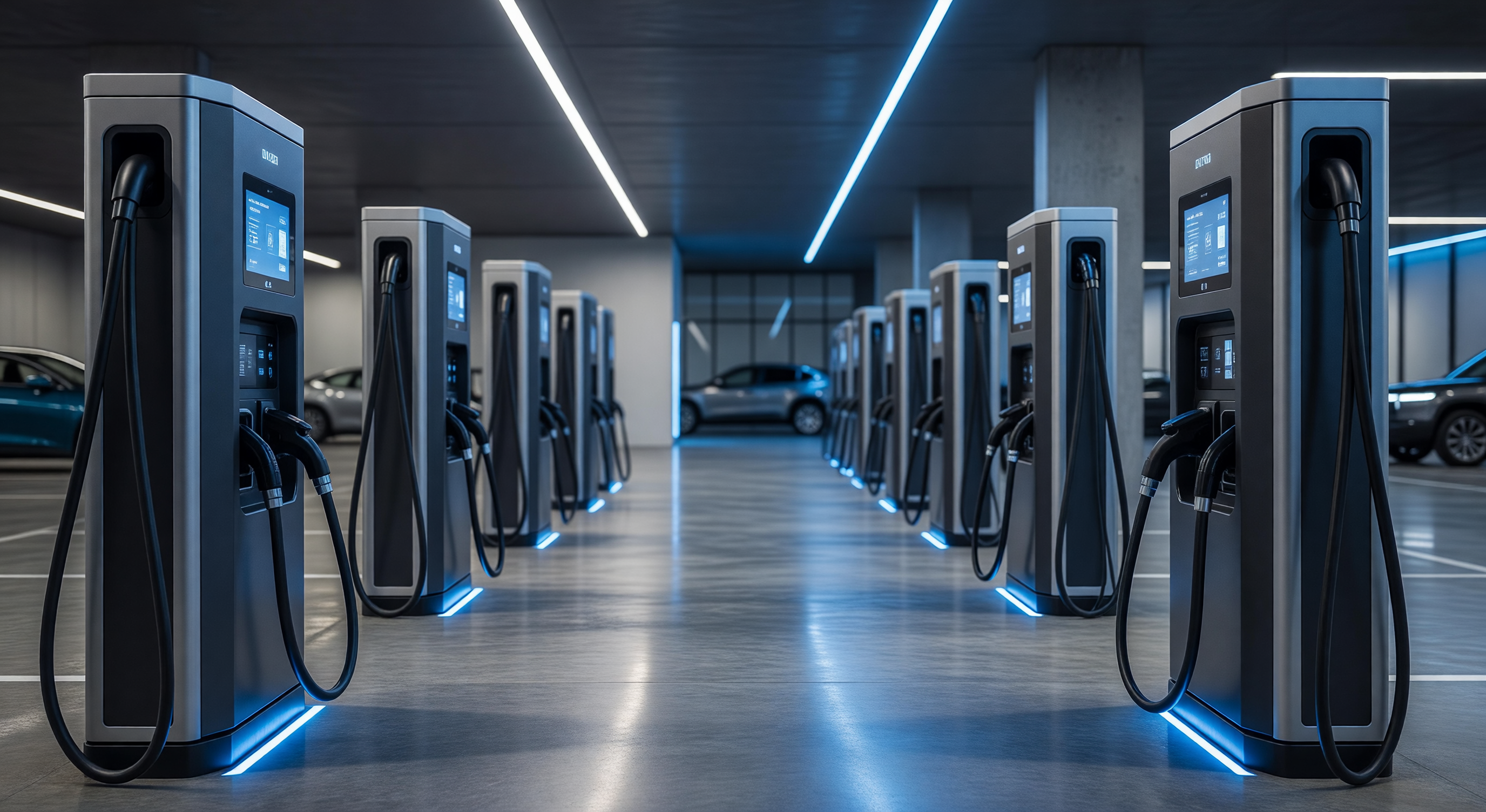
DCFC units operate at up to 480V DC and deliver 50–350 kW directly to the vehicle battery, bypassing the onboard charger. A 50 kW DCFC can add 150+ miles of range in under an hour. These are appropriate for facilities with high turnover and short dwell times — transit hubs, retail centers, or dedicated fast-charge plazas.
Hardware costs for DCFC range from $15,000 to $150,000+ per unit. Electrical infrastructure requirements are substantially higher — 50 kW units typically require 100A service at 480V, and 150–350 kW units require dedicated electrical service that may involve utility transformer upgrades.
For most parking structures and office/residential lots, Level 2 provides the best cost-per-driver-served ratio. DCFC makes sense as a supplement for facilities with dedicated EV turnover goals, not as the primary deployment.
Make-Ready vs. Full Build-Out Strategy
Many facilities are adopting a “make-ready” approach: running conduit, pulling wire, and installing panels with capacity for full charging deployment while installing only the chargers immediately needed. This strategy reduces future installation costs significantly — the expensive work is running conduit and electrical infrastructure, not swapping hardware.
The cost difference between a make-ready installation and a full build-out is primarily labor. Installing conduit for 40 future EVSE stations at the time of a garage renovation or new construction adds $30,000–$80,000 in electrical infrastructure cost but avoids $200,000+ in future retrofit work.
Critical planning decisions for make-ready:
- Conduit sizing: Pull conduit for future amperage, not current
- Panel location: Centralized EV load centers simplify future management
- Breaker reservation: Reserve panel space for future EVSE circuits
- Load management wiring: Pre-wire for a load management controller
Load Management: The Most Underestimated Requirement
Electrical demand charges are the primary ongoing cost factor for EVSE-heavy facilities. Adding 40 Level 2 chargers at 7.2 kW each represents 288 kW of potential simultaneous draw — enough to trigger significant demand charge increases on most utility schedules.
Smart load management (also called energy management or power sharing) dynamically distributes available power across active charging sessions. When 30 cars are charging simultaneously but only 100 kW of capacity is available, the load management system allocates power per-session based on priority rules, dwell time, and session state.
Effective load management requires:
- A load management controller (hardware or cloud-based)
- EVSE units with OCPP (Open Charge Point Protocol) compliance — this is non-negotiable for interoperability
- Integration with the facility’s electrical monitoring system or smart meter
Without load management, facilities either undersize charging capacity (low utilization) or face high demand charges that make charging economically untenable.
Network Connectivity and Software Platforms
Commercial EVSE almost universally operates through a network management platform that handles: session authorization, payment processing, usage reporting, fault alerts, and remote diagnostics.
Key software evaluation criteria:
- OCPP compliance: Require OCPP 1.6J or 2.0.1 compliance. This ensures you can switch network providers without replacing hardware — a critical flexibility point as this market evolves.
- Payment processing: Does the platform support credit/debit, RFID cards, mobile apps, and contactless payment? Fee structures vary — some platforms charge per-transaction, others charge monthly flat rates.
- Reporting: Can you export charging session data, energy consumption by station, and utilization reports? This data is required for sustainability reporting and cost allocation in multi-tenant facilities.
- Driver experience: Evaluate the mobile app and charger display interface from a driver perspective before committing.
Avoid proprietary networks that lock hardware to a single software platform. OCPP compliance protects the hardware investment if network providers raise prices or discontinue service.
Outdoor vs. Structured Parking Requirements
EVSE installed in parking structures has different requirements than surface lot or outdoor installations.
Structured parking:
- Ventilation considerations: Not an issue for battery EVs, but worth noting for any mixed-use garages with propane vehicles
- Cable management: Retractable or managed cables prevent trip hazards
- Mounting: Pedestal vs. wall mount depends on aisle width and traffic patterns
- IP rating: IP44 minimum; IP54 preferred for areas exposed to vehicle splash
Surface lots and exposed areas:
- IP66 rating minimum
- Bollard protection for low-traffic awareness areas
- UV-resistant housing and cable
- Thermal management: Extreme heat affects charging speed in some units — verify operating temperature ranges
Revenue and Cost Recovery Models
Facility-owned, direct billing: The facility owns the EVSE and charges drivers directly via the network platform. Revenue goes to the operator; operator bears all hardware, installation, and maintenance costs. Best for facilities with high EV utilization and clear cost recovery timelines.
Charging-as-a-service: A third-party EVSE provider installs equipment at low or no upfront cost in exchange for a revenue share or host site agreement. Reduces capital exposure but limits long-term revenue capture. Read contract terms carefully — some agreements include exclusivity provisions that prevent adding equipment during the term.
Tenant-funded deployment: In multi-tenant facilities, tenants fund chargers for dedicated use in their assigned areas. The facility provides electrical infrastructure access; tenants own the EVSE. Requires clear utility cost allocation agreements.
Frequently Asked Questions
How many EV spaces should I plan for? Industry guidance for new construction ranges from 10–20% of spaces as EV-ready (make-ready), with 2–5% fully energized at opening. For existing facilities, start with demand data — survey tenant and parker EV ownership rates annually and phase deployment accordingly.
What is the realistic installation cost for 10 Level 2 chargers? In a typical parking garage with adequate electrical capacity within 100 feet, expect $40,000–$80,000 total installed cost including hardware, electrical work, networking, and commissioning. Facilities requiring new electrical service or long conduit runs will see higher costs.
Does EVSE affect my parking revenue control system? Charging sessions can be integrated with PARCS to bundle parking and charging payment, but this requires native integration or API development. Verify with your PARCS vendor before purchasing EVSE hardware.
What maintenance does EVSE require? Level 2 chargers require minimal routine maintenance — cable inspection, connector cleaning, and software updates. Annual preventive maintenance visits from a certified electrician are best practice. DCFC units have more complex maintenance requirements due to power electronics components.
Key Takeaway
EV charging equipment procurement decisions made today will define infrastructure capacity for 10–15 years. The most important investment is often not the chargers themselves but the electrical infrastructure and conduit designed for full build-out — making future charger additions a hardware-swap rather than a construction project.