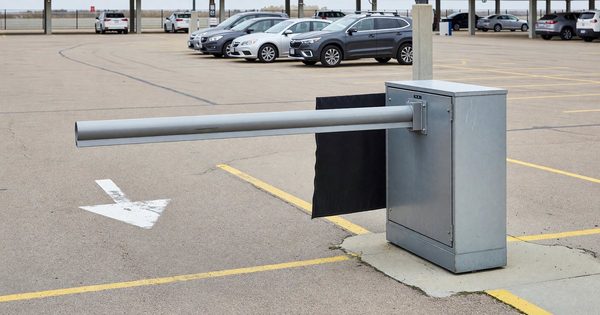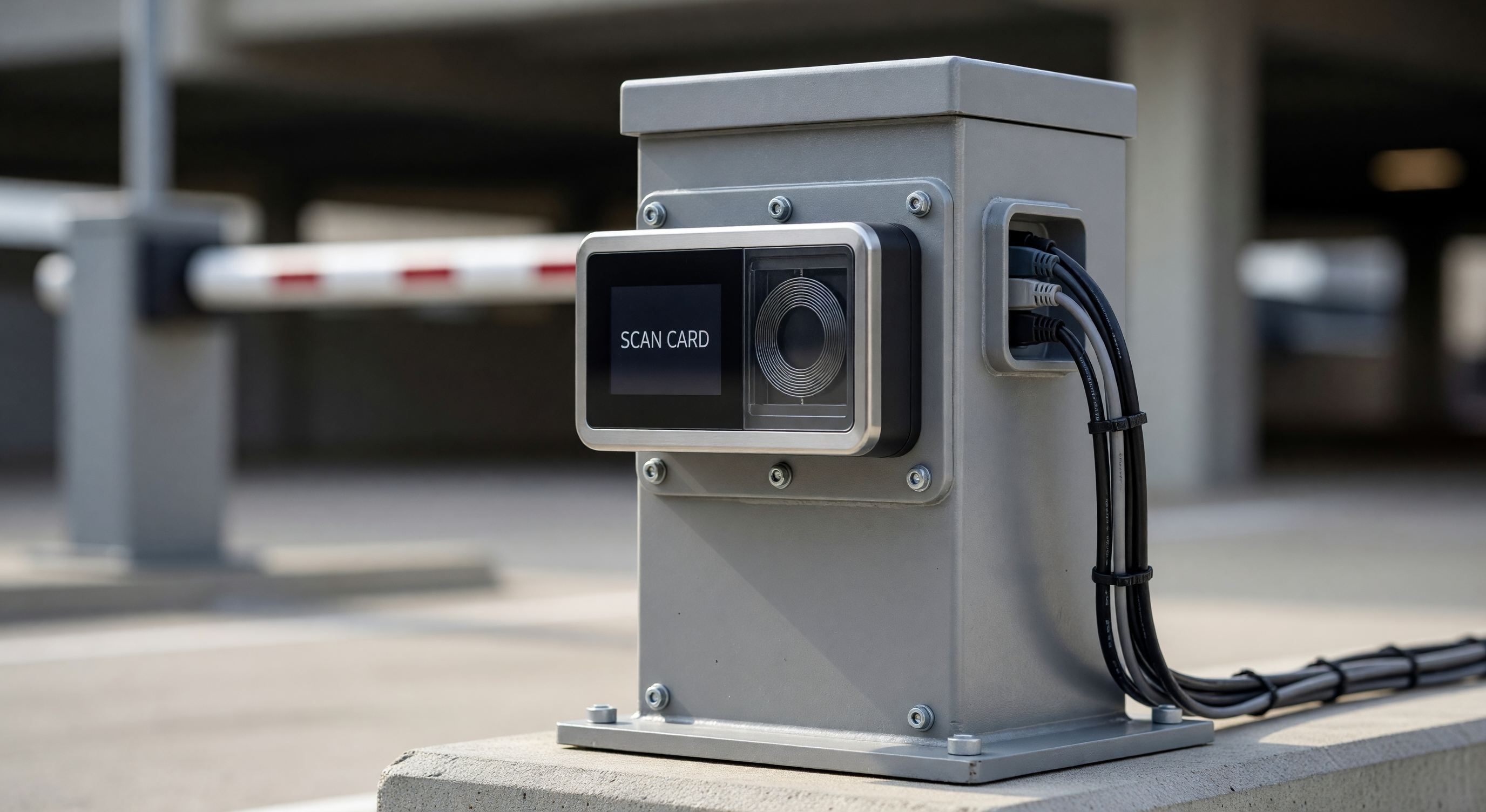
RFID credential readers are the physical access control interface at parking lane entries — the point where the system verifies whether a vehicle and its associated credential is authorized to enter. Reader performance depends heavily on correct installation: mounting height, orientation, read zone design, and interference mitigation all affect whether the system works reliably under real parking entry conditions.
This guide covers the technology differences that affect installation requirements, the mounting specifications that produce reliable reads, and the configuration steps that must be completed after physical installation.
RFID vs. Proximity: Technology Comparison
The terms “RFID” and “proximity” are often used interchangeably, but they refer to distinct radio frequency technologies with different operating characteristics.
Low-Frequency Proximity (125 kHz)
Traditional proximity readers and cards operate at 125 kHz. The technology is simple, robust, and has been the access control standard for over 30 years. Read range is short — typically 1–6 inches for standard cards.
For parking applications: Short-range 125 kHz readers require the driver to hold the card near the reader window — either by reaching out the vehicle window or by lowering the window to present the card at arm’s length. This creates a friction point in the access experience: the driver must stop, lower the window, reach out, and wait for the gate to respond.
125 kHz cards and readers are widely deployed and inexpensive. Credential format standardization is poor — many proprietary formats exist that aren’t interoperable across reader brands.
High-Frequency Smart Cards (13.56 MHz)
HF smart cards (ISO 14443 standard) operate at 13.56 MHz with read ranges of 1–4 inches. They support more sophisticated authentication protocols and are the basis for modern contactless payment cards and many mobile credential implementations.
For parking applications: Similar short range to 125 kHz proximity — still requires stopping and presenting the card. HF cards offer stronger security through encrypted authentication rather than simple credential number transmission.
Ultra-High-Frequency Long-Range RFID (UHF, 900 MHz)
UHF RFID operates in the 902–928 MHz band and provides read ranges of 10–30 feet for vehicle-mounted transponders. This is the technology behind hands-free parking access — the gate opens automatically as the vehicle approaches without requiring the driver to stop or present a card.
For parking applications: UHF long-range systems with vehicle windshield transponders are the gold standard for permit lot access. The driver experiences no friction — the gate opens as they approach at normal speed.
Transponder installation: UHF systems require a windshield transponder (hang tag or adhesive label) mounted in a specific location on the vehicle. Transponder placement affects read performance — metal-backed windshields, tinted glass, and incorrect placement all affect read range and reliability.
Reader Mounting Requirements
Short-Range Reader Mounting (125 kHz and 13.56 MHz)
For readers requiring card presentation at close range, mounting height and position are optimized for convenience:
- Recommended mounting height: 36–48 inches from the finished grade to the center of the read window. This allows most drivers to reach the reader from a lowered window without excessive stretching.
- Position relative to the gate: Readers are typically mounted on a pedestal or wall 2–4 feet before the gate arm, on the driver’s side of the lane. The reader should be accessible without the driver’s door opening.
- Tilt: Slight inward tilt (5–10 degrees toward the driver) allows cards to be held more naturally against the reader face.
Driver height considerations: In facilities serving diverse vehicle types (standard cars, trucks, SUVs), a single mounting height can’t perfectly serve all drivers. A height of 42 inches typically provides the best range coverage across standard to tall vehicles.
Long-Range UHF Reader Mounting
UHF lane readers require different installation planning due to the longer read zone:
- Mounting height: 7–12 feet, typically on a gantry over the lane or on a high mounting pole on the lane side. Elevation reduces multipath interference from ground reflections.
- Antenna orientation: The reader antenna must be oriented to provide coverage in the vehicle approach zone — typically horizontal with slight forward tilt toward the approaching vehicle.
- Read zone design: Define the read zone boundaries carefully. The reader should reliably read transponders when the vehicle is 10–25 feet from the gate but not read transponders in adjacent lanes or vehicles parked nearby. Read zone tuning requires site-specific adjustment after installation.
- Multi-lane installations: In facilities with multiple adjacent lanes, UHF reader antennas from adjacent lanes can cross-read transponders in the wrong lane. Reader positioning, power level management, and antenna polarization choices address this.
Avoiding Interference
Metal and Conductive Materials
Metal surfaces near RFID readers affect the read zone in both directions: they can extend the read zone (reflecting signals) or reduce it (blocking signals depending on geometry). Common interference sources:
- Metal gate cabinets near the reader (particularly relevant for short-range readers mounted on gate pedestals)
- Concrete with rebar in structured parking (relevant for in-ground or embedded readers)
- Nearby metal bollards, curbs, or structural elements
Mount short-range readers with at least 2–3 inches clearance from metal surfaces. For UHF readers, conduct an RF coverage test after installation with a reference transponder to map the actual read zone before commissioning.
Co-Location of Multiple Readers
When two readers are installed close together (entry and exit on a reversible lane, or paired long-range readers at a wide gate), mutual interference is possible. Readers operating on the same frequency at close range can desensitize each other.
Solutions:
- Use readers that support frequency hopping or time-division multiplexing to avoid interference
- Physical separation: 6–10 feet between readers reduces mutual interference significantly
- Antenna shielding between reader positions
Vehicle Anti-Theft Systems (LoJack, etc.)
Some vehicle security systems transmit radio signals that can cause false reads or interference with parking RFID systems. This is rare but worth noting as a diagnostic consideration if unexplained false triggers occur after installation.
Configuration After Installation
Physical installation is followed by configuration steps that determine operational behavior:
Credential Enrollment
For each authorized credential (card, fob, transponder), enroll the credential in the access control software with:
- The credential’s unique identifier (card number, facility code, transponder EPC)
- The access level (which lanes, which times)
- The credential holder’s identity (for audit purposes)
- The expiration date (for temporary or time-limited access)
Test each enrolled credential against the reader before the system goes live.
Anti-Passback Configuration
Anti-passback prevents a credential from entering the facility twice without exiting — a security control that prevents credential sharing. Configuration options:
- Soft anti-passback: logs violations without preventing access
- Hard anti-passback: denies access if the credential is in violation state
- Timed anti-passback: resets the violation state after a defined period
For parking applications, timed anti-passback with a reset period matching expected dwell time (1–24 hours depending on facility type) is common.
Read Range Adjustment (UHF)
UHF readers allow read power adjustment that changes the read range. Start with a calibrated baseline power level (from the manufacturer’s recommendation for the installation geometry) and adjust based on actual read zone testing. Reduce power until the desired read zone boundary is achieved; don’t operate at maximum power if it creates cross-lane reads.
Frequently Asked Questions
Can we use the same RFID cards for parking access and building access? Yes, if both the parking reader and the building access reader use the same credential format. 125 kHz proximity cards are the most commonly shared credential. 13.56 MHz HF cards with the same data format are also usable across systems. Verify credential format compatibility with both access control vendors before issuing combined credentials.
What causes inconsistent long-range RFID reads at the same lane? The most common causes: transponder placement variation across vehicles (some drivers place the transponder behind tinted glass or in suboptimal positions), multipath interference that creates nulls in specific approach positions, or power adjustments that were changed without re-verifying the full read zone.
How far in advance of the gate should UHF readers detect the transponder? Detect at 15–25 feet for a gate that needs 3–4 seconds to complete its open cycle, allowing the vehicle to approach at 10–15 mph without stopping. Design for the approach speed of your specific entry lane.
What’s the lifespan of RFID readers and transponders? Commercial RFID readers have rated service lives of 7–15 years. UHF vehicle transponders (properly installed, not exposed to damage) last the life of the vehicle they’re installed on — typically 10+ years. Short-range cards and fobs typically last 3–7 years with normal wear before replacement is needed.
Key Takeaway
RFID reader installation success depends on matching the technology to the access experience requirement (hands-free UHF vs. stop-and-present short-range), precise mounting for the chosen technology, and systematic read zone testing after installation. Configuration steps — credential enrollment, anti-passback, and read zone calibration — complete the installation and must not be skipped.