Parking entry intercom systems provide the communication link between drivers who need assistance and the operators or remote monitoring services who can help them. When a ticket dispenser jams, a credential doesn’t read, or a driver has a question, the intercom is the fail-safe. A well-designed intercom system reduces lane downtime, improves customer experience, and provides documentation for incidents.
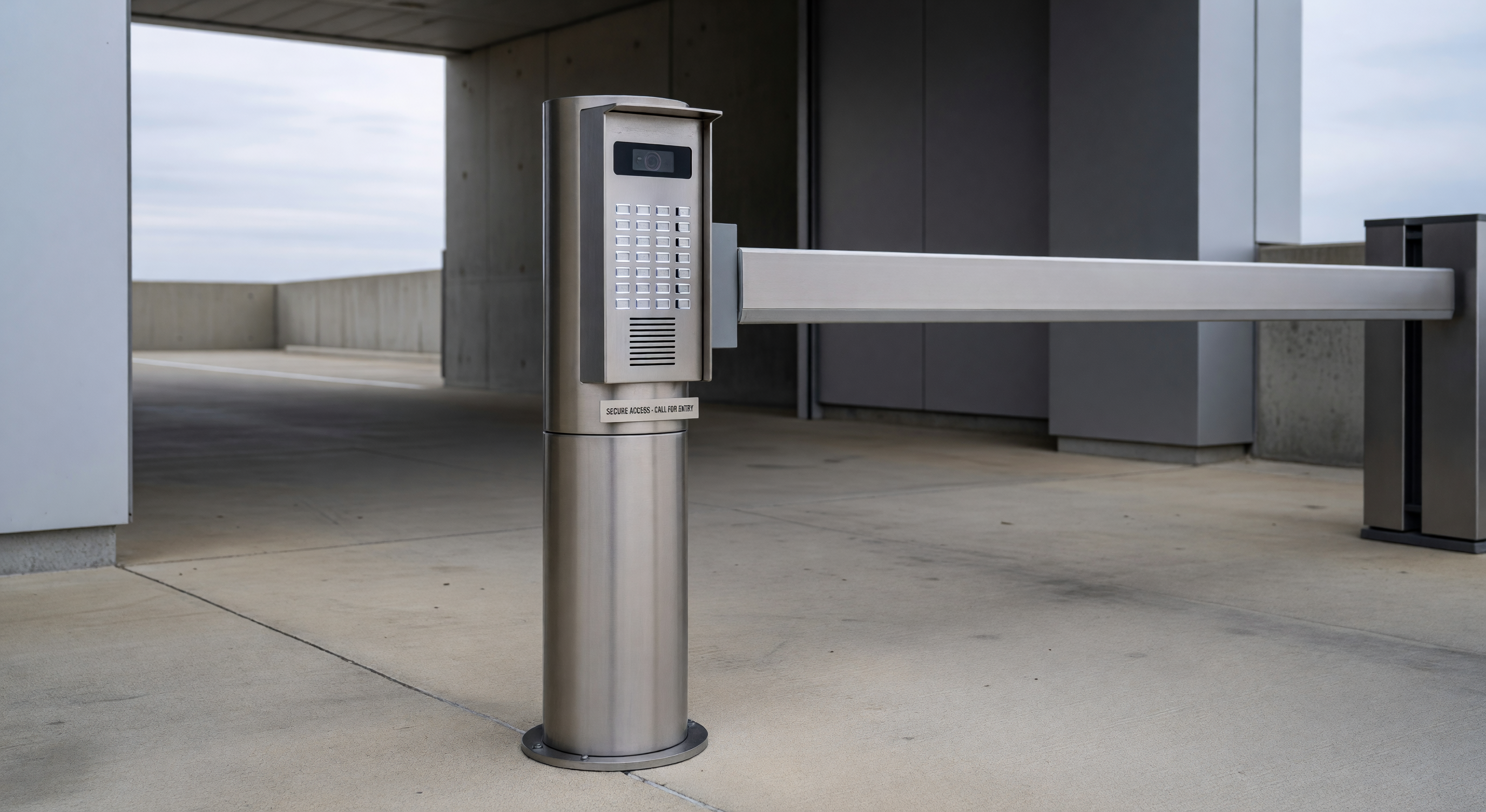
Video intercoms add a camera to the audio communication, allowing the answering party to see the driver and the immediate environment — supporting better remote assistance and security incident documentation.
Intercom Roles in Parking Access Control
Parking entry intercoms serve three distinct functions that should inform system design:
Customer assistance: The primary function — providing a way for drivers to reach help when the normal access process fails or they have a question. Speed of answer and audio quality determine customer experience.
Operator security: Seeing who is requesting access allows operators to make informed decisions about granting assistance — particularly relevant in after-hours operations.
Documentation: Video intercom interactions create a record of who requested access, when, and the nature of the interaction. This supports incident investigation and dispute resolution.
Systems designed primarily for one function may perform poorly in the others. Define which function is primary for your operation before specifying.
Audio vs. Video Intercom
Audio-Only Intercom
Audio intercoms provide a voice channel between the field unit and the answering station. They’re simple, reliable, and less expensive than video systems.
When audio-only is appropriate:
- Attended facilities where the answering operator has direct visual contact with the lane from the cashier booth
- Low-security facilities where driver identification isn’t a security requirement
- Budget-constrained retrofits of existing facilities
Video Intercom
Video intercoms add a camera at the field unit that displays the driver and the immediate environment on the answering station monitor.
Advantages of video:
- Operator can visually verify the driver’s identity and vehicle before granting access
- Video record of every intercom interaction provides documentation
- Remote operators at off-site monitoring centers can respond to access requests with visual context
- Camera at the entry point provides surveillance coverage regardless of intercom interaction
Video specifications:
- Minimum 2MP (1080p) camera resolution for usable identification detail
- Night vision (IR illumination) for after-hours operation — a video intercom without night vision provides a black image after dark
- Wide-angle lens (100° or greater) to show both the driver and the vehicle door area
- Adjustable camera angle at installation to account for varying vehicle heights
IP vs. Analog Intercom Architecture
Analog Intercom Systems
Traditional analog intercoms use dedicated copper wire pairs for audio (and in some cases, video) communication between field units and master stations. They operate independently of IP networks.
Advantages:
- No dependence on network infrastructure
- Simple installation and troubleshooting
- Highly reliable — fewer software and protocol dependencies
Disadvantages:
- Limited to on-site answering stations — can’t route calls off-site without analog telephone network integration
- Individual cable run from each field unit to the master station
- Video over analog has lower quality than IP video
- Limited to fixed master station locations
IP Intercom Systems
IP intercoms encode audio and video into IP data and transmit over standard Ethernet networks. They can be answered from any network-connected device.
Advantages:
- Calls can be routed to any location with internet connectivity — remote monitoring centers, management offices, mobile phones
- Higher-quality video than analog equivalents
- Integration with VoIP phone systems allows parking intercom calls to ring on regular desk phones
- Software-configurable call routing (time-of-day, day-of-week, escalation)
Disadvantages:
- Dependence on network infrastructure — a network outage affects all intercoms simultaneously
- More complex configuration and troubleshooting
- Requires adequate network bandwidth for audio and video streams
For most commercial parking operations with some off-site management or remote monitoring, IP intercoms are the appropriate choice. For small, fully attended facilities, analog remains viable.
Call Routing and Remote Answering
On-Site Master Station
The traditional configuration: a monitor and speaker/microphone unit in the cashier booth or management office. All calls route to the on-site station.
Limitations: Requires a staffed on-site location during facility operating hours. For 24/7 unmanned facilities, on-site-only routing provides no after-hours support.
Remote Monitoring Center Integration
IP intercoms can route calls to a third-party remote monitoring and intercom answering service. When a driver presses the call button:
- The call rings at the remote monitoring center
- An operator answers and can see the video feed
- The operator assists the driver and can remotely trigger gate operations if integrated with the PARCS system
Remote monitoring services for parking intercoms typically charge $50–$200/month per facility depending on call volume and response requirements. This enables 24/7 staffed response without on-site personnel.
Mobile App Answering
Some IP intercom platforms allow calls to be answered on a smartphone app. This provides flexibility for facilities where the operator moves around the property and can’t always be at a fixed master station.
Mobile answering works best as a supplement to fixed master station answering — the fixed station is the primary answer point; mobile provides backup when the primary operator is away.
ADA and Accessibility Requirements
ADA applies to parking facility intercoms accessible to the public. Key requirements:
Mounting height: Intercom controls (call button, microphone, speaker) must be within ADA reach range (15–48 inches for unobstructed reach).
Audio quality: The intercom must provide adequate audio for drivers with hearing impairments when used with hearing aids. TTY (Teletypewriter) compatibility may be required in some contexts.
Visual indicator: A visual indication that a call has been connected (light indicator, display) provides feedback for drivers with hearing impairments who cannot confirm a dial tone by audio.
Operating force: The call button must be operable with 5 lbs or less operating force.
Integration with Access Control
Entry intercoms can be integrated with the PARCS system to allow operators to grant remote access without physically being at the lane:
- Remote gate release: The answering operator can trigger the gate to open from the master station or mobile app after verifying the driver’s identity
- Event logging: Intercom-assisted access events should be logged in the access control software with timestamp and operator ID
- Authorization levels: Define which staff can remotely release gates and for which situations (e.g., only supervisors can override anti-passback)
The integration requires a relay or API connection between the intercom master station and the PARCS system. Verify this integration is available and documented before purchasing either system.
Frequently Asked Questions
How many intercom units does a facility typically need? Every entry and exit lane should have an intercom. Pedestrian entries, elevator lobbies adjacent to parking, and pay-on-foot station locations should also have intercom coverage. Coverage at every point where a customer might be stranded without access is the planning standard.
What audio quality standards should we specify? G.711 or G.729 codec support (standard VoIP audio) provides adequate voice quality for intercom applications. Specify a signal-to-noise ratio of at least 50 dB at the field unit microphone. Test audio quality in the intended installation environment before acceptance — ambient noise from traffic, HVAC, and vehicle engines affects usable audio quality significantly.
Can the parking entry intercom be on the same network as security cameras? Yes, but VLAN segmentation is recommended — intercom traffic on one VLAN, camera traffic on another. This prevents bandwidth competition between video recording and intercom calls and simplifies network security management.
How do we handle multiple simultaneous intercom calls? Entry facilities with multiple lanes may experience simultaneous calls during peak periods. IP intercom systems that route to a call center or multi-station master can queue calls. Single-station systems may miss simultaneous calls. Evaluate expected call frequency against your answering capacity before selecting a configuration.
Key Takeaway
Video intercom selection for parking entry systems should be driven by the answering model — who answers, where, and under what conditions. The technology (IP vs. analog, video vs. audio) should support the answering workflow you’ve defined, not the other way around. For modern facilities with any off-site management, IP video intercom with remote answering capability is the appropriate starting point.