Gate arm collisions with vehicles and pedestrians represent both a safety hazard and a costly maintenance problem. Safety sensors on parking barrier gates — safety edges, presence loops, infrared sensors, and radar detectors — are the primary defense against these collisions. Understanding how each type works, what failures they protect against, and how they interact with gate control logic is essential for anyone specifying, installing, or maintaining parking access control equipment.
Why Safety Sensors Are Critical
A barrier gate arm descending on a vehicle can cause significant damage. A barrier gate arm closing on a pedestrian can cause serious injury. These events occur:
- When a vehicle enters the gate’s closing zone during the closing cycle
- When a pedestrian crosses the gate lane while the gate is closing
- When a vehicle fails to clear the gate after triggering the exit loop
- During system malfunctions that cause gates to close unexpectedly
Safety sensors detect these events and interrupt the closing cycle — reversing the arm, stopping it, or preventing the close command from completing. Well-designed safety sensor systems stop arm descent within milliseconds of detecting an intrusion.
Safety Edges
How They Work
Safety edges are pressure-sensitive rubber or foam strips mounted on the bottom of the gate arm. When the arm contacts an object during the closing cycle, the pressure on the safety edge triggers a signal that reverses the arm direction.
Safety edges are the last line of defense — they prevent damage and injury when the arm has already made contact with an object. They’re not designed to prevent contact; they’re designed to stop the arm the instant contact occurs.
Activation force: Commercial parking safety edges are calibrated to activate at a contact force of 15–30 Newtons — sufficient to detect vehicle contact while avoiding activation from the arm’s own weight or air resistance. Verify the activation force specification against regulatory requirements in your jurisdiction.
Mounting: Safety edges must be mounted along the full length of the gate arm’s underside. Partial coverage leaves sections of the arm unprotected. Check that corner sections (where the arm bends for articulated designs) maintain continuous coverage.
Types
Pneumatic safety edges: Air-filled tubes that compress when contacted, changing air pressure in a sensor circuit. Reliable; simple; require periodic inspection for air leaks.
Electromechanical safety edges: Contain a pressure-activated switch mechanism. More compact than pneumatic; no inflation required; can fail from moisture intrusion.
Resistive safety edges: Contain a resistive sensing element that changes resistance under compression. Allows detection of contact location along the arm, enabling more sophisticated responses.
Loop Detectors for Presence Detection
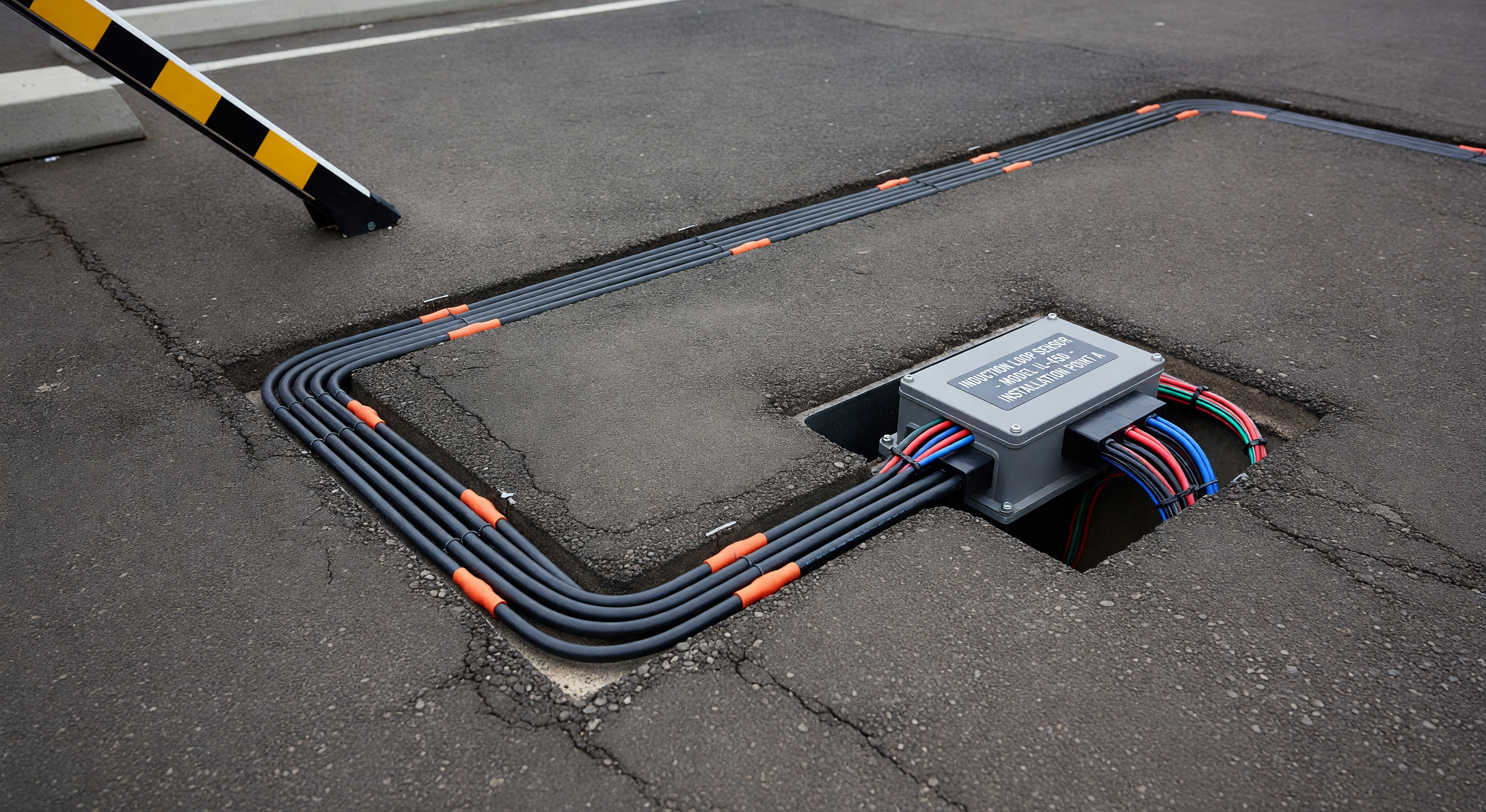
Inductive loop detectors used for presence detection — as distinct from the vehicle detection function that triggers ticket dispensing and gate opening — protect vehicles that are stationary or moving slowly under the gate arm when the closing cycle begins.
Exit Loop (Vehicle Clear Detection)
The exit loop is typically installed in the pavement 3–8 feet beyond the gate arm on the exit side. When a vehicle exits, it triggers the exit loop, which signals the gate controller that the vehicle has cleared the gate. The gate can then begin closing.
If the exit loop remains triggered (a vehicle is still above it) when the close command is issued, the gate controller holds the arm open until the loop clears. This prevents the arm from closing on a vehicle that hasn’t fully exited.
Safety Loop (Under Gate Arm)
A safety loop installed directly beneath the gate arm detects vehicle presence in the gate zone. If the safety loop is triggered during a closing cycle (indicating an unexpected vehicle presence), the gate controller reverses the arm.
Safety loop calibration is critical — the loop must be sensitive enough to detect any vehicle, including motorcycles, but not so sensitive that it triggers from metal in nearby lanes or from the gate hardware itself.
Infrared (IR) Presence Detection
Active IR Sensors
Active IR sensors emit a beam and detect interruptions. For parking gates, they’re typically mounted in pairs at the gate frame — one emitter, one receiver — with the beam crossing the gate lane at a defined height. When the beam is broken, an obstacle is detected.
Advantages:
- Detects any object (not just metal vehicles) — includes pedestrians and bicyclists
- No pavement modification required
- Fast response time (milliseconds)
- Easy to test and verify
Disadvantages:
- Single beam height — may miss low-profile objects or objects that don’t intersect the beam path
- Can be triggered by non-vehicle sources (rain, insects, blowing debris) in some configurations
- Direct sun alignment can blind the receiver temporarily
For pedestrian safety at parking gates, IR sensors that detect both vehicle height and pedestrian height are more effective than single-beam configurations.
Photoelectric Curtain Sensors
Multiple IR beams stacked vertically create a “light curtain” that detects intrusion at any height. Light curtain sensors provide complete lane protection from ground level to the beam array height.
These are more sophisticated and more expensive than single-beam IR sensors but provide superior pedestrian detection, particularly for gate installations where pedestrian crossing of the gate lane is frequent.
Radar-Based Presence Detection
Radar presence sensors emit microwave radio waves and detect reflections from objects in the detection zone. They can detect moving and stationary objects across a defined area.
Advantages:
- Area detection rather than point or beam — can detect vehicles in a zone rather than requiring the vehicle to intersect a specific beam
- All-weather performance (not affected by precipitation or sun glare)
- No moving parts
Disadvantages:
- Can detect nearby vehicles in adjacent lanes if not carefully configured
- Detection zone requires calibration to match the desired gate protection area
- More expensive than loop detectors for equivalent presence detection
Radar sensors are increasingly used as supplements to loop detectors in situations where loops are difficult to install (existing pavement) or where the detection zone needs to extend beyond the loop geometry.
Sensor Coordination and Gate Control Logic
Safety sensors are only effective when correctly integrated with the gate controller logic. The controller must:
- Monitor all safety sensors continuously during gate operation
- Stop and reverse arm descent immediately on any safety sensor activation
- Log safety sensor events for maintenance trending
- Alert operators when sensors are in fault condition or disconnected
Testing safety sensor integration: After installation and after any maintenance, test each safety sensor by intentionally triggering it during a closing cycle. The arm must reverse within the specified response time (typically 100–300ms from sensor activation to arm reversal). Verify this for each sensor independently.
Fail-safe configuration: If a safety sensor disconnects or fails, the gate controller should fail safe — either holding the gate open (allowing passage) or preventing closing. A gate that closes normally when a safety sensor is disconnected provides no protection against sensor failures during operation.
Frequently Asked Questions
How often should gate safety sensors be tested? Safety loop and IR sensor function should be tested monthly as part of routine PM. Safety edge function should be tested quarterly (intentional arm contact with a test object to verify reversal). Document all test results.
What causes a safety loop to trigger when no vehicle is present? False triggers on safety loops are typically caused by loop sensitivity set too high, interference from adjacent loops or electrical equipment, or a deteriorating loop with inconsistent inductance. A loop that frequently false-triggers should be inspected for wire integrity and sensitivity should be adjusted after confirming no interference source.
Can we use radar or IR sensors instead of loop detectors for gate control? Above-ground sensors can replace loop detectors for gate trigger functions in some configurations. This avoids pavement cutting but requires careful calibration to define precise detection zones that match the desired gate control behavior. Loop detectors remain more common for gate control due to their simplicity and reliability; above-ground sensors are typically used as supplements for safety functions.
What standard governs parking gate safety sensor requirements? In the US, UL 325 (Entrapment Protection Standard for Door, Driveway, and Similar Opening Operators) applies to parking gate operators and requires specific safety sensor configurations. Check for the UL 325 listing on any gate operator you specify — this certification indicates the product meets the minimum safety standard for automatic gate operation.
Key Takeaway
Gate safety sensors are safety-critical components — their function must be verified at installation, tested regularly, and monitored for degradation. A gate with non-functional safety sensors is a liability waiting to trigger. Build safety sensor testing into your preventive maintenance program as a mandatory, documented test with pass/fail criteria.