Electric vehicle charging infrastructure and parking access control are increasingly deployed together — and increasingly need to share data. A parking credential that opens a gate should also determine which chargers a driver can use, at what rate, and for how long. Session management that ends parking access should also end a charging session. These integrations are technically achievable but require deliberate planning at the equipment and software layer before installation.
This guide covers the integration points between EV charging equipment and parking access control systems, the authentication and session management approaches, and the configuration decisions that determine whether the combined system works cleanly or creates operational friction.
Why EV and Access Control Integration Matters
The Problem With Siloed Systems
In most early EV charging deployments, charging access and parking access are managed separately. A permit holder has a gate transponder for parking access and a separate RFID card or mobile app account for the charger. The two systems don’t communicate.
This creates predictable operational problems:
- A permit holder whose parking access is terminated may retain charger access (or vice versa), requiring manual deactivation in two separate systems
- There’s no enforcement mechanism to restrict charger use to EV permit holders; any driver who reaches the charger can initiate a session
- Revenue reconciliation requires pulling data from two separate systems
- Reporting on parking occupancy doesn’t reflect which spaces are occupied by charging vehicles vs. non-charging vehicles
Integration between the systems eliminates these gaps by making a single credential (or credential decision) govern both parking and charging access.
What Integration Enables
When parking access control and EV charging are integrated:
- A single credential (transponder, plate, or mobile credential) authenticates both gate access and charger use
- Charger authorization can be conditional on parking credential status (active permit required for charger access)
- Session termination in the parking system can automatically stop an in-progress charging session
- Occupancy data combines parking and charging state for complete facility reporting
- Revenue from parking and charging can be reconciled against a single credential record
EV Charger Authentication Methods
RFID Authentication at the Charger
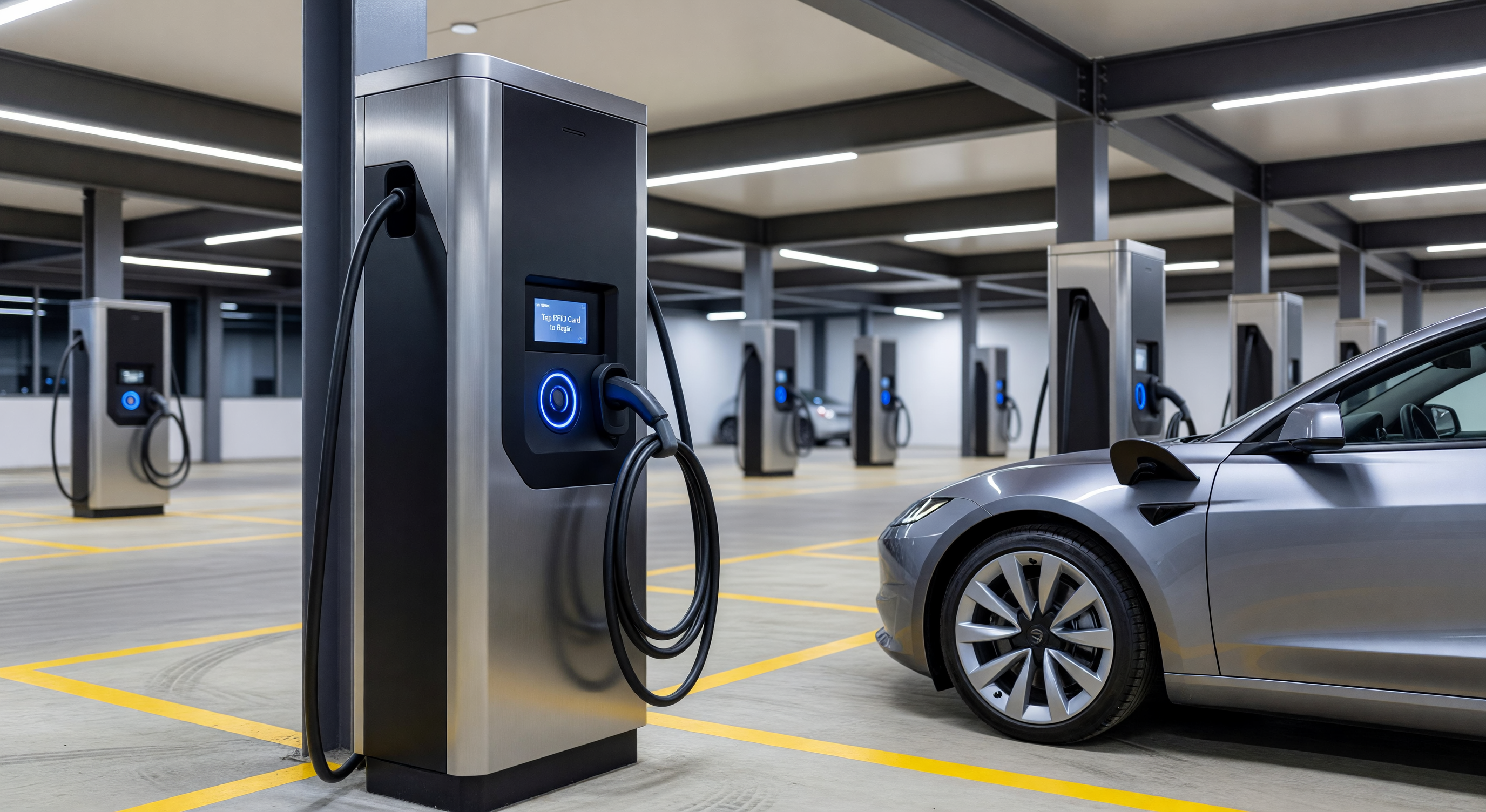
The most common EV charger authentication method uses an RFID card presented at the charger’s reader. In integrated deployments, this RFID card is the same credential used for parking gate access — the same card number is enrolled in both the PARCS system and the charger management system.
Integration approach: The charger management system and PARCS share a credential database (or synchronize credential lists). When a parking credential is added, modified, or revoked, the change propagates to the charger authorization list.
Credential formats: Ensure the charger’s RFID reader supports the same credential format as your parking readers. Mixing 125 kHz proximity parking credentials with 13.56 MHz HF charger readers requires dual-format cards or credential reissuance.
License Plate Recognition Authentication
LPR-based access control can extend to charger authentication in facilities that use plate-based parking credentials. The charger management system or a connected LPR camera verifies the plate of the vehicle at the charger against the authorized plate database.
Implementation note: Charger-side LPR requires a camera positioned to read the plate of a vehicle parked at the charger. Lane-entry LPR cameras are typically not positioned to read parked vehicle plates at charger stations. A separate camera per charger station (or per charger bay) is generally required.
Mobile App Authentication
Many EV charging networks use mobile app authentication — the driver uses a network app to start and stop sessions. In integrated deployments, the charger network app can be linked to the parking portal account, so that an active parking permit is required before the app allows session initiation.
Integration approach: API-level integration between the charger network’s authorization layer and the parking permit management system. The charger network queries the parking system to verify active permit status before authorizing the session. This is more complex to implement but provides the tightest integration of credential management.
OCPP and System Integration Architecture
OCPP Overview
OCPP (Open Charge Point Protocol) is the communication standard between EV charger hardware (charge points) and a central charger management system (CMS). OCPP-compliant chargers communicate with any OCPP-compatible CMS, enabling integration between charger hardware from one vendor and management software from another.
For parking access control integration, OCPP matters because it defines the events and commands the CMS receives and can act on — including authorization requests, session start/stop events, and status notifications.
OCPP versions in use: OCPP 1.6 and OCPP 2.0.1 are the most widely deployed. Verify which version your chargers support and which versions your chosen integration layer can handle. Version mismatches require protocol translation middleware.
Integration Architectures
Architecture 1: Unified platform Some PARCS vendors offer integrated EV charging management as part of their platform. The parking permit database and charger authorization database are the same system; no API integration is required. This is the simplest architecture but requires both parking and charging to be managed through the same vendor.
Architecture 2: Bidirectional API integration The PARCS system and the charger CMS maintain separate databases but synchronize credential status via API. When a parking credential is activated or deactivated, a webhook or scheduled sync updates the charger authorization list. This is more flexible for mixed-vendor environments but introduces synchronization lag.
Architecture 3: Shared authorization service An intermediate authorization service handles credential lookups for both the PARCS system and the charger CMS. Both systems query the same authorization source; credential management is centralized. This architecture is common in large campus deployments but requires custom development.
Reserved EV Space Enforcement
The Enforcement Gap
Designating spaces as EV-only is a policy decision; enforcing it requires either signage (relying on voluntary compliance), staff enforcement, or automated detection. Without enforcement, EV spaces are frequently occupied by non-EVs (“ICE-ing”), leaving charging vehicles unable to use the equipped spaces.
Gate-Level Enforcement
In fully gated facilities with zone-based access control, EV-designated areas can require an EV permit credential for access. A driver without an EV permit is denied entry to the EV zone at the gate. This is the strongest enforcement mechanism but requires physical separation between EV zones and non-EV parking areas.
Sensor-Based Enforcement
In mixed-use facilities where EV and non-EV spaces aren’t physically separated, sensor-based enforcement detects whether the vehicle in an EV space is connected to the charger:
- A space occupancy sensor detects vehicle presence
- The charger’s OCPP status indicates whether a session is active
- If the space is occupied but no charging session is active for more than a defined window (15–30 minutes), an alert is generated for enforcement action
This approach doesn’t prevent ICE-ing but creates a real-time alert that enables faster enforcement response compared to periodic lot patrols.
Session Management Across Systems
Coordinating Session Termination
When a parking permit expires or is revoked mid-session, the corresponding charging session should also terminate — or at minimum, the credential should be flagged so the next session cannot start. The specific behavior depends on your policy:
- Immediate termination: Revocation in the parking system triggers an OCPP remote stop command via the CMS. The charger session ends within seconds. Most appropriate for security-driven revocations.
- Session completion allowed: Revocation is flagged in the authorization database but the current in-progress session is allowed to complete. Subsequent sessions are denied. Most appropriate for standard permit expirations at billing cycle end.
Define this policy before configuration — the default behavior varies by vendor and needs to match operational expectations.
Overstay Management
EV chargers in shared-use facilities need overstay management: a vehicle that has completed charging but remains in the space blocks the charger from others. Integration with the parking access control system enables:
- OCPP session completion event triggers a parking access alert (vehicle in space is fully charged)
- The alert notifies the driver via mobile app or intercom to move their vehicle
- Overstay fees can be applied through the parking payment system after a grace period
Frequently Asked Questions
Do we need a separate credential for EV charging, or can we use the same RFID as the gate? The same RFID credential can work for both gate and charger access if both systems support the same RFID format and a shared authorization database or synchronization is configured. Using the same credential is operationally preferable — it eliminates the credential management burden of maintaining two credential populations. Verify format compatibility before assuming it will work without hardware changes.
How does OCPP integration affect charger hardware selection? Prioritize chargers with OCPP 2.0.1 support for new installations — it provides better security (TLS 1.3 required) and more detailed session data than OCPP 1.6. Also verify that the charger supports the specific OCPP features your integration requires: remote start/stop, authorization list caching (for offline operation), and smart charging profiles if you’re implementing load management.
What happens to EV sessions when the internet connection is lost? OCPP chargers with local authorization list caching can continue to authorize sessions offline for credentials cached on the charger. If the charger requires cloud authorization for every session, an internet outage stops new sessions from starting. Verify your chargers’ offline behavior matches your resilience requirements — this parallels the same question asked about cloud PARCS systems.
How do we handle EV charging billing when it’s bundled with a parking permit? Three common approaches: (1) include a kilowatt-hour or session allowance in the permit price; (2) charge for parking via permit and charge for electricity separately at the charger; (3) charge a combined permit + charging rate that covers both. The accounting and system configuration differs for each. Clarify which approach your permit management and charger CMS systems support before committing to a billing model.
Key Takeaway
EV charging and parking access control integration works best when planned as a unified system from the start — credential format, authorization database architecture, and session management policies need to be defined before equipment is purchased. Retrofitting integration onto siloed systems is possible but typically requires middleware, custom development, and synchronization management that adds ongoing operational complexity. Facilities planning new EV charging deployments should use the integration architecture as a primary evaluation criterion for both PARCS and charger management system selection.