Barrier gates are the most spec-sensitive piece of equipment in a parking facility. Get the duty cycle wrong and you’re replacing a motor in 18 months. Undersize the boom and you’re blocking oversized vehicles. Order the wrong electrical configuration and installation costs double.
This guide covers every spec that matters — boom length, duty cycle, motor type, loop detectors, and the maintenance schedule that keeps gates running for 10+ years.
Types of Parking Barrier Gates
Not all barrier gates are the same form factor. The right type depends on lane width, overhead clearance, traffic volume, and aesthetic requirements.
Full-Boom Gates
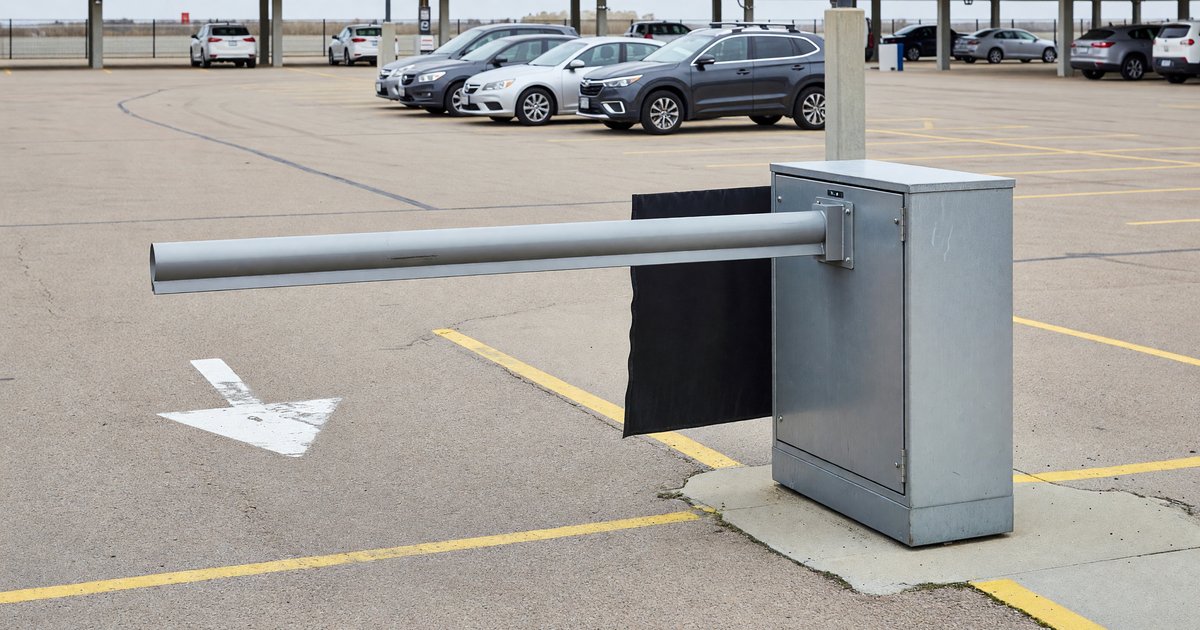
Full-boom gates use a single rigid arm that spans the entire lane — typically 9 to 20 feet. These are the standard choice for most parking facility entry and exit lanes. The boom rotates 90 degrees (vertical open position) and seats in a cradle or arm holder when closed.
Best for: standard entry/exit lanes, gated lots, airport parking, hospital parking structures.
Half-Boom (Short-Arm) Gates
Half-boom gates use a shorter arm, often combined with a skirt barrier to extend effective coverage. The arm itself is typically 3–6 feet, with a PVC or rubber skirt hanging below that discourages tailgating. These are commonly used in parking garages with low ceilings or constrained overhead clearance.
Best for: parking garages, indoor installations, locations where a vertical 14-foot boom swing is not practical.
Folding Boom Gates
A folding boom uses a two-section arm connected by a hinged joint. When opening, both sections fold upward, keeping the total vertical height well below that of a rigid full-boom gate. Folding booms are the solution for sites with overhead obstructions — HVAC ducts, signage, low ceilings — that would prevent a standard boom from fully raising.
Best for: tight indoor garages, facilities with overhead clearance under 7 feet.
Rising Arm / Bollard-Style Gates
These are technically a different category — a vertical rising arm rather than a horizontal rotating boom — but they serve similar access control functions in pedestrian-priority or aesthetics-sensitive environments. More common in corporate campuses and mixed-use developments.
Key Specifications to Compare
Boom Length
Boom length is determined by lane width, not by preference. Measure the clear lane width — curb to curb or barrier to barrier — and select a boom that spans it fully with minimal overhang.
Standard boom lengths available from most manufacturers:
| Boom Length | Typical Application |
|---|---|
| 3 ft | Pedestrian gates, narrow access points |
| 6 ft | Single-lane vehicle access, narrow drives |
| 9 ft | Standard parking lane (most common) |
| 12 ft | Wide lanes, two-way entry/exit |
| 14 ft | Oversized vehicle lanes |
| 16–20 ft | Commercial loading, bus/truck facilities |
Most parking facilities with standard 8–10 foot lanes use a 9-foot boom. If your lane is wider than 12 feet and you need a single gate (rather than two opposing gates), confirm the motor torque rating is appropriate for the longer arm — longer booms require higher torque ratings to maintain cycle speed and avoid premature wear.
Duty Cycle Rating
Duty cycle is arguably the most critical spec for high-volume installations and the most commonly mismatched.
Standard duty: 50–300 cycles per day. Appropriate for smaller lots, employee-only access, or facilities with low peak-hour demand.
High-cycle duty: 300–1,000+ cycles per day. Required for hospital main entrances, airport short-term parking, transit facilities, or any installation that sees continuous traffic during peak periods.
Continuous duty: Some manufacturers offer a “continuous” rating designed for installations where the gate may stay open during peak periods — rated for the thermal load of the motor running indefinitely, not just cycling.
Undersizing duty cycle is the single most common cause of early motor failure. If you’re estimating, size up — a high-cycle motor in a standard-duty application causes no harm, but the reverse will fail.
Motor Type: AC vs DC
AC motors are the traditional choice. They’re robust, widely understood by maintenance technicians, and generally lower cost upfront. The tradeoff is that AC motors draw full power through the entire open/close cycle and have a harder stop at end-of-travel. They are more sensitive to voltage fluctuations.
DC motors are now the preferred spec for most commercial installations. DC motors with encoder feedback can modulate speed — slow at start and end of travel (reducing mechanical stress on the arm), with faster speed through the middle of the arc. This results in smoother operation, lower peak current draw, and longer hardware lifespan. Most modern battery backup systems are also designed around DC motor architectures.
For any high-cycle application, specify DC.
Operating Speed
Cycle speed — measured from the gate receiving an open command to the boom reaching the fully open position — ranges from about 1.5 seconds (fast operators used in exit lanes) to 6 seconds (standard commercial units).
Typical specs by category:
- High-speed exit lanes: 1.5–2.5 seconds
- Standard entry: 3–4 seconds
- Low-cost/residential: 5–6 seconds
Faster is not always better. In facilities with pedestrians or mixed traffic, a gate that opens in 1.5 seconds poses a safety risk if someone walks into the lane. Match speed to the lane design and safety requirements.
Environmental Ratings
IP (Ingress Protection) Ratings
Most commercial barrier gate control boards and motors are rated IP54 (dust-protected, splash-resistant) at minimum. For outdoor installations in wet climates or car washes, specify IP65 or higher.
- IP54: Protected against dust ingress and water splashing from any direction. Suitable for most covered entry kiosks.
- IP65: Fully dust-tight and protected against water jets. Required for fully exposed outdoor installations.
- IP67: Dust-tight and can withstand submersion to 1 meter. Relevant in flood-prone areas.
Operating Temperature Range
Most commercial gate operators are rated for −20°C to +65°C (−4°F to +149°F). For installations in extreme cold — northern facilities, Canada, high-altitude sites — confirm the lubricants and control board components are rated to the local minimum temperature. Some manufacturers offer arctic-rated packages with heated enclosures.
Wind and Snow Load
For any installation in a high-wind or heavy-snow region, request wind load specifications. A 9-foot fiberglass boom in a 70 mph wind event will flex differently than an aluminum boom. Counterweight configuration and pivot hardware should be sized for local wind conditions.
Folding booms generally handle high-wind better than rigid long-arm gates — less surface area in the raised position.
Loop Detectors and Vehicle Detection
What’s Integrated vs Separate
Most modern barrier gate operators include a built-in loop detector card for at least one detection zone (typically the safety loop positioned under the boom). This integrated card handles the free-exit or anti-crush safety function — the gate will not close if a vehicle is detected under the boom.
What is usually separate (purchased and installed independently):
- Entry detection loop: Triggers the system to begin the access control sequence (ticket dispense, card reader prompt, etc.)
- Exit detection loop: In pay-before-exit configurations, detects vehicle approach at the exit lane
- Presence loop: Extends gate open time while a queue of vehicles passes
Inductive Loop Installation
Loops are saw-cut into the pavement in a rectangular pattern, typically 6 feet × 3 feet for standard vehicle detection. The lead wire runs in a saw-cut channel to the gate cabinet. Loops must be installed before final pavement surface — plan loop placement in the site design phase, not as a retrofit.
For installations where saw-cutting is not practical, above-ground video detection or radar detection modules are available as alternatives, though they carry a higher equipment cost and require careful positioning.
Installation Requirements
Electrical
Standard commercial barrier gates run on 120V or 240V single-phase power. Confirm the voltage requirement before ordering — some DC motor units with battery backup require 240V. The electrical panel serving the gate cabinet should be on a dedicated circuit, typically 20A for a single gate.
For any installation in an unheated outdoor cabinet in a cold climate, a thermostat-controlled heater inside the cabinet (drawing 50–150W) is worth budgeting.
Concrete Pad
The gate operator mounts on a concrete foundation pad. Manufacturer specs will provide pad dimensions and anchor bolt pattern — most units require a pad in the range of 18" × 18" × 12" deep minimum, though larger high-cycle units may require a larger pour. The pad must be level and cured before mounting.
Clearance Dimensions
Verify three clearances before finalizing gate placement:
- Vertical clearance — boom must clear any overhead obstruction in the open position. Standard booms require 10–16 feet of vertical clearance depending on boom length.
- Side clearance — distance from the gate cabinet to the curb or barrier on the operator side. Most units need 18–24 inches for maintenance access.
- Lane width — must match boom length selection.
Maintenance Schedule
A well-maintained barrier gate should run for 10–15 years before major component replacement. The failure point for most neglected units is the motor or the clutch — both of which fail earlier when lubrication is inadequate and limit switch adjustment is deferred.
Quarterly
- Inspect and lubricate boom pivot point (manufacturer-specified grease — do not substitute)
- Check counterweight balance — boom should hold horizontal position with motor power off
- Clean photo-eye sensors (if equipped) and verify alignment
- Test safety loop: place a vehicle under the boom and confirm gate does not close
Semi-Annual
- Inspect all wiring connections in the control cabinet for corrosion or looseness
- Test limit switch positions: confirm boom reaches full open and full closed without mechanical impact
- Lubricate pivot arm, pivot shaft, and any linkage points
- Check boom for cracks, deformation, or UV degradation (particularly on fiberglass booms)
Annual
- Full limit switch adjustment — reset open and close positions to ensure clean stops
- Inspect motor mounting hardware for looseness
- Test battery backup (if equipped): disconnect primary power and confirm gate operates through a full cycle
- Review cycle counter if the controller logs it — compare against duty cycle rating
For a facility-wide schedule covering all parking equipment types, see our preventive maintenance schedule.
Specifying the Right Gate: Quick Decision Framework
| Requirement | Specification |
|---|---|
| High volume (500+ cycles/day) | High-cycle duty rating, DC motor |
| Lane wider than 10 ft | 12-ft boom or dual opposing gates |
| Indoor/low ceiling | Folding boom or half-boom |
| Cold climate (below −20°F) | Arctic-rated lubricants, cabinet heater |
| Wet/exposed installation | IP65 minimum |
| Need battery backup | DC motor architecture required |
Where to Go From Here
For a broader look at entry and exit lane equipment — ticket dispensers, pay-on-foot stations, intercoms, and how all components integrate — see our complete entry/exit equipment guide.
Purpose-built commercial and industrial barrier gate systems from major manufacturers are typically available in configurations from 6-foot to 20-foot boom lengths, with DC motor drive and integrated battery backup for high-cycle commercial applications.
parkingequipmentguide.com is an independent buyer’s reference. We cover equipment from multiple manufacturers. Sister resources: barriergatesystems.com | parkingtech.org | facilityparkingguide.com