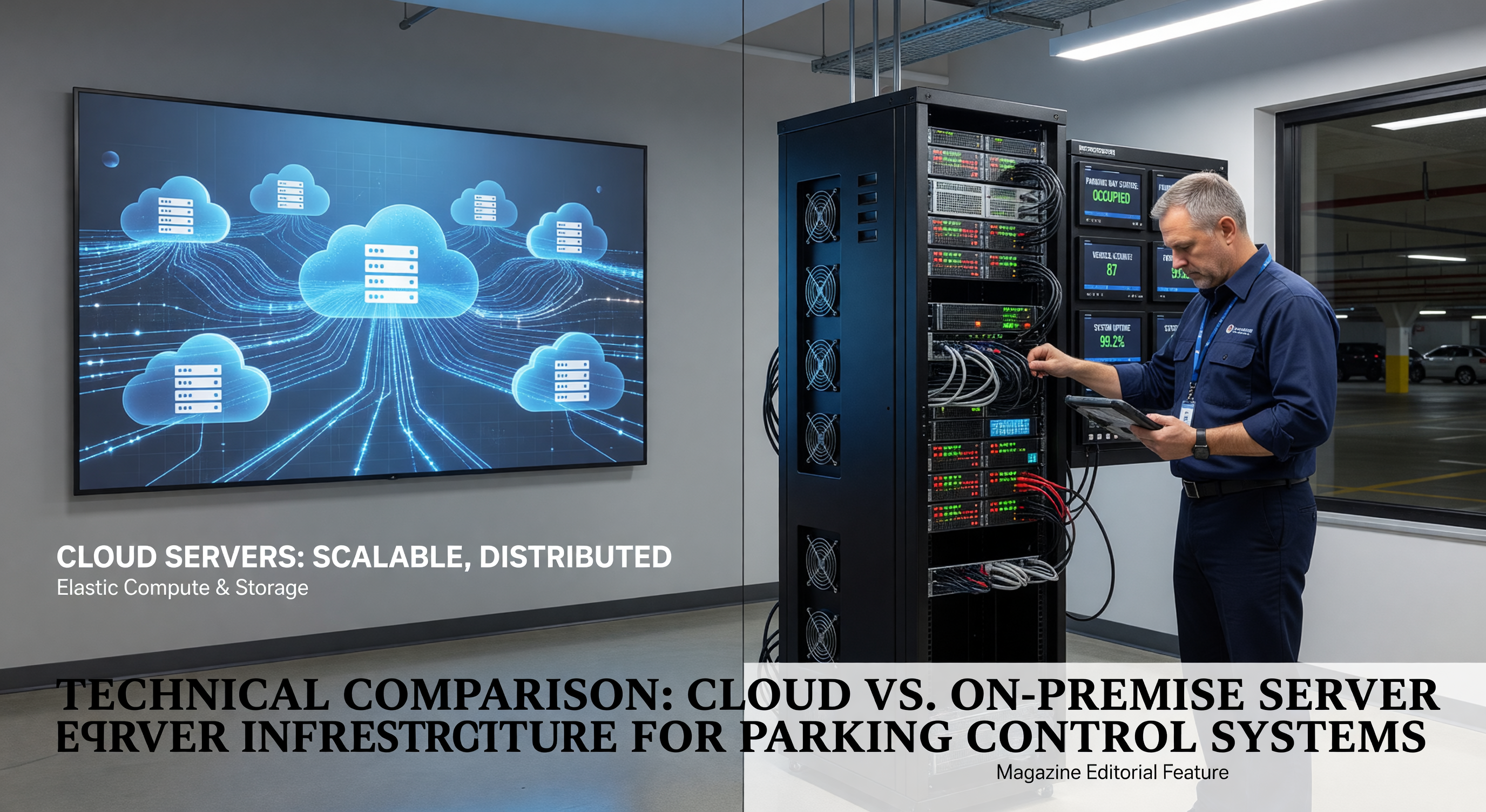
The architectural choice between cloud-hosted and on-premise parking access control affects system resilience, management flexibility, cost structure, and operational capability for years after the decision is made. Neither architecture is universally superior — the right choice depends on facility size, IT infrastructure, multi-site requirements, and operational priorities.
This guide compares the two architectures across the dimensions that matter most for parking operations, with the specific questions to ask vendors before committing to either.
Architecture Overview
On-Premise PARCS
In an on-premise architecture, the access control server, database, and management software run on hardware located at the facility (or a nearby data center under the operator’s control). All processing occurs locally; the internet connection (if any) is used for remote access and integrations, not for core access control function.
Data flow: Reader → Lane controller → Local server → Local database
Management access: Via local network or VPN; remote access requires VPN connection to the facility network
Cloud-Hosted PARCS
In a cloud architecture, the access control logic, database, and management software run in the vendor’s cloud infrastructure. Lane controllers at the facility communicate with the cloud platform over the internet for most functions.
Data flow: Reader → Lane controller → Internet → Cloud server → Cloud database
Management access: Web browser or mobile app from any location with internet
Hybrid Architecture
Many modern systems use a hybrid approach: credential data and access logic are cached locally at the lane controller for offline resilience, while management, reporting, and advanced features run in the cloud. This provides the offline reliability of on-premise with the management flexibility of cloud.
Reliability and Resilience Comparison
Internet Dependency
This is the most operationally significant difference between the architectures.
Cloud-only systems: Core access control function depends on internet connectivity. If the internet connection is lost:
- Best case: Lane controllers use cached credentials and continue normal operation indefinitely
- Worst case: All gates default to open or locked; facility operations stop
The specific behavior during internet outages varies dramatically between vendors. Some cloud systems cache all active credentials locally and operate fully offline for extended periods. Others require cloud connectivity for every access decision. This is the most important question to ask any cloud PARCS vendor.
On-premise systems: Local internet outage has no effect on core access control. Gates operate normally from local server. Remote management access may be affected if VPN depends on internet, but the access control function itself is unaffected.
Key question for cloud vendors: “Describe specifically what happens when our internet connection is down for 4 hours. What is the behavior at each gate? Which credentials work? What is the management impact?”
Hardware Failure Scenarios
On-premise: Server hardware failure is the most critical failure scenario. Without a redundant server configuration, a server failure can take the entire access control system offline. Server hardware maintenance, backup procedures, and failover planning are the operator’s responsibility.
Cloud: The vendor’s cloud infrastructure provides redundancy. Server hardware failures at the vendor’s data center are handled by the vendor’s operations team, typically without impact to the operator.
Software Updates
On-premise: Software updates are applied on the operator’s schedule, with testing before production deployment. The operator controls the update timing and can roll back if problems arise.
Cloud: Software updates are deployed by the vendor, often automatically. Operators may have limited control over update timing. This can mean access to new features faster — or unexpected changes to behavior that affect operations.
Management and Operations Comparison
Multi-Site Management
This is where cloud architecture typically wins decisively.
Cloud: All sites are managed from a single interface without VPN tunnels, site-by-site logins, or data aggregation work. A manager can view access events, generate reports, and make configuration changes for any site from a single browser session.
On-premise: Multi-site management requires either a multi-site server deployment with replication (complex), a VPN-connected management workstation that can reach each site’s server (functional but cumbersome), or separate management for each site (operationally fragmented).
For operators with 3+ facilities, cloud management provides significant operational efficiency advantages.
Reporting
Cloud: Reports typically span all facilities, draw on real-time data, and can be scheduled and emailed without any local IT configuration.
On-premise: Reporting requires connectivity to the local server. Multi-site reports require data aggregation that isn’t always automated.
Integration with External Systems
Cloud: Modern cloud PARCS platforms typically offer richer API ecosystems and more frequent integration updates. Cloud-to-cloud integrations (with mobile payment platforms, property management systems, or EV charging networks) are generally easier to implement.
On-premise: Integration is possible but may require on-site integration middleware, VPN exposure of on-premise APIs, or custom development.
Cost Structure Comparison
On-Premise Total Cost
- Capital costs: Server hardware ($3,000–$10,000), server software license (often $10,000–$50,000+ for commercial PARCS)
- Ongoing costs: IT support for server maintenance, backup verification, OS and software patching
- Refresh cycle: Server hardware replacement every 5–7 years; software major version upgrades may have additional license fees
Cloud Total Cost
- Capital costs: Minimal — primarily lane controller hardware, which is similar regardless of architecture
- Ongoing costs: Monthly or annual SaaS fee ($200–$800/month for mid-size facilities); no server hardware costs
- 5-year total: Typically comparable to or higher than on-premise for large facilities; lower for small facilities without dedicated IT support
The cloud cost advantage is most pronounced for:
- Small facilities without dedicated IT staff
- Operators who would otherwise need to maintain server infrastructure without expertise
- Multi-site operators who avoid per-site server costs
Hidden Costs to Compare
On-premise: IT labor for server maintenance, backup testing, security patching; server hardware refresh; disaster recovery planning.
Cloud: Bandwidth costs for high-volume video or access log data; per-transaction or per-device fees that compound in large fleets; potential cost increases at contract renewal when switching vendors is difficult.
Security Considerations
Data Security
Cloud: Vendor-managed security infrastructure — typically more sophisticated than what most parking operators maintain on-premise. Reputable vendors have SOC 2 Type II certification, encryption at rest and in transit, and dedicated security teams.
On-premise: Security is the operator’s responsibility. Servers that aren’t regularly patched, inadequately protected networks, and poor backup practices create significant security vulnerabilities.
Credential Security
In both architectures, access credentials (card numbers, plate numbers) are sensitive data. Verify that both cloud and on-premise systems:
- Encrypt credential data at rest
- Encrypt communication between lane controllers and the server/cloud
- Provide audit logs for credential access and modification
Making the Decision
Choose Cloud When:
- Multiple facilities to manage under a single operation
- Limited IT staff or IT infrastructure at the facility
- Remote management is a priority
- The vendor’s cloud reliability and offline resilience have been verified by reference calls
Choose On-Premise When:
- The facility has dedicated IT staff and server infrastructure already
- Regulatory requirements mandate data residency or restrict cloud data hosting
- The internet connection at the facility is unreliable and the vendor’s cloud system doesn’t provide adequate offline resilience
- The operation requires update control that cloud deployment doesn’t allow
Choose Hybrid When:
- Maximum offline resilience is required but cloud management is also a priority
- The operation is transitioning from on-premise and wants to maintain some local control
- Specific functions (mission-critical access control) must be local while others (reporting, management) can be cloud
Frequently Asked Questions
What is the risk if our cloud PARCS vendor goes out of business? This is a legitimate risk. Mitigate it by: requiring data export capability in the contract (full data portability), choosing vendors with established track records rather than early-stage startups, and evaluating vendor financial stability as part of procurement. A vendor with a strong balance sheet and established customer base is lower risk than a well-funded startup.
Can we switch from cloud to on-premise (or vice versa) later? Switching PARCS platforms is a significant project regardless of direction. Most operators commit to a platform for 7–10 years. Make the architecture decision with a 10-year horizon in mind rather than optimizing for current preferences.
How do we evaluate cloud vendor uptime reliability? Request historical uptime data (12 months of uptime statistics) and the vendor’s SLA commitment. Verify the SLA has meaningful penalties for breach — a 99.9% uptime SLA without consequences for breach is just an aspiration. Also ask specifically about uptime for the access control function (gate opening) separately from the management interface — these have different reliability requirements.
Is there a hybrid option for our existing on-premise system? Some on-premise PARCS vendors offer cloud management modules that can be added to existing installations — the local server remains for offline resilience while cloud management interface replaces or supplements the local management console. Ask your current vendor whether a hybrid upgrade path exists before committing to a full replacement.
Key Takeaway
The cloud vs. on-premise decision for parking access control is primarily a question of offline resilience requirements and management model — not technology sophistication. Verify cloud vendor offline behavior with the specificity of “what happens during a 4-hour internet outage” before committing to cloud architecture. Verify on-premise vendor IT burden requirements before committing to on-premise.